A M Daoud, M M Hemada, N Saber, A A El-Araby, L Moussa
Soils and Water & Environment Research Institute, Agricultural Research Center, Giza 12112, Egypt.
Botany Department, Faculty of Science, Alexandria University, Alexandria 21511, Egypt.
Plants (Basel). 2018 Apr 3;7(2):29. doi: 10.3390/plants7020029.
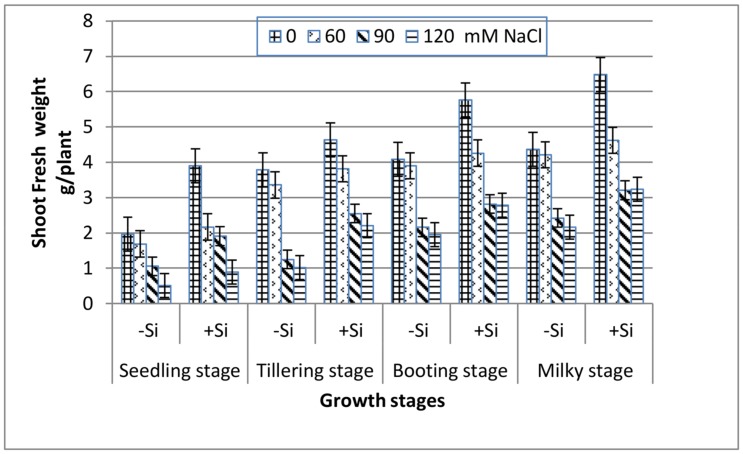
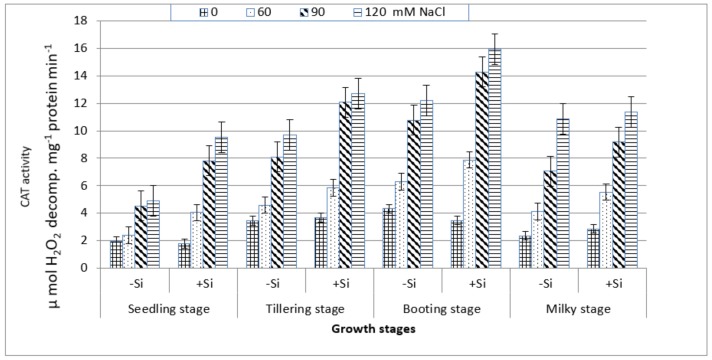
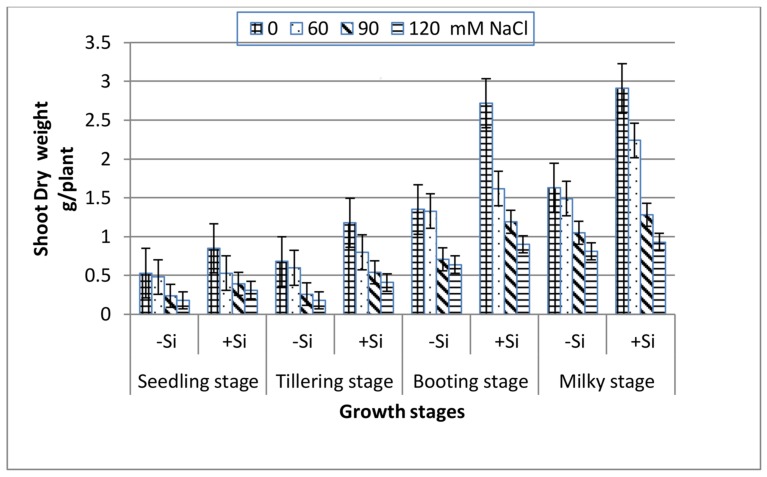
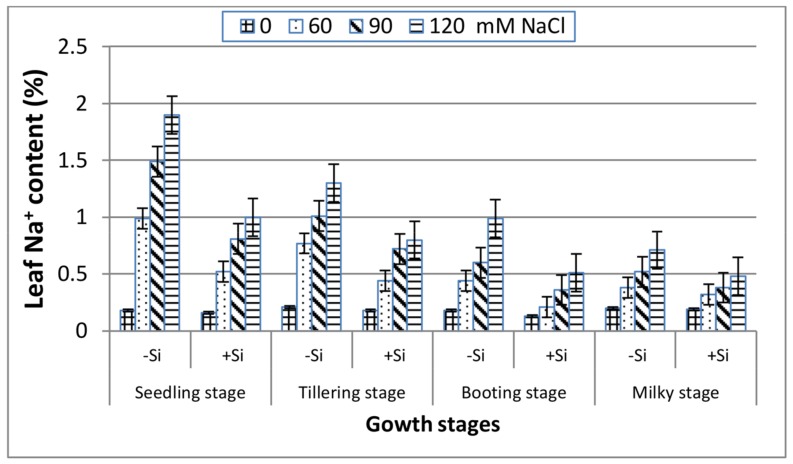
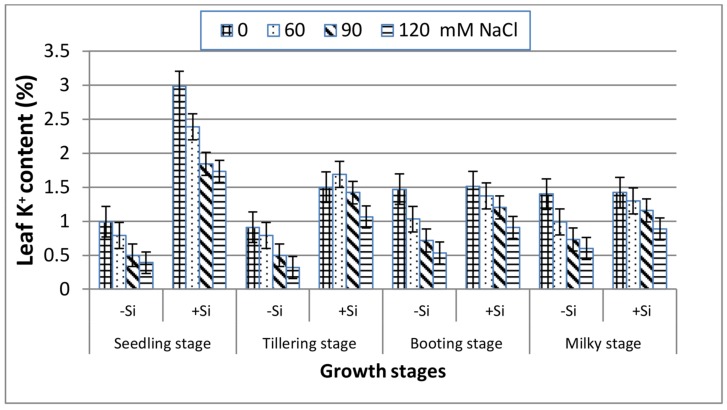
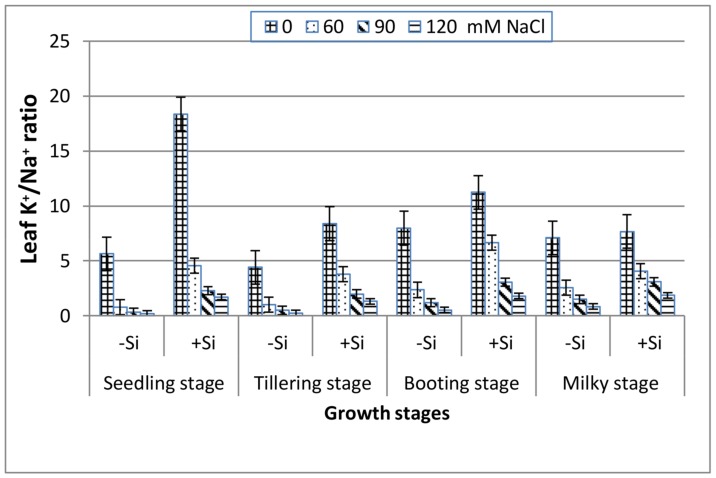
This paper aims to determine the most tolerant growth stage(s) of wheat to salinity stress with the addition of silicon. The aim was to investigate whether saline water could be used instead of good quality water for irrigation without implicating a greater risk to crop production. Local wheat cv. Gimmiza 11 was germinated and grown in sand cultures. Four different NaCl salinity levels were used as treatments: 0, 60, 90 and 120 mM. This was in the presence of 0 and 0.78 mM Si which added as sodium meta- silicate (Na₂SiO₃·9H₂O). Both the NaCl and Si treatments were carried out using a full strength nutrient solution that was adjusted at pH 6.0 and used for irrigation in four replications. The application of Si with the saline nutrient media significantly enhanced superoxide dismutase (SOD) and catalase (CAT) activities in plant leaves at the booting stage compared to the other stages. This was associated with a marked decline in the H₂O₂ content. At the booting stage, the Si treatment promoted CAT activity in 120 mM NaCl-stressed leaves compared to the leaves treated with only 120 mM NaCl solution. SOD showed greater prevalence at the booting stage when Si was added into the saline media, and it also revealed maximum activity at the milky stage with salinity stress. This was associated with a smaller reduction in shoot fresh and dry weights, greater reduction in the leaf Na⁺ content and an increase in the K⁺ content, which ultimately increased the cytosolic K⁺/Na⁺ ratio. Chlorophyll and and carotenoid (total photosynthetic pigments) were also higher at the booting stage of salt-stressed plants treated with Si compared to other stages. Accordingly, Si application enhanced the salt tolerance of wheat and reduced the inhibitory effect of Na⁺ and oxidative stress damage as growth proceeded towards maturity, particularly at the booting stage. This shows that saline water can be used for wheat irrigation at the booting stage (much water is consumed) when good quality water is not available for supplemental irrigation. A field study is needed to confirm the greenhouse results.
本文旨在确定添加硅时小麦对盐分胁迫最耐受的生长阶段。目的是研究在不增加作物生产风险的情况下,是否可用咸水代替优质水进行灌溉。当地小麦品种吉米扎11在砂培中发芽生长。使用四种不同的NaCl盐度水平作为处理:0、60、90和120 mM。这是在添加0和0.78 mM硅(以偏硅酸钠(Na₂SiO₃·9H₂O)形式添加)的情况下进行的。NaCl和硅处理均使用全强度营养液,将其pH值调至6.0,并进行四次重复灌溉。与其他阶段相比,在孕穗期将硅与含盐营养液一起施用可显著提高植物叶片中的超氧化物歧化酶(SOD)和过氧化氢酶(CAT)活性。这与H₂O₂含量的显著下降有关。在孕穗期,与仅用120 mM NaCl溶液处理的叶片相比,硅处理促进了120 mM NaCl胁迫叶片中的CAT活性。当将硅添加到含盐培养基中时,SOD在孕穗期表现出更高的活性,并且在乳熟期盐分胁迫下也表现出最大活性。这与地上部鲜重和干重的减少较小、叶片Na⁺含量的减少较大以及K⁺含量的增加有关,最终增加了细胞质K⁺/Na⁺比率。与其他阶段相比,在硅处理的盐胁迫植物的孕穗期,叶绿素a、叶绿素b和类胡萝卜素(总光合色素)也更高。因此,随着生长进入成熟期,施用硅增强了小麦的耐盐性,并降低了Na⁺的抑制作用和氧化应激损伤,特别是在孕穗期。这表明,在无法获得优质水进行补充灌溉时,在孕穗期(耗水量大)可用咸水进行小麦灌溉。需要进行田间研究以证实温室试验结果。