Gupta Bhaskar, Huang Bingru
Department of Biological Sciences (Section Biotechnology), Presidency University, 86/1 College Street, Kolkata 700073, India.
Department of Plant Biology and Pathology, Rutgers University, New Brunswick, NJ 08901, USA.
Int J Genomics. 2014;2014:701596. doi: 10.1155/2014/701596. Epub 2014 Apr 3.
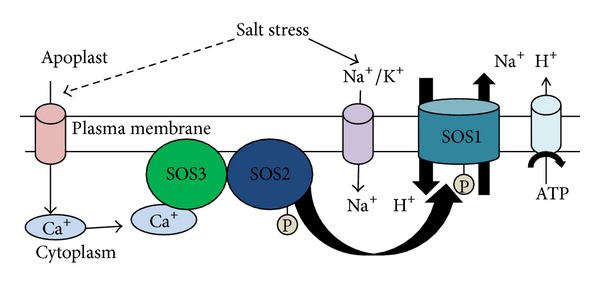
Salinity is a major abiotic stress limiting growth and productivity of plants in many areas of the world due to increasing use of poor quality of water for irrigation and soil salinization. Plant adaptation or tolerance to salinity stress involves complex physiological traits, metabolic pathways, and molecular or gene networks. A comprehensive understanding on how plants respond to salinity stress at different levels and an integrated approach of combining molecular tools with physiological and biochemical techniques are imperative for the development of salt-tolerant varieties of plants in salt-affected areas. Recent research has identified various adaptive responses to salinity stress at molecular, cellular, metabolic, and physiological levels, although mechanisms underlying salinity tolerance are far from being completely understood. This paper provides a comprehensive review of major research advances on biochemical, physiological, and molecular mechanisms regulating plant adaptation and tolerance to salinity stress.
由于灌溉用水质量不佳以及土壤盐渍化现象日益严重,盐分是限制世界许多地区植物生长和生产力的主要非生物胁迫因素。植物对盐胁迫的适应或耐受性涉及复杂的生理特性、代谢途径以及分子或基因网络。全面了解植物如何在不同水平上应对盐胁迫,以及将分子工具与生理生化技术相结合的综合方法,对于在受盐影响地区培育耐盐植物品种至关重要。尽管耐盐机制远未被完全理解,但最近的研究已经在分子、细胞、代谢和生理水平上确定了对盐胁迫的各种适应性反应。本文全面综述了调节植物对盐胁迫适应和耐受性的生化、生理和分子机制的主要研究进展。