Pharmacogenetics and Human Genetics, Genomics Research Center, AbbVie Inc., North Chicago, IL, United States of America.
Clinical Pharmacology and Pharmacometrics, AbbVie Inc., North Chicago, IL, United States of America.
PLoS One. 2018 Apr 3;13(4):e0195325. doi: 10.1371/journal.pone.0195325. eCollection 2018.
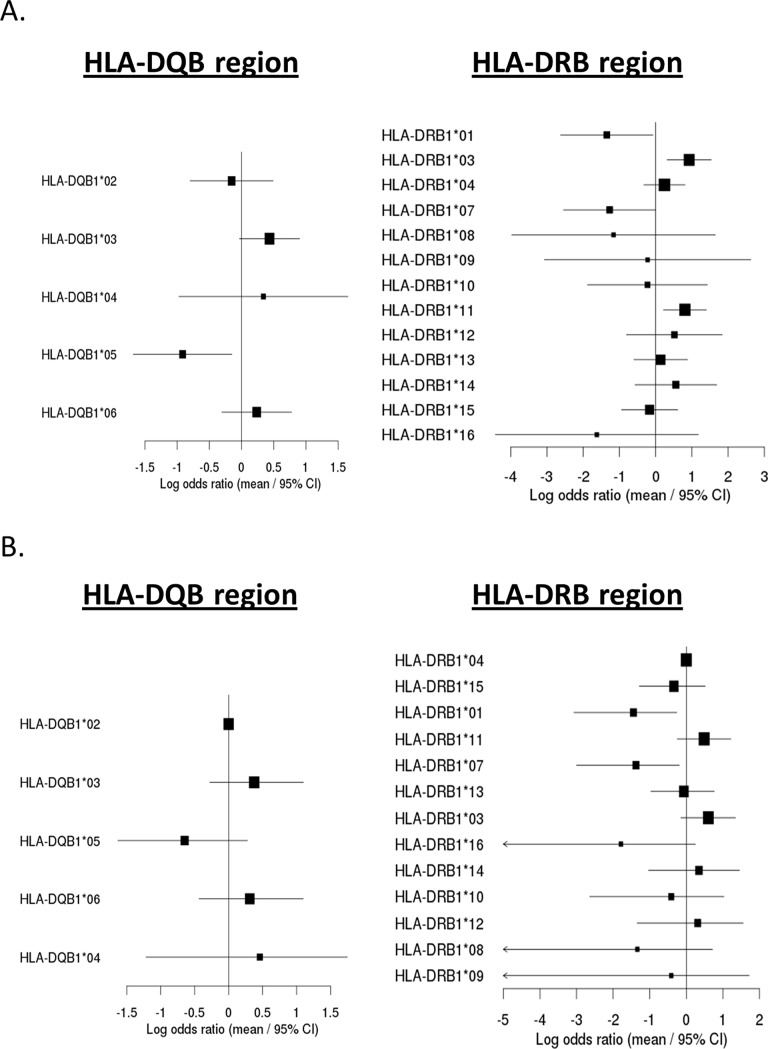
Anti-drug antibody formation occurs with most biological agents across disease states, but the mechanism by which they are formed is unknown. The formation of anti-drug antibodies to adalimumab (AAA) may decrease its therapeutic effects in some patients. HLA alleles have been reported to be associated with autoantibody formation against interferons and other TNF inhibitors, but not adalimumab. We analyzed samples from 634 subjects with either rheumatoid arthritis (RA) or hidradenitis suppurativa (HS): 37 subjects (17 RA and 20 HS) developed AAA (AAA+) during adalimumab treatment and 597 subjects (348 RA, 249 HS) did not develop AAA (AAA-) during the clinical trials. Using next-generation sequencing-based HLA typing, we identified three protective HLA alleles (HLA-DQB105, HLA-DRB101,and HLA-DRB107) that were less prevalent in AAA+ than AAA-subjects (ORs: 0.4, 0.25 and 0.28, respectively; and P values: 0.012, 0.012 and 0.018, respectively) and two risk HLA alleles (HLA-DRB103 and HLA-DRB1011) that were more abundant in AAA+ than AAA-subjects (ORs: 2.52, and 2.64, respectively; and P values: 0.006 and 0.019). Similar to the finding of Billiet et al. who found that carriage of the HLA-DRB103 allele was more prevalent in those with anti-infliximab antibodies (OR = 3.6, p = 0.002, 95% CI: [1.5,8.6]).), we found HLA-DRB1*03 allele was also more prevalent in anti-adalimumab positive (OR = 2.52, p = 0.006, 95% CI: [1.37,4.63]). The results suggest that specific HLA alleles may play a key role in developing AAAs in RA and HS patients treated with adalimumab.
抗药物抗体的形成发生在大多数疾病状态的生物制剂中,但它们形成的机制尚不清楚。抗阿达木单抗(AAA)的抗药物抗体的形成可能会降低其在某些患者中的治疗效果。HLA 等位基因已被报道与针对干扰素和其他 TNF 抑制剂的自身抗体形成有关,但与阿达木单抗无关。我们分析了来自 634 名类风湿关节炎(RA)或化脓性汗腺炎(HS)患者的样本:37 名患者(17 名 RA 和 20 名 HS)在阿达木单抗治疗期间发生了 AAA(AAA+),而 597 名患者(348 名 RA,249 名 HS)在临床试验期间未发生 AAA(AAA-)。使用基于下一代测序的 HLA 分型,我们确定了三个保护性 HLA 等位基因(HLA-DQB105、HLA-DRB101 和 HLA-DRB107),它们在 AAA+中的流行率低于 AAA-(OR:分别为 0.4、0.25 和 0.28;P 值:分别为 0.012、0.012 和 0.018),两个风险 HLA 等位基因(HLA-DRB103 和 HLA-DRB1011)在 AAA+中的丰度高于 AAA-(OR:分别为 2.52 和 2.64;P 值:分别为 0.006 和 0.019)。与 Billiet 等人的发现相似,他们发现携带 HLA-DRB103 等位基因在抗英夫利昔单抗抗体阳性患者中更为常见(OR = 3.6,p = 0.002,95%CI:[1.5,8.6]),我们发现 HLA-DRB1*03 等位基因在抗阿达木单抗阳性患者中也更为常见(OR = 2.52,p = 0.006,95%CI:[1.37,4.63])。结果表明,特定的 HLA 等位基因可能在接受阿达木单抗治疗的 RA 和 HS 患者中产生抗药物抗体中起关键作用。