Laboratory for Social and Neural Systems Research, Department of Economics, University of Zurich, Zurich, Switzerland.
Zurich Center for Neuroscience, University of Zurich and ETH, Zurich, Switzerland.
PLoS One. 2018 Apr 3;13(4):e0195328. doi: 10.1371/journal.pone.0195328. eCollection 2018.
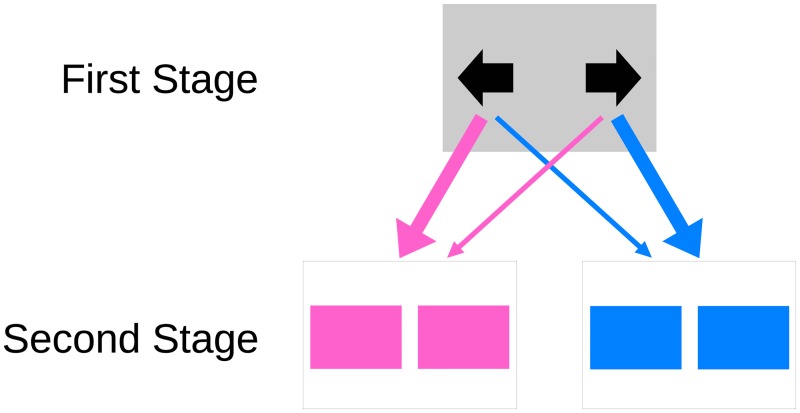
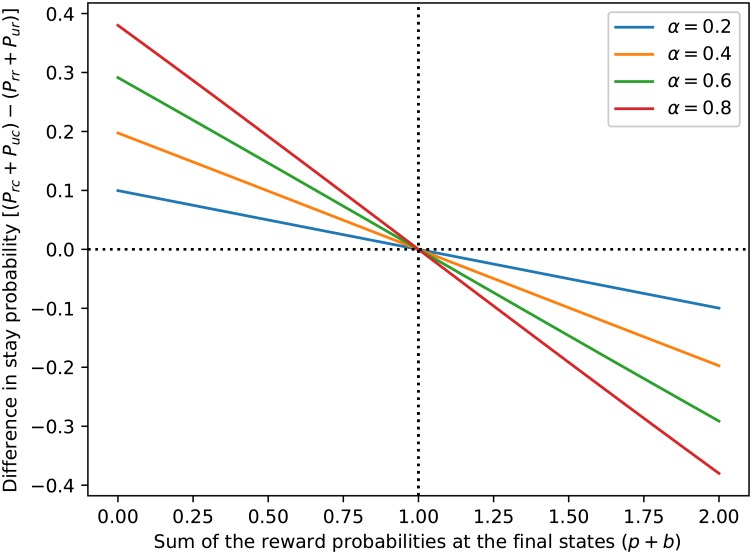
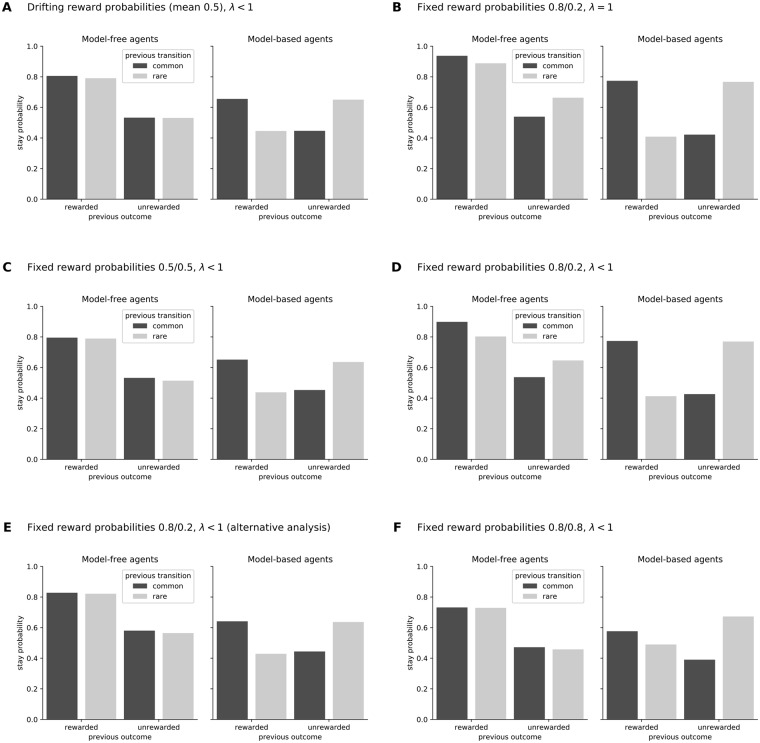
Many studies that aim to detect model-free and model-based influences on behavior employ two-stage behavioral tasks of the type pioneered by Daw and colleagues in 2011. Such studies commonly modify existing two-stage decision paradigms in order to better address a given hypothesis, which is an important means of scientific progress. It is, however, critical to fully appreciate the impact of any modified or novel experimental design features on the expected results. Here, we use two concrete examples to demonstrate that relatively small changes in the two-stage task design can substantially change the pattern of actions taken by model-free and model-based agents as a function of the reward outcomes and transitions on previous trials. In the first, we show that, under specific conditions, purely model-free agents will produce the reward by transition interactions typically thought to characterize model-based behavior on a two-stage task. The second example shows that model-based agents' behavior is driven by a main effect of transition-type in addition to the canonical reward by transition interaction whenever the reward probabilities of the final states do not sum to one. Together, these examples emphasize the task-dependence of model-free and model-based behavior and highlight the benefits of using computer simulations to determine what pattern of results to expect from both model-free and model-based agents performing a given two-stage decision task in order to design choice paradigms and analysis strategies best suited to the current question.
许多旨在检测行为的无模型和基于模型影响的研究都采用了由 Daw 及其同事在 2011 年开创的两阶段行为任务类型。此类研究通常会修改现有的两阶段决策范式,以便更好地解决给定的假设,这是科学进步的重要手段。然而,充分了解任何修改或新颖的实验设计特征对预期结果的影响是至关重要的。在这里,我们使用两个具体的例子来说明,两阶段任务设计中的相对较小的变化可以极大地改变无模型和基于模型的代理在先前试验的奖励结果和转变的函数下所采取的行为模式。在第一个例子中,我们表明,在特定条件下,纯粹的无模型代理将通过通常被认为是两阶段任务中基于模型的行为的转变交互来产生奖励。第二个例子表明,只要最终状态的奖励概率不总和为一,基于模型的代理的行为就会受到转变类型的主要效应的驱动,除了经典的转变奖励交互作用之外。总之,这些例子强调了无模型和基于模型行为的任务依赖性,并强调了使用计算机模拟来确定无模型和基于模型代理在执行给定的两阶段决策任务时的预期结果模式的好处,以便设计最适合当前问题的选择范式和分析策略。