Donegan Kelly R, Brown Vanessa M, Price Rebecca B, Gallagher Eoghan, Pringle Andrew, Hanlon Anna K, Gillan Claire M
School of Psychology, Trinity College Dublin, Dublin, Ireland.
Trinity College Institute of Neuroscience, Trinity College Dublin, Dublin, Ireland.
Commun Psychol. 2023 Nov 1;1(1):31. doi: 10.1038/s44271-023-00031-y.
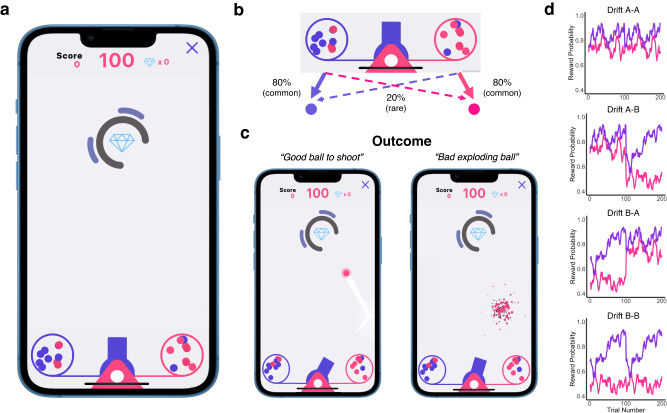
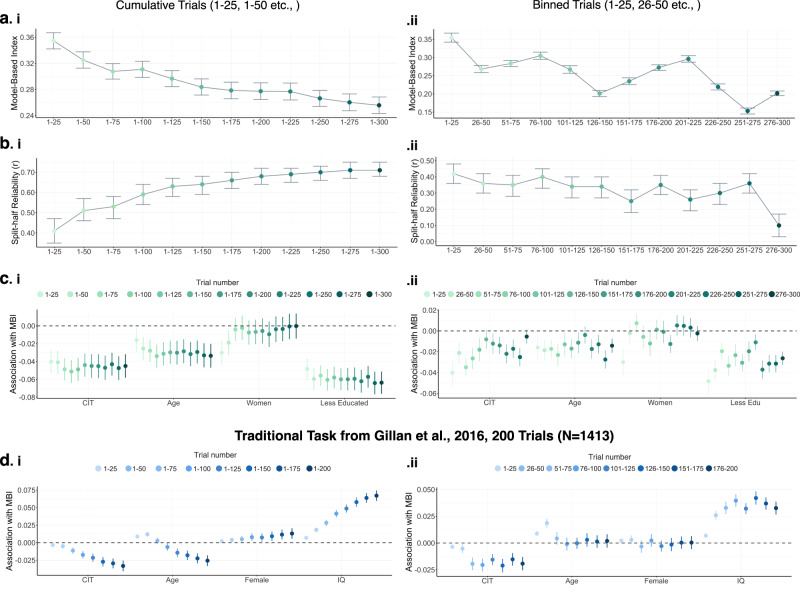
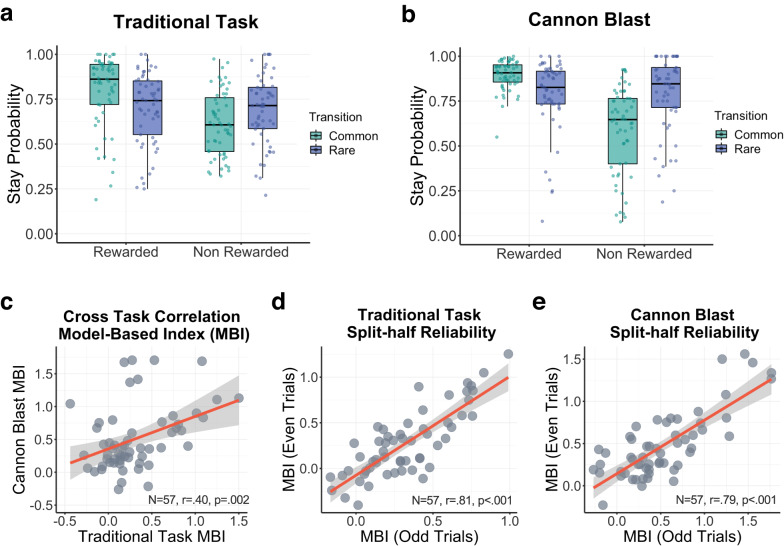
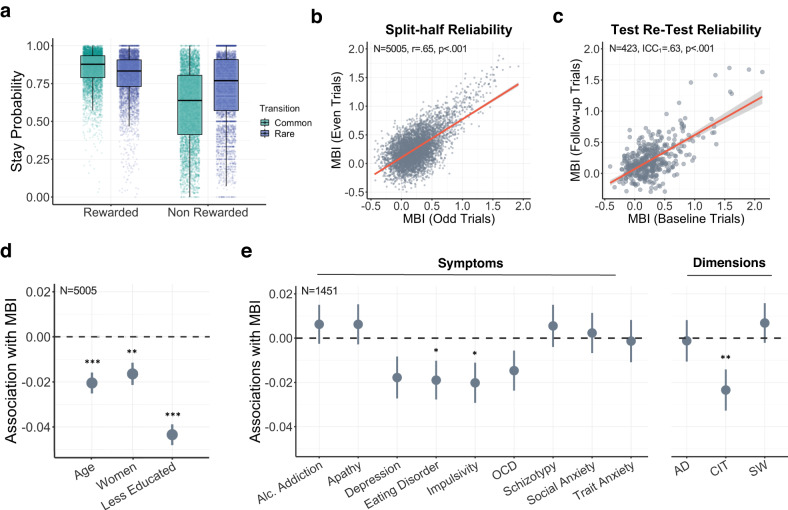
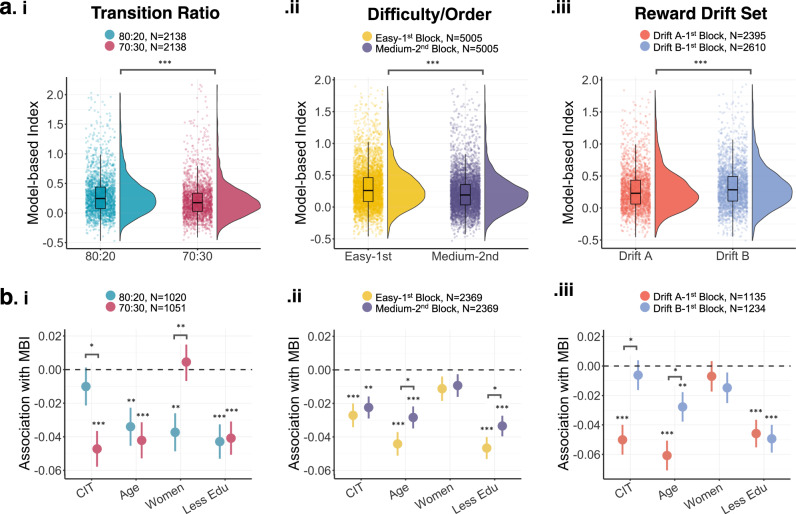
Model-based planning is thought to protect against over-reliance on habits. It is reduced in individuals high in compulsivity, but effect sizes are small and may depend on subtle features of the tasks used to assess it. We developed a diamond-shooting smartphone game that measures model-based planning in an at-home setting, and varied the game's structure within and across participants to assess how it affects measurement reliability and validity with respect to previously established correlates of model-based planning, with a focus on compulsivity. Increasing the number of trials used to estimate model-based planning did remarkably little to affect the association with compulsivity, because the greatest signal was in earlier trials. Associations with compulsivity were higher when transition ratios were less deterministic and depending on the reward drift utilised. These findings suggest that model-based planning can be measured at home via an app, can be estimated in relatively few trials using certain design features, and can be optimised for sensitivity to compulsive symptoms in the general population.
基于模型的规划被认为可以防止过度依赖习惯。在强迫性较高的个体中,这种能力会有所下降,但效应量较小,且可能取决于用于评估它的任务的细微特征。我们开发了一款射击钻石的智能手机游戏,用于在家庭环境中测量基于模型的规划,并在参与者内部和之间改变游戏结构,以评估其如何影响与基于模型的规划的先前既定相关因素(重点是强迫性)相关的测量可靠性和有效性。增加用于估计基于模型的规划的试验次数对与强迫性的关联影响甚微,因为最大的信号出现在早期试验中。当转换比率的确定性较低且取决于所使用的奖励漂移时,与强迫性的关联更高。这些发现表明,基于模型的规划可以通过应用程序在家庭中进行测量,可以使用某些设计特征在相对较少的试验中进行估计,并且可以针对普通人群中强迫症状的敏感性进行优化。