Department of Pharmacology, School of Pharmaceutical Sciences, Jilin University, Changchun 130021, China.
School of Materials Science and Engineering, South China University of Technology, Guangzhou 510640, China.
Int J Mol Sci. 2018 Apr 2;19(4):1053. doi: 10.3390/ijms19041053.
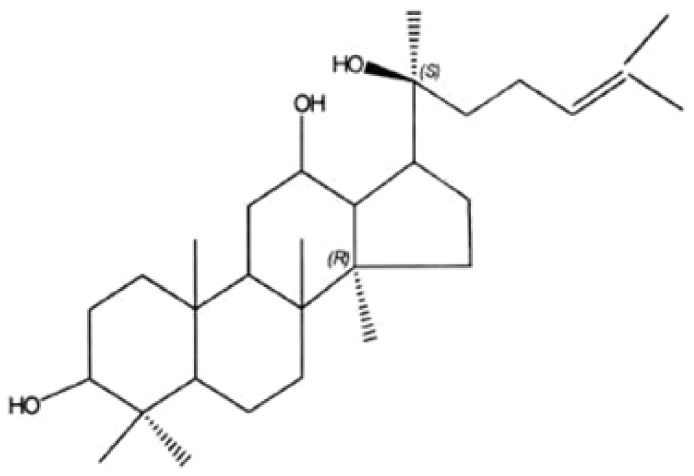
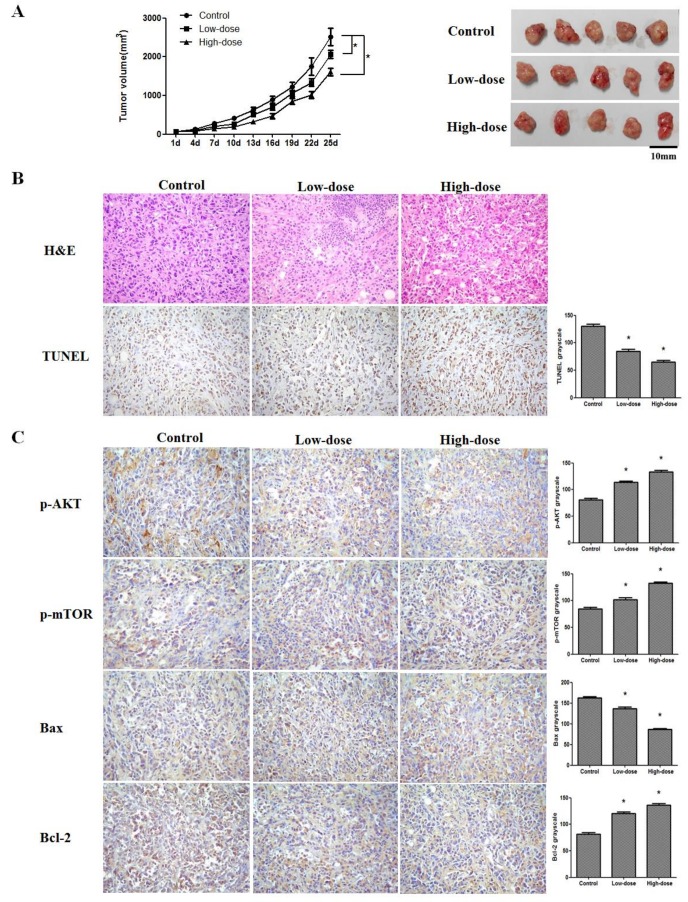
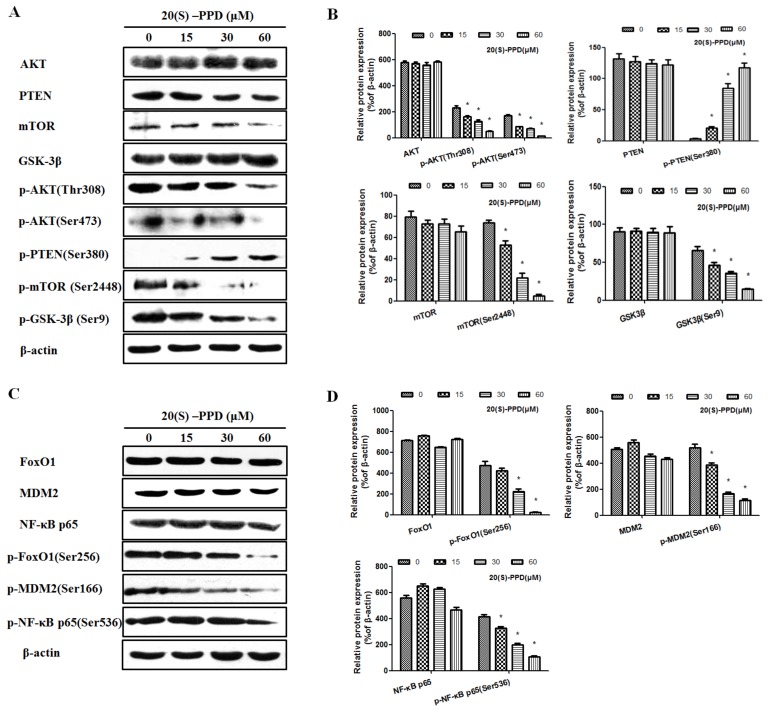
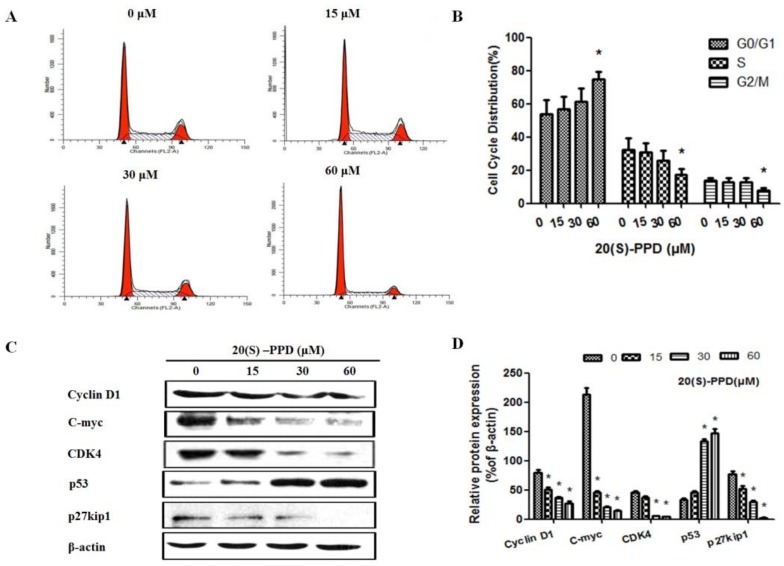
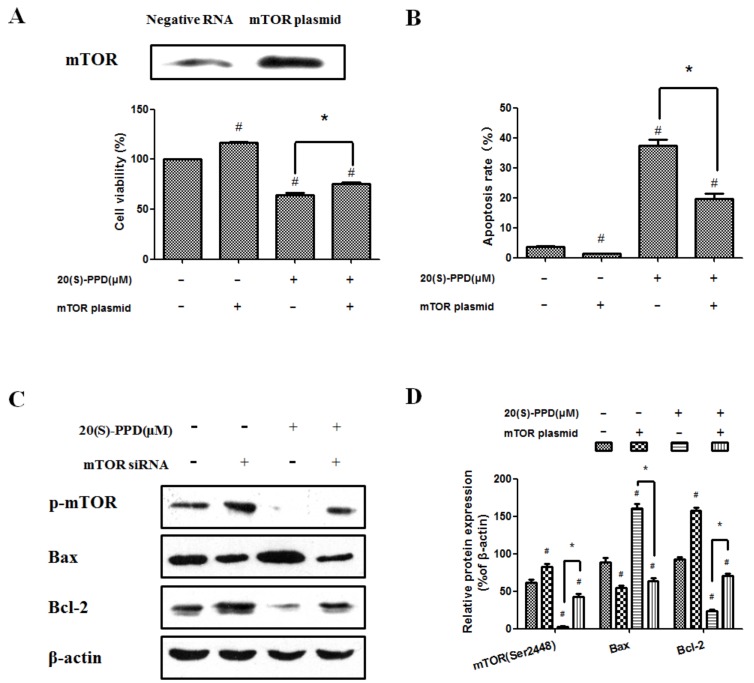
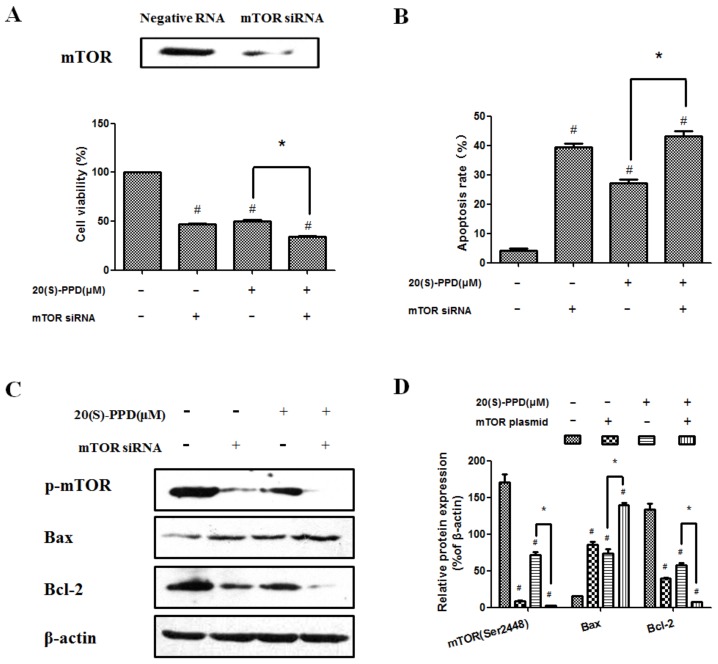
20(S)-Protopanaxadiol (PPD) is one of the major active metabolites of ginseng. It has been reported that 20(S)-PPD shows a broad spectrum of antitumor effects. Our research study aims were to investigate whether apoptosis of human breast cancer MCF-7 cells could be induced by 20(S)-PPD by targeting the Phosphatidylinositol 3-kinase/Protein kinase B/Mammalian target of rapamycin (PI3K/AKT/mTOR) signal pathway in vitro and in vivo. Cell cycle analysis was performed by Propidium Iodide (PI) staining. To overexpress and knock down the expression of mTOR, pcDNA3.1-mTOR and mTOR small interfering RNA (siRNA) transient transfection assays were used, respectively. Cell viability and apoptosis were evaluated by 3-(4,5-dimethylthiazol-2-yl)-2,5-diphenyltetrazolium bromide (MTT)-test and Annexin V /PI double-staining after transfection. The antitumor effect in vivo was determined by the nude mice xenograft assay. After 24 h of incubation, treatment with 20(S)-PPD could upregulate phosphorylated-Phosphatase and tensin homologue deleted on chromosome 10 (p-PTEN) expression and downregulate PI3K/AKT/mTOR-pathway protein expression. Moreover, G0/G1 cell cycle arrest in MCF-7 cells could be induced by 20(S)-PPD treatment at high concentrations. Furthermore, overexpression or knockdown of mTOR could inhibit or promote the apoptotic effects of 20(S)-PPD. In addition, tumor volumes were partially reduced by 20(S)-PPD at 100 mg/kg in a MCF-7 xenograft model. Immunohistochemical staining indicated a close relationship between the inhibition of tumor growth and the PI3K/AKT/mTOR signal pathway. PI3K/AKT/mTOR pathway-mediated apoptosis may be one of the potential mechanisms of 20(S)-PPD treatment.
20(S)-原人参二醇(PPD)是人参的主要活性代谢物之一。据报道,20(S)-PPD 具有广谱的抗肿瘤作用。我们的研究旨在探讨 20(S)-PPD 是否可以通过靶向磷脂酰肌醇 3-激酶/蛋白激酶 B/哺乳动物雷帕霉素靶蛋白(PI3K/AKT/mTOR)信号通路诱导人乳腺癌 MCF-7 细胞凋亡,无论是在体外还是体内。通过碘化丙啶(PI)染色进行细胞周期分析。为了过表达和敲低 mTOR 的表达,分别使用 pcDNA3.1-mTOR 和 mTOR 小干扰 RNA(siRNA)瞬时转染实验。转染后通过 3-(4,5-二甲基噻唑-2-基)-2,5-二苯基四氮唑溴盐(MTT)试验和 Annexin V/PI 双染评估细胞活力和凋亡。通过裸鼠异种移植试验确定体内的抗肿瘤作用。孵育 24 小时后,20(S)-PPD 处理可上调磷酸化的第 10 号染色体缺失的磷酸酶和张力蛋白同源物(p-PTEN)表达,并下调 PI3K/AKT/mTOR 通路蛋白表达。此外,20(S)-PPD 处理可在高浓度下诱导 MCF-7 细胞的 G0/G1 细胞周期停滞。此外,过表达或敲低 mTOR 可抑制或促进 20(S)-PPD 的促凋亡作用。此外,在 MCF-7 异种移植模型中,20(S)-PPD 以 100mg/kg 的剂量可部分减少肿瘤体积。免疫组织化学染色表明肿瘤生长抑制与 PI3K/AKT/mTOR 信号通路密切相关。PI3K/AKT/mTOR 通路介导的细胞凋亡可能是 20(S)-PPD 治疗的潜在机制之一。