Infectious Disease Research Collaboration, Mulago Hospital Complex, Kampala, Uganda.
Department of Geography and Environment, University of Southampton, Southampton, UK.
Lancet Planet Health. 2018 Feb;2(2):e83-e94. doi: 10.1016/S2542-5196(18)30010-X. Epub 2018 Feb 9.
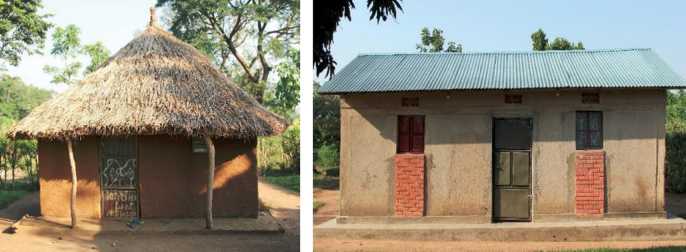
Rapid population growth in Africa requires an urgent expansion and improvement of housing options. Improving housing presents a promising opportunity for malaria control by reducing indoor exposure to mosquitoes. We measured recent changes in house design in rural Uganda and evaluated their association with malaria in relation to a mass scale-up of control efforts.
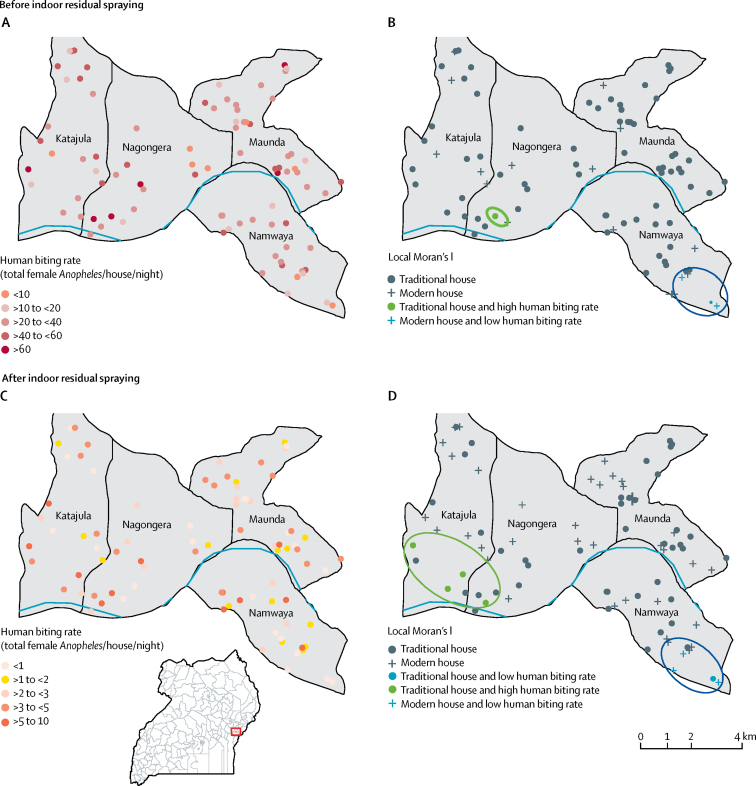
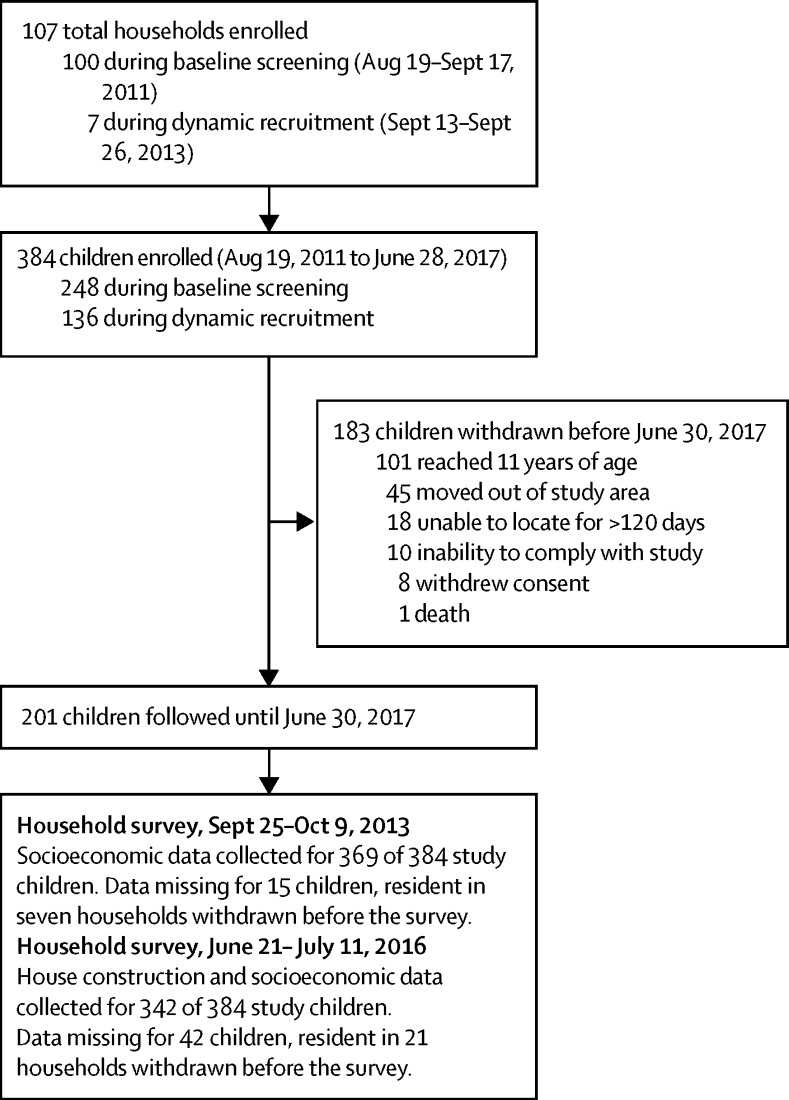
This analysis was part of a cohort study designed to compare temporal changes in malaria incidence from a cohort of children and adults with temporal changes in malaria test positivity rate from health facility surveillance. All children aged 6 months to 10 years (n=384) living in 107 households in Nagongera sub-country, Tororo, Uganda, were given long-lasting insecticide-treated nets and followed between Aug 19, 2011, and June 30, 2017. Repeat rounds of indoor residual spraying of insecticide were initiated on Dec 5, 2014. Socioeconomic data were collected at two timepoints (Sept 25-Oct 9, 2013 and June 21-July 11, 2016) and houses were classified as modern (cement, wood, or metal walls, tiled or metal roof, and closed eaves) or traditional (all other homes). Associations between house design and three outcomes were evaluated before and after the introduction of indoor residual spraying: human biting rate estimated monthly in each household using US Centers for Disease Control and Prevention light traps; parasite prevalence measured routinely by microscopy every 3 months before indoor residual spraying and monthly after indoor residual spraying; and malaria incidence measured by passive surveillance.
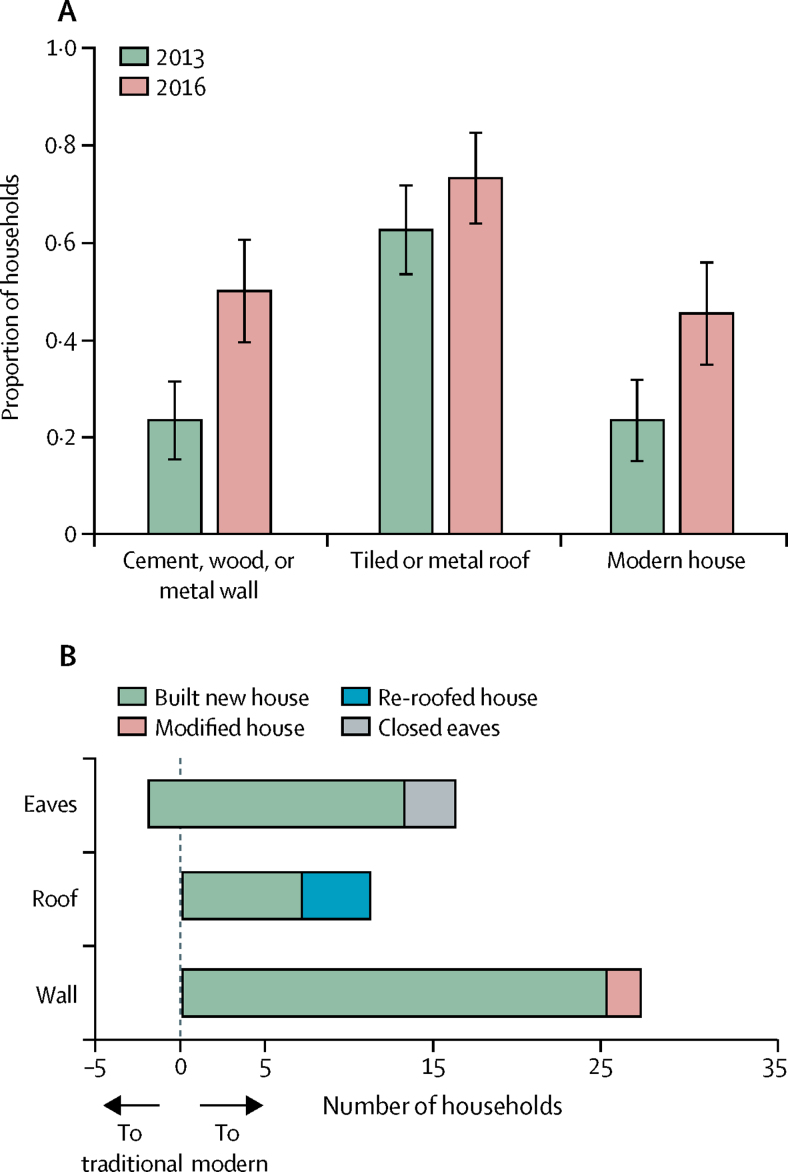
The implementation of indoor residual spraying was associated with significant declines in human biting rate (33·5 vs 2·7 Anopheles per house per night after indoor residual spraying, p<0·0001), parasite prevalence (32·0% vs 14·0%, p<0·0001), and malaria incidence (3·0 vs 0·5 episodes per person-year at risk, p<0·0001). The prevalence of modern housing increased from 23·4% in 2013 to 45·4% in 2016 (p=0·001). Compared with traditional houses, modern houses were associated with a 48% reduction in human biting rate before indoor residual spraying (adjusted incidence rate ratio [aIRR] 0·52, 95% CI 0·36-0·73, p=0·0002), and a 73% reduction after indoor residual spraying (aIRR 0·27, 0·17-0·42, p<0·0001). Before indoor residual spraying, there was no association between house type and parasite prevalence, but after indoor residual spraying there was a 57% reduction in the odds of parasitaemia in modern houses compared with traditional houses, controlling for age, sex, and socioeconomic position (adjusted odds ratio 0·43, 95% CI 0·24-0·77, p=0·004). House type was not associated with malaria incidence before or after indoor residual spraying.
House design improved rapidly in rural Uganda and was associated with additional reductions in mosquito density and parasite prevalence following the introduction of indoor residual spraying. Changes to house design in endemic Africa, including closing eaves and the replacement of traditional building materials, might help further the gains achieved with more widely accepted malaria control interventions.
US National Institutes of Health, Bill & Melinda Gates Foundation, and Medical Research Council UK.
非洲人口的快速增长迫切需要扩大和改善住房选择。改善住房为控制疟疾提供了一个有希望的机会,因为它可以减少室内与蚊子的接触。我们测量了乌干达农村地区最近的房屋设计变化,并评估了它们与疟疾的关联,同时还评估了大规模控制工作的影响。
这项分析是一项队列研究的一部分,旨在比较儿童和成年人的疟疾发病率随时间的变化,以及医疗机构监测的疟疾检测阳性率随时间的变化。所有居住在乌干达托罗罗省纳贡格拉次县的 107 户家庭中年龄在 6 个月至 10 岁之间的儿童(n=384)都使用了长效驱虫蚊帐,并在 2011 年 8 月 19 日至 2017 年 6 月 30 日期间进行了随访。2014 年 12 月 5 日开始进行室内残留喷雾的重复轮次。在两个时间点(2013 年 9 月 25 日至 10 月 9 日和 2016 年 6 月 21 日至 7 月 11 日)收集了社会经济数据,并将房屋分为现代(水泥、木材或金属墙、瓷砖或金属屋顶和封闭的屋檐)或传统(所有其他房屋)。在引入室内残留喷雾之前和之后,评估了房屋设计与三个结果之间的关系:使用美国疾病控制与预防中心的诱蚊灯每月在每个家庭中估计的人蚊叮咬率;在引入室内残留喷雾之前每三个月通过显微镜常规测量的寄生虫流行率和引入室内残留喷雾后每月测量的寄生虫流行率;以及通过被动监测测量的疟疾发病率。
室内残留喷雾的实施与显著降低人蚊叮咬率(室内残留喷雾后,每间房屋每晚每间房屋叮咬的疟蚊为 33.5 只与 2.7 只,p<0.0001)、寄生虫流行率(32.0%与 14.0%,p<0.0001)和疟疾发病率(3.0 与 0.5 人年发病率,p<0.0001)相关。现代住房的比例从 2013 年的 23.4%增加到 2016 年的 45.4%(p=0.001)。与传统房屋相比,现代房屋在引入室内残留喷雾前与蚊子叮咬率降低了 48%(调整发病率比值 [aIRR] 0.52,95%CI 0.36-0.73,p=0.0002),在引入室内残留喷雾后降低了 73%(aIRR 0.27,0.17-0.42,p<0.0001)。在引入室内残留喷雾之前,房屋类型与寄生虫流行率之间没有关联,但在引入室内残留喷雾后,与传统房屋相比,现代房屋感染寄生虫的几率降低了 57%,同时控制了年龄、性别和社会经济地位(调整比值比 0.43,95%CI 0.24-0.77,p=0.004)。在引入室内残留喷雾之前和之后,房屋类型与疟疾发病率均无关联。
乌干达农村地区的房屋设计迅速改进,并在引入室内残留喷雾后,与蚊子密度和寄生虫流行率的进一步降低相关。在疟疾流行地区,包括封闭屋檐和更换传统建筑材料等房屋设计的改变,可能有助于进一步提高更广泛接受的疟疾控制干预措施的效果。
美国国立卫生研究院、比尔和梅琳达盖茨基金会以及英国医学研究理事会。