Department of Disease Control, London School of Hygiene & Tropical Medicine, London, UK.
Big Data Institute, Nuffield Department of Medicine, University of Oxford, Oxford, UK.
Infect Dis Poverty. 2016 Aug 4;5(1):78. doi: 10.1186/s40249-016-0164-3.
Malaria control and sustainable development are linked, but implementation of 'multisectoral' intervention is restricted by a limited understanding of the causal pathways between poverty and malaria. We investigated the relationships between socioeconomic position (SEP), potential determinants of SEP, and malaria in Nagongera, rural Uganda.
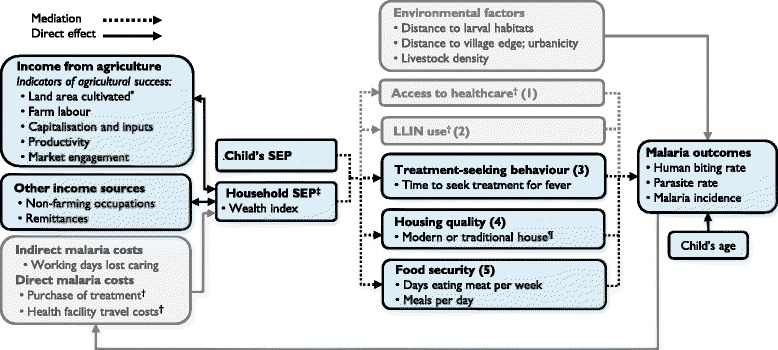
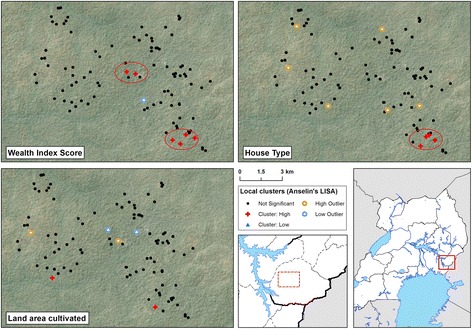
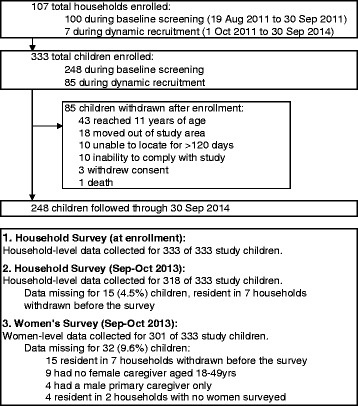
Socioeconomic information was collected for 318 children aged six months to 10 years living in 100 households, who were followed for up to 36 months. Mosquito density was recorded using monthly light trap collections. Parasite prevalence was measured routinely every three months and malaria incidence determined by passive case detection. First, we evaluated the association between success in smallholder agriculture (the primary livelihood source) and SEP. Second, we explored socioeconomic risk factors for human biting rate (HBR), parasite prevalence and incidence of clinical malaria, and spatial clustering of socioeconomic variables. Third, we investigated the role of selected factors in mediating the association between SEP and malaria.
Relative agricultural success was associated with higher SEP. In turn, high SEP was associated with lower HBR (highest versus lowest wealth index tertile: Incidence Rate Ratio 0.71, 95 % confidence intervals (CI) 0.54-0.93, P = 0.01) and lower odds of malaria infection in children (highest versus lowest wealth index tertile: adjusted Odds Ratio 0.52, 95 % CI 0.35-0.78, P = 0.001), but SEP was not associated with clinical malaria incidence. Mediation analysis suggested that part of the total effect of SEP on malaria infection risk was explained by house type (24.9 %, 95 % CI 15.8-58.6 %) and food security (18.6 %, 95 % CI 11.6-48.3 %); however, the assumptions of the mediation analysis may not have been fully met.
Housing improvements and agricultural development interventions to reduce poverty merit further investigation as multisectoral interventions against malaria. Further interdisplinary research is needed to understand fully the complex pathways between poverty and malaria and to develop strategies for sustainable malaria control.
疟疾控制与可持续发展密切相关,但由于对贫困与疟疾之间因果关系的理解有限,“多部门”干预措施的实施受到限制。我们在乌干达农村的 Nagongera 研究了社会经济地位(SEP)、SEP 的潜在决定因素与疟疾之间的关系。
为居住在 100 户家庭中的 318 名 6 个月至 10 岁的儿童收集社会经济信息,对他们进行了长达 36 个月的随访。每月使用诱蚊灯收集来记录蚊虫密度。每三个月常规测量寄生虫流行率,并通过被动病例检测确定疟疾发病率。首先,我们评估了小农经营(主要生计来源)的成功与 SEP 之间的关系。其次,我们探讨了与人类叮咬率(HBR)、寄生虫流行率和临床疟疾发病率以及社会经济变量空间聚类相关的社会经济风险因素。第三,我们研究了选定因素在介导 SEP 与疟疾之间的关联中的作用。
相对农业成功与更高的 SEP 相关。反过来,较高的 SEP 与较低的 HBR 相关(最高与最低财富指数三分位数相比:发病率比 0.71,95%置信区间(CI)0.54-0.93,P=0.01),且儿童感染疟疾的可能性较低(最高与最低财富指数三分位数相比:调整后的优势比 0.52,95%CI 0.35-0.78,P=0.001),但 SEP 与临床疟疾发病率无关。中介分析表明,SEP 对疟疾感染风险的总效应部分由住房类型(24.9%,95%CI 15.8-58.6%)和粮食安全(18.6%,95%CI 11.6-48.3%)解释;然而,中介分析的假设可能没有得到充分满足。
住房改善和农业发展干预措施以减少贫困值得进一步研究,作为对抗疟疾的多部门干预措施。需要进一步开展跨学科研究,以充分了解贫困与疟疾之间的复杂关系,并制定可持续疟疾控制策略。