Department of Biosciences, Durham University, Durham, UK; Medical Research Council Unit The Gambia at the London School of Hygiene & Tropical Medicine, Banjul, The Gambia.
MRC Tropical Epidemiology Group, London School of Hygiene & Tropical Medicine, London, UK.
Lancet Planet Health. 2021 Apr;5(4):e220-e229. doi: 10.1016/S2542-5196(21)00002-4.
In malaria-endemic areas, residents of modern houses have less malaria than those living in traditional houses. We aimed to assess whether children in The Gambia received an incremental benefit from improved housing, where current best practice of insecticide-treated nets, indoor residual spraying, seasonal malaria chemoprevention in children younger than 5 years, and prompt treatment against clinical malaria was in place.
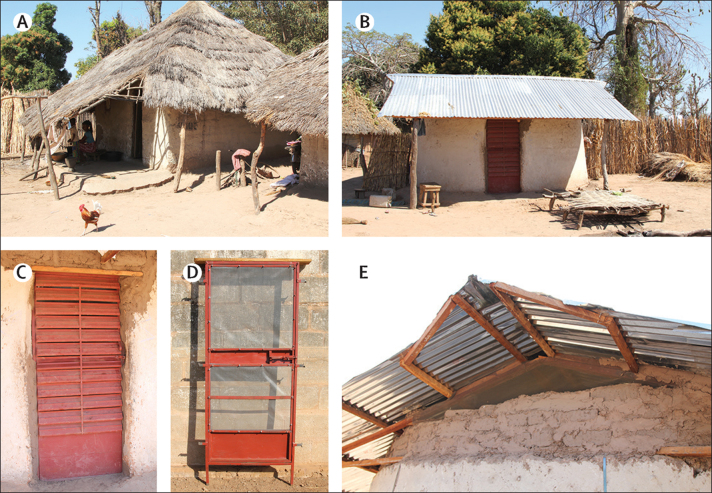
In this randomised controlled study, 800 households with traditional thatched-roofed houses were randomly selected from 91 villages in the Upper River Region of The Gambia. Within each village, equal numbers of houses were randomly allocated to the control and intervention groups using a sampling frame. Houses in the intervention group were modified with metal roofs and screened doors and windows, whereas houses in the control group received no modifications. In each group, clinical malaria in children aged 6 months to 13 years was monitored by active case detection over 2 years (2016-17). We did monthly collections from indoor light traps to estimate vector densities. Primary endpoints were the incidence of clinical malaria in study children with more than 50% of observations each year and household vector density. The trial is registered at ISRCTN02622179.
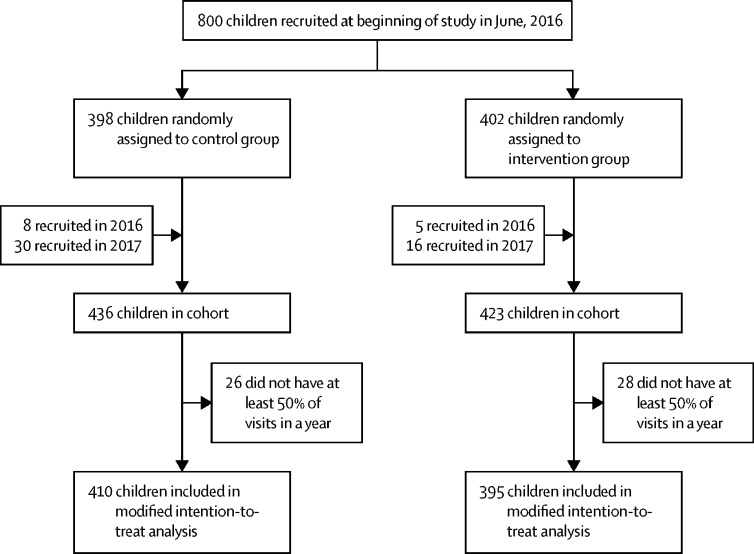
In June, 2016, 785 houses had one child each recruited into the study (398 in unmodified houses and 402 in modified houses). 26 children in unmodified houses and 28 children in modified houses did not have at least 50% of visits in a year and so were excluded from analysis. 38 children in unmodified houses were recruited after study commencement, as were 21 children in modified houses, meaning 410 children in unmodified houses and 395 in modified houses were included in the parasitological analyses. At the end of the study, 659 (94%) of 702 children were reported to have slept under an insecticide-treated net; 662 (88%) of 755 children lived in houses that received indoor residual spraying; and 151 (90%) of 168 children younger than 5 years had seasonal malaria chemoprevention. Incidence of clinical malaria was 0·12 episodes per child-year in children in the unmodified houses and 0·20 episodes per child-year in the modified houses (unadjusted incidence rate ratio [RR] 1·68 [95% CI 1·11-2·55], p=0·014). Household vector density was 3·30 Anopheles gambiae per house per night in the unmodified houses compared with 3·60 in modified houses (unadjusted RR 1·28 [0·87-1·89], p=0·21).
Improved housing did not provide protection against clinical malaria in this area of low seasonal transmission with high coverage of insecticide-treated nets, indoor residual spraying, and seasonal malaria chemoprevention.
Global Health Trials funded by Medical Research Council, UK Department for International Development, and Wellcome Trust.
在疟疾流行地区,现代房屋的居民比传统房屋的居民患疟疾的几率要低。我们旨在评估冈比亚的儿童是否从改善住房中获得了额外的益处,目前最佳的做法是在儿童中使用驱虫蚊帐、室内残留喷洒、季节性疟疾化学预防,以及对临床疟疾的及时治疗。
在这项随机对照研究中,从冈比亚上河区的 91 个村庄中随机抽取了 800 户传统的茅草屋顶房屋。在每个村庄中,使用抽样框架将数量相等的房屋随机分配到对照组和干预组。干预组的房屋用金属屋顶和带纱窗的门窗进行了改造,而对照组的房屋则没有进行任何改造。在每个组中,通过主动病例检测监测 6 个月至 13 岁儿童的临床疟疾,持续 2 年(2016-17 年)。我们每月从室内灯光陷阱中收集样本,以估计蚊虫密度。主要终点是每年观察到超过 50%的研究儿童的临床疟疾发生率和家庭蚊虫密度。该试验在 ISRCTN02622179 注册。
2016 年 6 月,785 户家庭各有一名儿童被招募入组(未改良房屋 398 户,改良房屋 402 户)。26 名未改良房屋的儿童和 28 名改良房屋的儿童每年有少于 50%的就诊记录,因此被排除在分析之外。38 名未改良房屋的儿童在研究开始后被招募,21 名改良房屋的儿童也被招募,因此共有 410 名未改良房屋的儿童和 395 名改良房屋的儿童纳入寄生虫学分析。研究结束时,报告有 659(94%)名 702 名儿童在睡觉时使用了驱虫蚊帐;662(88%)名 755 名儿童居住的房屋接受了室内残留喷洒;151(90%)名 168 名 5 岁以下儿童接受了季节性疟疾化学预防。未改良房屋儿童的临床疟疾发病率为每年每儿童 0.12 例,改良房屋儿童为每年每儿童 0.20 例(未调整发病率比 [RR] 1.68 [95%CI 1.11-2.55],p=0.014)。未改良房屋的家庭蚊虫密度为每晚每间房屋 3.30 只冈比亚按蚊,而改良房屋的蚊虫密度为每晚每间房屋 3.60 只(未调整 RR 1.28 [0.87-1.89],p=0.21)。
在季节性传播低、杀虫剂处理蚊帐、室内残留喷洒和季节性疟疾化学预防覆盖率高的地区,改善住房并不能提供对临床疟疾的保护。
由英国医学研究理事会、英国国际发展部和惠康信托基金会资助的全球卫生试验。