Chen Zhiyao, Liu Guocong, Chen Jianying, Li Shunming, Jiang Ting, Xu Bin, Ye Xiaohua
School of Public Health, Guangdong Pharmaceutical University, Guangzhou, China.
Health Education Section, Guangzhou Yuexiu Center for Disease Control and Prevention, Guangzhou, China.
BMJ Open. 2018 Apr 3;8(4):e019875. doi: 10.1136/bmjopen-2017-019875.
Although previous studies have suggested an association between second-hand smoke (SHS) exposure and respiratory symptoms, current evidence is inconsistent. Additionally, it remains unclear whether there are frequency-risk relationships between SHS exposure and respiratory symptoms among adolescents.
A cross-sectional survey was conducted using a stratified cluster sampling method to obtain a representative sample of high school students in Guangzhou, China. The respiratory symptoms were defined as persistent cough or sputum for three consecutive months during the past 12 months. Self-reported SHS exposure was defined as non-smokers' inhalation of the smoke exhaled from smokers on ≥1 day a week in the past 7 days. The univariable and multivariable logistic regression models were fitted to explore the potential frequency-risk relationships between SHS exposure and respiratory symptoms.
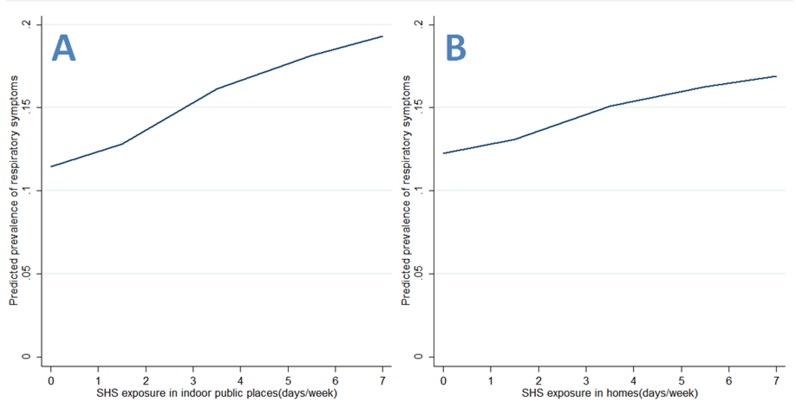
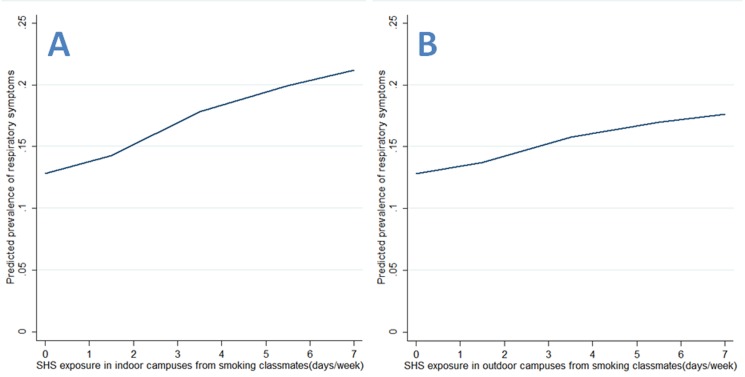
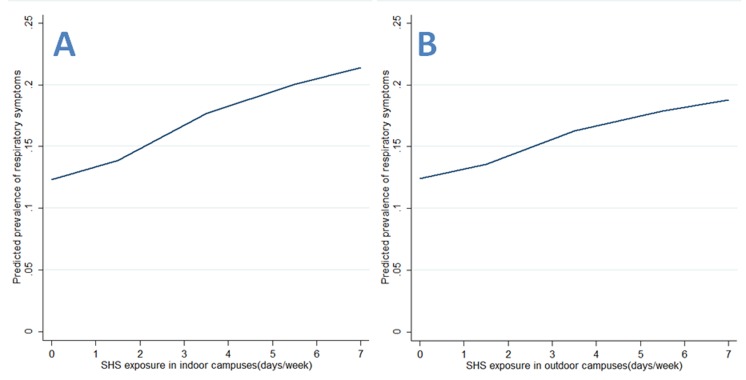
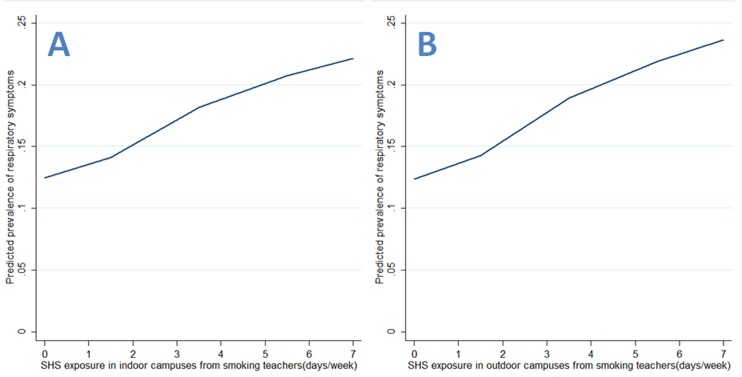
Among 3575 students, the overall prevalence of SHS exposure was 69.2%, including 49.5% for SHS in public places, 34.5% in homes, 22.7% in indoor campuses and 29.2% in outdoor campuses. There were significantly increased risks of having respiratory symptoms corresponding to SHS exposure in public places (OR=1.60, 95% CI 1.30 to 1.95), in homes (OR=1.53, 95% CI 1.25 to 1.87), in indoor campuses (OR=1.43, 95% CI 1.14 to 1.79) and in outdoor campuses (OR=1.37, 95% CI 1.10 to 1.69) using no exposure as reference. Notably, we observed monotonic frequency-risk relationships between setting-specific(eg, homes, public places and campuses) SHS exposure and respiratory symptoms.
Our findings suggest that setting-specific SHS exposure is associated with a significant, dose-dependent increase in risk of respiratory symptoms.
尽管先前的研究表明二手烟暴露与呼吸道症状之间存在关联,但目前的证据并不一致。此外,二手烟暴露与青少年呼吸道症状之间是否存在频率-风险关系仍不清楚。
采用分层整群抽样方法进行横断面调查,以获取中国广州高中生的代表性样本。呼吸道症状定义为在过去12个月中连续3个月持续咳嗽或咳痰。自我报告的二手烟暴露定义为非吸烟者在过去7天内每周至少有1天吸入吸烟者呼出的烟雾。采用单变量和多变量逻辑回归模型探讨二手烟暴露与呼吸道症状之间潜在的频率-风险关系。
在3575名学生中,二手烟暴露的总体患病率为69.2%,其中公共场所二手烟暴露率为49.5%,家庭为34.5%,校园室内为22.7%,校园室外为29.2%。以无暴露为参照,在公共场所(比值比=1.60,95%置信区间1.30至1.95)、家庭(比值比=1.53,95%置信区间1.25至1.87)、校园室内(比值比=1.43,95%置信区间1.14至1.79)和校园室外(比值比=1.37,95%置信区间1.10至1.69),二手烟暴露与呼吸道症状的风险显著增加。值得注意的是,我们观察到特定环境(如家庭、公共场所和校园)的二手烟暴露与呼吸道症状之间存在单调的频率-风险关系。
我们的研究结果表明,特定环境的二手烟暴露与呼吸道症状风险的显著剂量依赖性增加有关。