Gilbert Richard W D, Vickaryous Matthew K, Viloria-Petit Alicia M
School of Medicine, University College Cork, Cork, Ireland.
Department of Biomedical Sciences, Ontario Veterinary College, University of Guelph, Guelph, ON N1G 2W1, Canada.
J Dev Biol. 2016 Jun 22;4(2):21. doi: 10.3390/jdb4020021.
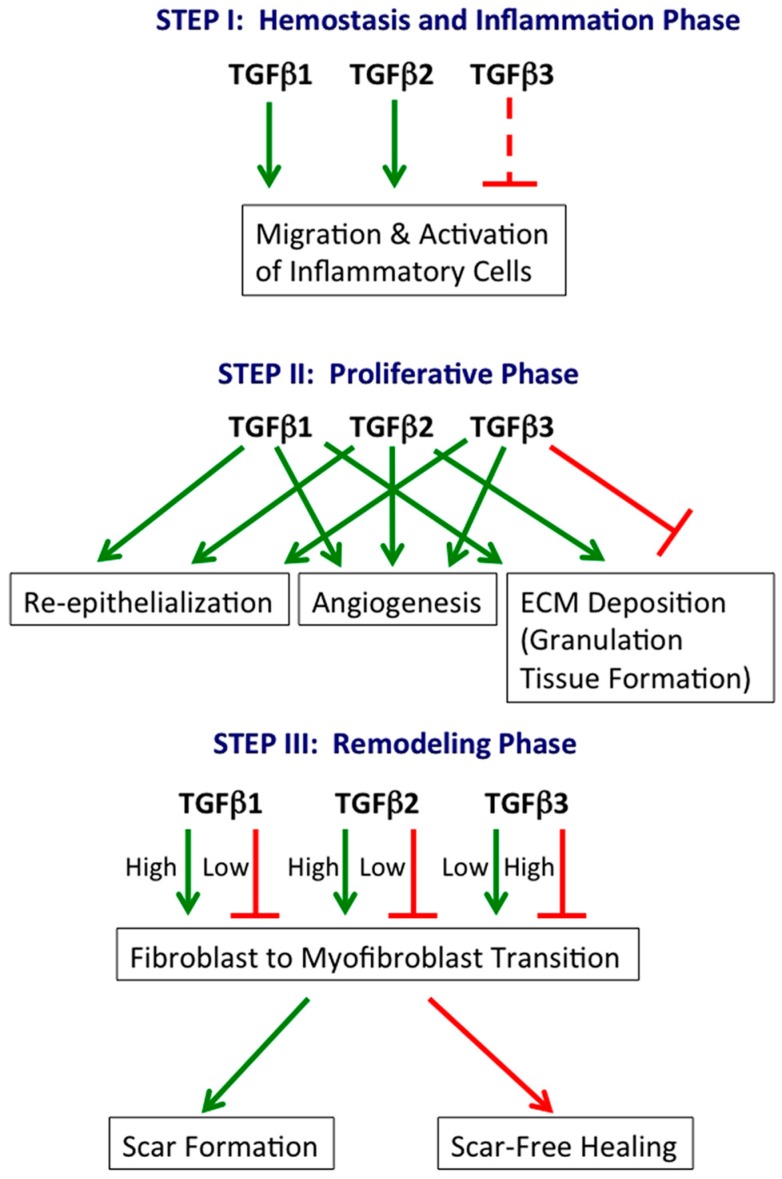
Transforming growth factor beta (TGFβ) signalling is essential for wound healing, including both non-specific scar formation and tissue-specific regeneration. Specific TGFβ isoforms and downstream mediators of canonical and non-canonical signalling play different roles in each of these processes. Here we review the role of TGFβ signalling during tissue repair, with a particular focus on the prototypic isoforms TGFβ1, TGFβ2, and TGFβ3. We begin by introducing TGFβ signalling and then discuss the role of these growth factors and their key downstream signalling mediators in determining the balance between scar formation and tissue regeneration. Next we discuss examples of the pleiotropic roles of TGFβ ligands during cutaneous wound healing and blastema-mediated regeneration, and how inhibition of the canonical signalling pathway (using small molecule inhibitors) blocks regeneration. Finally, we review various TGFβ-targeting therapeutic strategies that hold promise for enhancing tissue repair.
转化生长因子β(TGFβ)信号通路对于伤口愈合至关重要,包括非特异性瘢痕形成和组织特异性再生。特定的TGFβ亚型以及经典和非经典信号通路的下游介质在这些过程中各自发挥不同作用。在此,我们综述TGFβ信号通路在组织修复过程中的作用,尤其关注原型亚型TGFβ1、TGFβ2和TGFβ3。我们首先介绍TGFβ信号通路,然后讨论这些生长因子及其关键下游信号介质在决定瘢痕形成和组织再生之间平衡方面的作用。接下来,我们讨论TGFβ配体在皮肤伤口愈合和芽基介导的再生过程中的多效性作用实例,以及抑制经典信号通路(使用小分子抑制剂)如何阻断再生。最后,我们综述各种有望增强组织修复的靶向TGFβ的治疗策略。