Kerkhofs Amber, Canas Paula M, Timmerman A J, Heistek Tim S, Real Joana I, Xavier Carolina, Cunha Rodrigo A, Mansvelder Huibert D, Ferreira Samira G
Department of Integrative Neurophysiology, Center for Neurogenomics and Cognitive Research, VU University, Amsterdam, Netherlands.
Center for Neuroscience and Cell Biology, University of Coimbra, Coimbra, Portugal.
Front Pharmacol. 2018 Mar 20;9:133. doi: 10.3389/fphar.2018.00133. eCollection 2018.
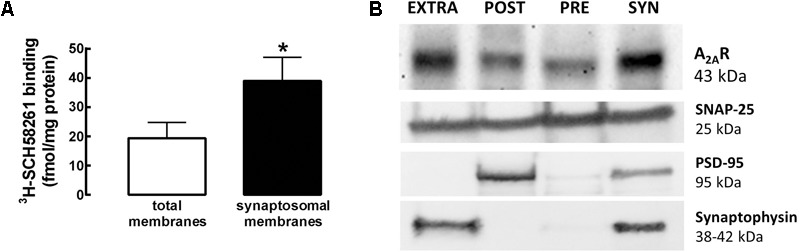
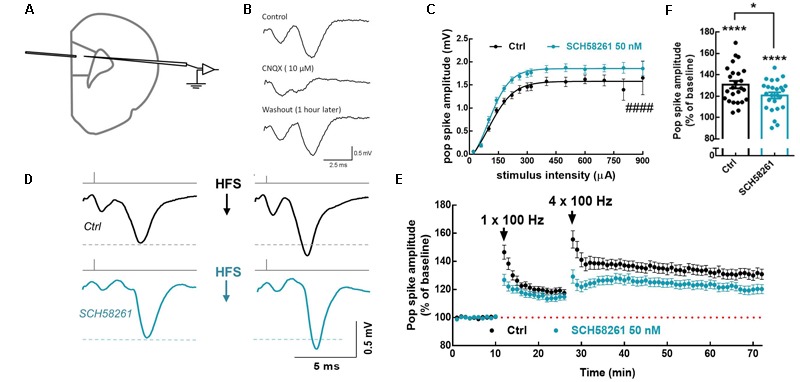
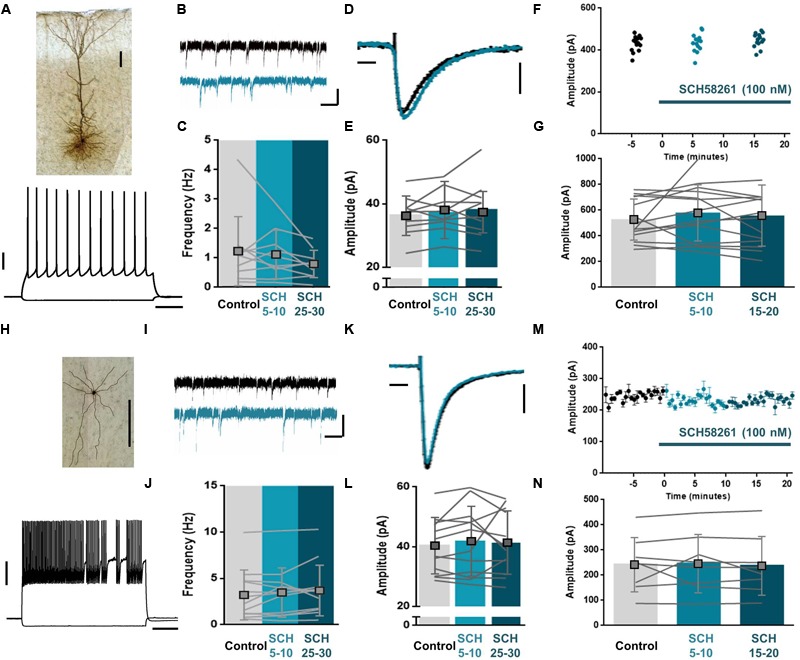
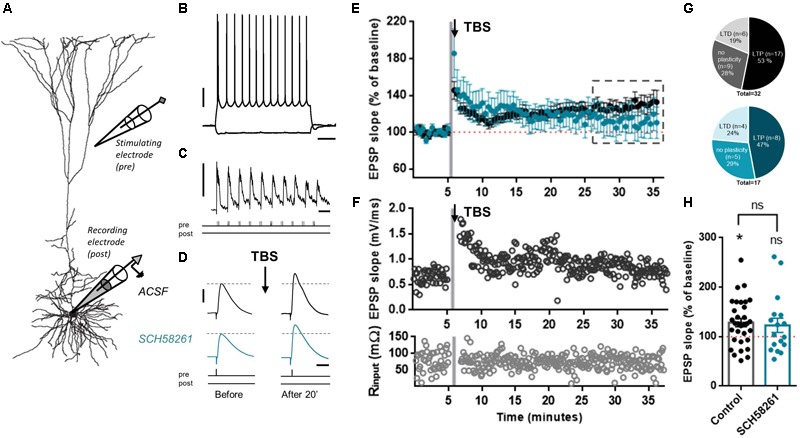
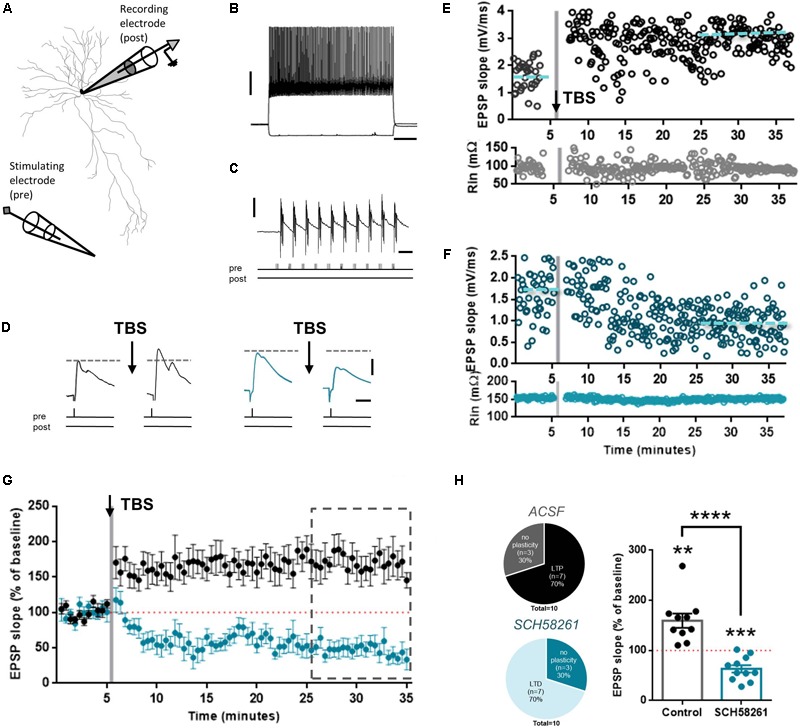
Adenosine A receptors (AR) are activated upon increased synaptic activity to assist in the implementation of long-term plastic changes at synapses. While it is reported that AR are involved in the control of prefrontal cortex (PFC)-dependent behavior such as working memory, reversal learning and effort-based decision making, it is not known whether AR control glutamatergic synapse plasticity within the medial PFC (mPFC). To elucidate that, we tested whether AR blockade affects long-term plasticity (LTP) of excitatory post-synaptic potentials in pyramidal neurons and fast spiking (FS) interneurons in layer 5 of the mPFC and of population spikes. Our results show that AR are enriched at mPFC synapses, where their blockade reversed the direction of plasticity at excitatory synapses onto layer 5 FS interneurons from LTP to long-term depression, while their blockade had no effect on the induction of LTP at excitatory synapses onto layer 5 pyramidal neurons. At the network level, extracellularly induced LTP of population spikes was reduced by AR blockade. The interneuron-specificity of AR in controlling glutamatergic synapse LTP may ensure that during periods of high synaptic activity, a proper excitation/inhibition balance is maintained within the mPFC.
腺苷A受体(AR)在突触活动增加时被激活,以协助在突触处实现长期的可塑性变化。虽然有报道称AR参与控制依赖前额叶皮质(PFC)的行为,如工作记忆、逆向学习和基于努力的决策,但尚不清楚AR是否控制内侧前额叶皮质(mPFC)内的谷氨酸能突触可塑性。为了阐明这一点,我们测试了AR阻断是否会影响mPFC第5层锥体神经元和快速放电(FS)中间神经元的兴奋性突触后电位以及群体峰电位的长期可塑性(LTP)。我们的结果表明,AR在mPFC突触处富集,其阻断将兴奋性突触到第5层FS中间神经元的可塑性方向从LTP逆转至长期抑制,而其阻断对兴奋性突触到第5层锥体神经元的LTP诱导没有影响。在网络水平上,AR阻断降低了细胞外诱导的群体峰电位LTP。AR在控制谷氨酸能突触LTP方面的中间神经元特异性可能确保在高突触活动期间,mPFC内维持适当的兴奋/抑制平衡。