Rädecker Nils, Raina Jean-Baptiste, Pernice Mathieu, Perna Gabriela, Guagliardo Paul, Kilburn Matt R, Aranda Manuel, Voolstra Christian R
Red Sea Research Center, Division of Biological and Environmental Science and Engineering (BESE), King Abdullah University of Science and Technology (KAUST), Thuwal, Saudi Arabia.
Climate Change Cluster, University of Technology Sydney, Sydney, NSW, Australia.
Front Physiol. 2018 Mar 16;9:214. doi: 10.3389/fphys.2018.00214. eCollection 2018.
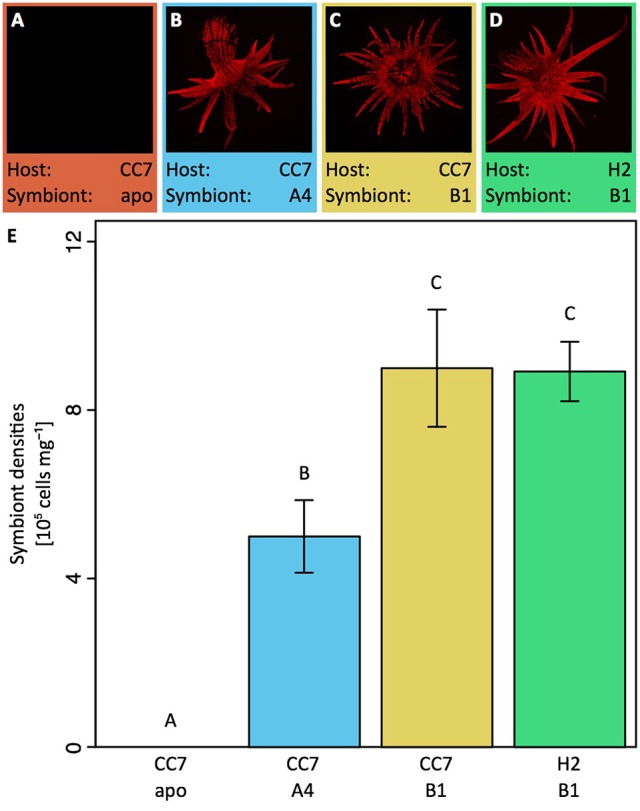
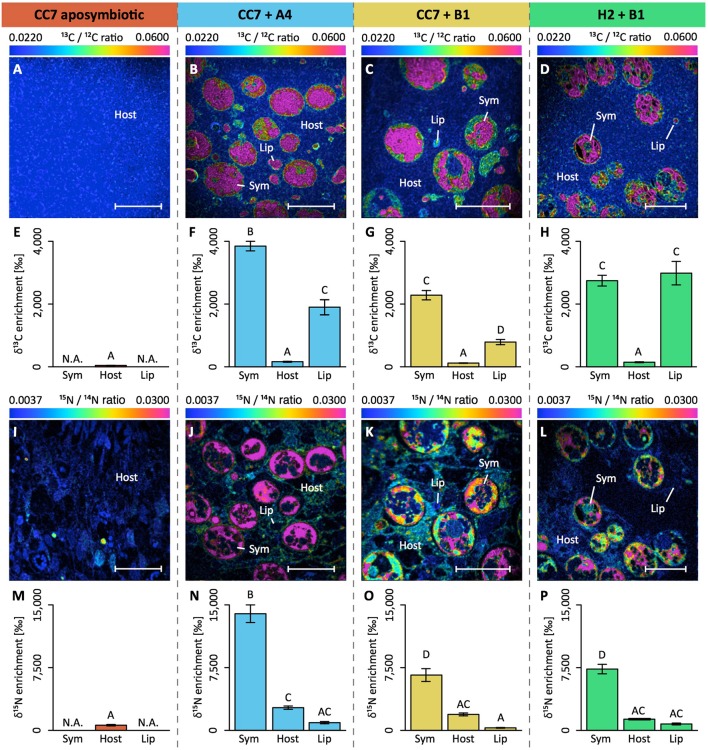
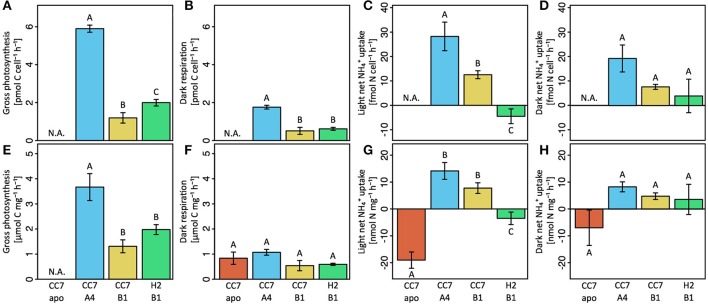
The symbiosis between cnidarian hosts and microalgae of the genus provides the foundation of coral reefs in oligotrophic waters. Understanding the nutrient-exchange between these partners is key to identifying the fundamental mechanisms behind this symbiosis, yet has proven difficult given the endosymbiotic nature of this relationship. In this study, we investigated the respective contribution of host and symbiont to carbon and nitrogen assimilation in the coral model anemone Aiptaisa. For this, we combined traditional measurements with nanoscale secondary ion mass spectrometry (NanoSIMS) and stable isotope labeling to investigate patterns of nutrient uptake and translocation both at the organismal scale and at the cellular scale. Our results show that the rate of carbon and nitrogen assimilation in Aiptasia depends on the identity of the host and the symbiont. NanoSIMS analysis confirmed that both host and symbiont incorporated carbon and nitrogen into their cells, implying a rapid uptake and cycling of nutrients in this symbiotic relationship. Gross carbon fixation was highest in Aiptasia associated with their native communities. However, differences in fixation rates were only reflected in the δC enrichment of the cnidarian host, whereas the algal symbiont showed stable enrichment levels regardless of host identity. Thereby, our results point toward a "selfish" character of the cnidarian- association in which both partners directly compete for available resources. Consequently, this symbiosis may be inherently instable and highly susceptible to environmental change. While questions remain regarding the underlying cellular controls of nutrient exchange and the nature of metabolites involved, the approach outlined in this study constitutes a powerful toolset to address these questions.
刺胞动物宿主与虫黄藻属微藻之间的共生关系为贫营养水域中珊瑚礁的形成奠定了基础。了解这些共生伙伴之间的营养物质交换是识别这种共生关系背后基本机制的关键,但鉴于这种关系的内共生性质,这一过程已被证明颇具难度。在本研究中,我们调查了在珊瑚模型海葵艾氏海葵中宿主与共生体对碳和氮同化作用的各自贡献。为此,我们将传统测量方法与纳米二次离子质谱(NanoSIMS)和稳定同位素标记相结合,以研究在生物体尺度和细胞尺度上营养物质吸收和转运的模式。我们的结果表明,艾氏海葵中碳和氮的同化速率取决于宿主和共生体的种类。NanoSIMS分析证实,宿主和共生体都将碳和氮纳入其细胞中,这意味着在这种共生关系中营养物质的快速吸收和循环。与天然虫黄藻群落共生的艾氏海葵总碳固定量最高。然而,固定率的差异仅反映在刺胞动物宿主的δC富集上,而藻类共生体无论宿主种类如何,其富集水平都保持稳定。因此,我们的结果表明刺胞动物与虫黄藻的共生关系具有“自私”的特性,即双方直接竞争可用资源。因此,这种共生关系可能本质上就不稳定,且极易受到环境变化的影响。尽管关于营养物质交换的潜在细胞控制以及所涉及代谢物的性质仍存在问题,但本研究中概述的方法构成了一个强大的工具集来解决这些问题。