Wang Mingshuang, Yang Xiao, Ruan Ruoxin, Fu Huilan, Li Hongye
Key Lab of Molecular Biology of Crop Pathogens and Insects, Institute of Biotechnology, Zhejiang University, Hangzhou, China.
Hangzhou Academy of Agricultural Sciences, Hangzhou, China.
Front Microbiol. 2018 Mar 20;9:508. doi: 10.3389/fmicb.2018.00508. eCollection 2018.
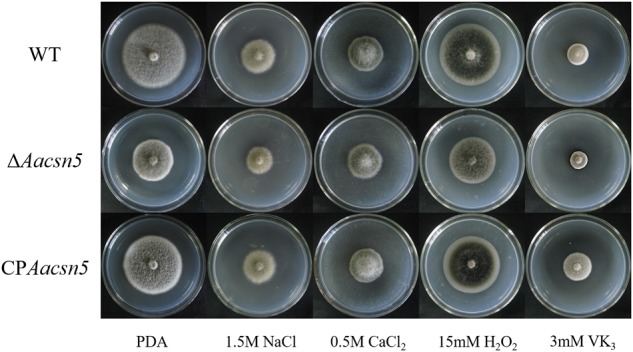
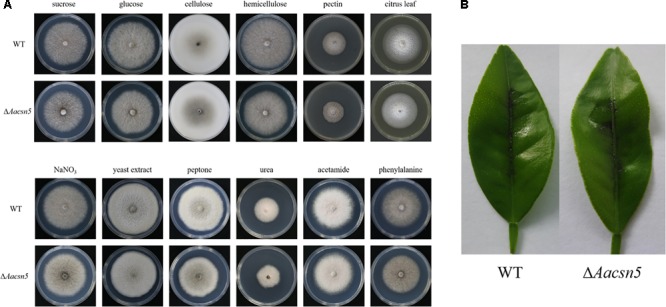
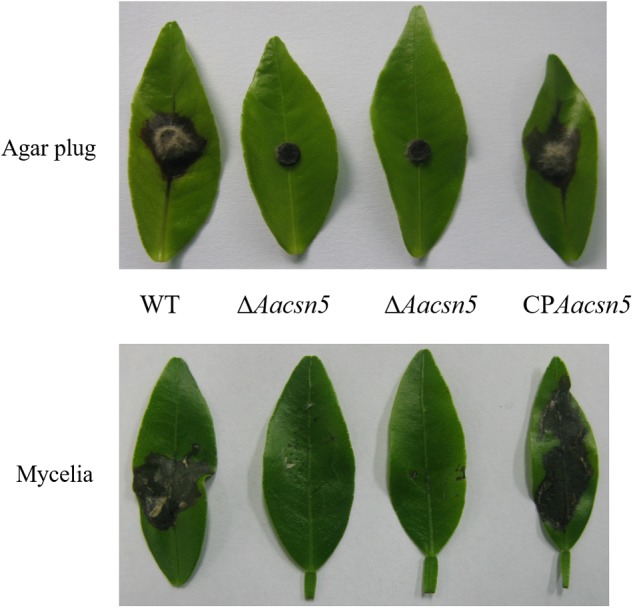
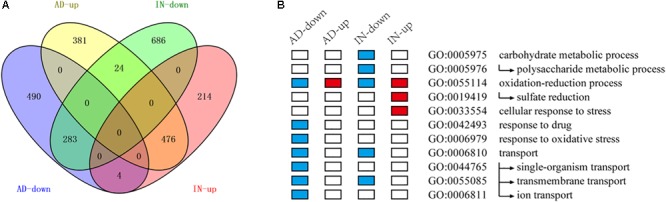
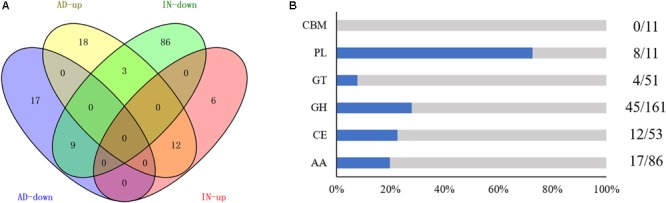
The COP9 signalosome (CSN) is a highly conserved protein complex involved in the ubiquitin-proteasome system. Its metalloisopeptidase activity resides in subunit 5 (CSN5). Functions of in phytopathogenic fungi are poorly understood. Here, we knocked out the ortholog () in the tangerine pathotype of . The Δ mutant showed a moderately reduced growth rate compared to the wildtype strain and was unable to produce conidia. The growth of Δ mutant was not affected in response to oxidative and osmotic stresses. Virulence assays revealed that Δ induced no or significantly reduced necrotic lesions on detached citrus leaves. The defects in hyphal growth, conidial sporulation, and pathogenicity of Δ were restored by genetic complementation of the mutant with wildtype . To explore the molecular mechanisms of conidiation and pathogenesis underlying regulation, we systematically examined the transcriptomes of both Δ and the wildtype. Generally, 881 genes were overexpressed and 777 were underexpressed in the Δ mutant during conidiation while 694 overexpressed and 993 underexpressed during infection. During asexual development, genes related to the transport processes and nitrogen metabolism were significantly downregulated; the expression of and in Δ was significantly elevated; secondary metabolism gene clusters were broadly affected; especially, the transcript level of the whole of cluster 28 and 30 was strongly induced. During infection, the expression of the host-specific ACT toxin gene cluster which controls the biosynthesis of the citrus specific toxin was significantly repressed; many other SM clusters with unknown products were also regulated; 86 out of 373 carbohydrate-active enzymes responsible for breaking down the plant dead tissues showed uniquely decreased expression. Taken together, our results expand our understanding of the roles of on conidiation and pathogenicity in plant pathogenic fungi and provide a foundation for future investigations.
COP9信号体(CSN)是一种参与泛素-蛋白酶体系统的高度保守的蛋白质复合物。其金属异肽酶活性存在于亚基5(CSN5)中。人们对其在植物病原真菌中的功能了解甚少。在此,我们敲除了柑橘溃疡病菌(Xanthomonas citri subsp. citri)橘黄致病型中的CSN5直系同源基因(XacCSN5)。与野生型菌株相比,ΔXacCSN5突变体的生长速率适度降低,且无法产生分生孢子。ΔXacCSN5突变体的生长在氧化应激和渗透胁迫条件下不受影响。致病性测定表明,ΔXacCSN5在离体柑橘叶片上不引起或显著减少坏死病斑。通过用野生型XacCSN5对突变体进行遗传互补,恢复了ΔXacCSN5在菌丝生长、分生孢子形成和致病性方面的缺陷。为了探究XacCSN5调控分生孢子形成和致病性的分子机制,我们系统地检测了ΔXacCSN5和野生型的转录组。一般来说,在分生孢子形成过程中,ΔXacCSN5突变体中有881个基因过度表达,777个基因表达不足;而在感染过程中,有694个基因过度表达,993个基因表达不足。在无性发育过程中,与转运过程和氮代谢相关的基因显著下调;ΔXacCSN5中Slt2和Mkk2的表达显著升高;次级代谢基因簇受到广泛影响;特别是,整个28和30簇的转录水平被强烈诱导。在感染过程中,控制柑橘特异性毒素生物合成的宿主特异性ACT毒素基因簇的表达显著受到抑制;许多其他产物未知的次级代谢簇也受到调控;在373种负责分解植物死组织的碳水化合物活性酶中,有86种表现出独特的表达下降。综上所述,我们的结果扩展了我们对XacCSN5在植物病原真菌分生孢子形成和致病性中作用的理解,并为未来的研究提供了基础。