Jin Yue, Chen Zixuan, Yang Jun, Mysore Kirankumar S, Wen Jiangqi, Huang Jirong, Yu Nan, Wang Ertao
College of Life and Environment Sciences, Shanghai Normal University, Shanghai, China.
National Key Laboratory of Plant Molecular Genetics, CAS Center for Excellence in Molecular Plant Sciences, Institute of Plant Physiology and Ecology, Chinese Academy of Sciences, Shanghai, China.
Front Plant Sci. 2018 Mar 16;9:267. doi: 10.3389/fpls.2018.00267. eCollection 2018.
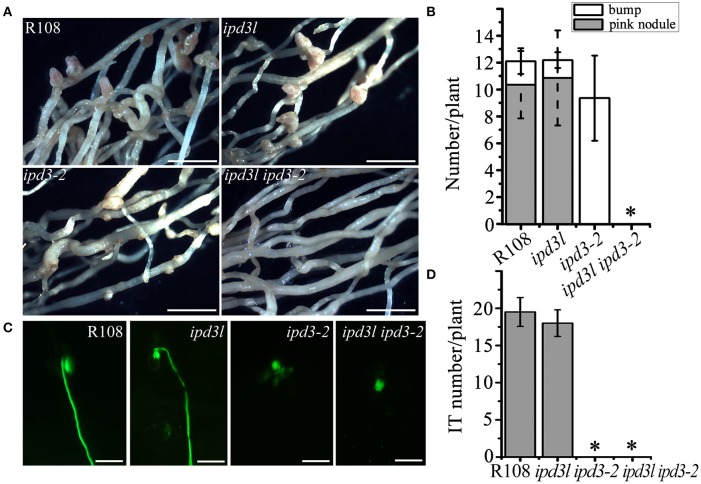
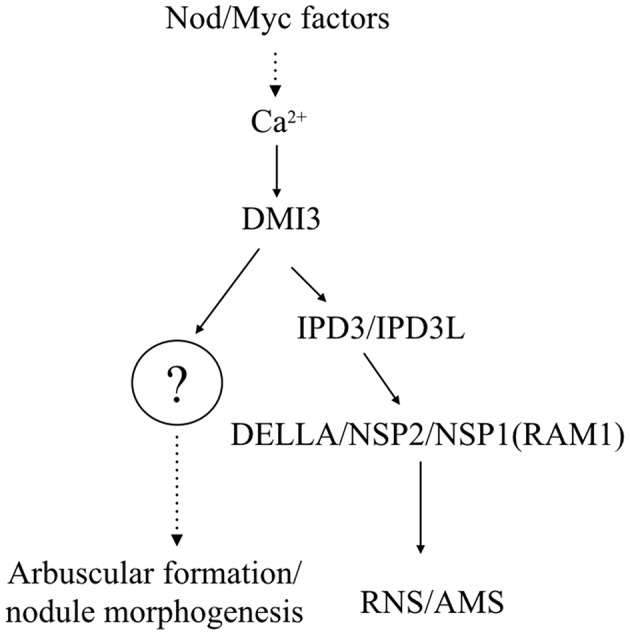
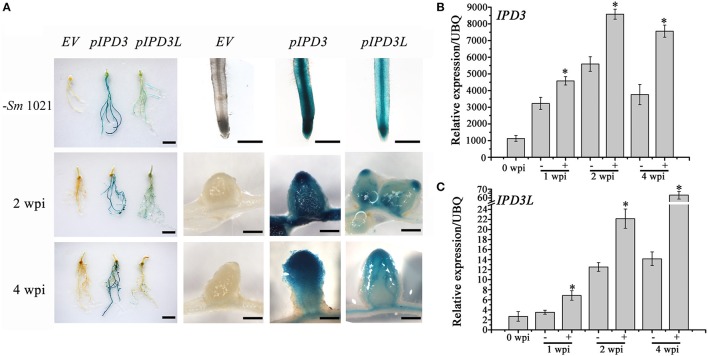
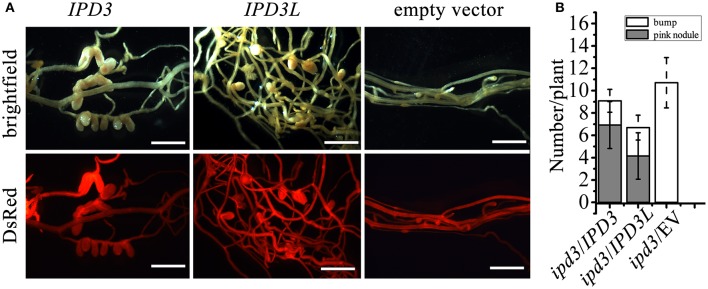
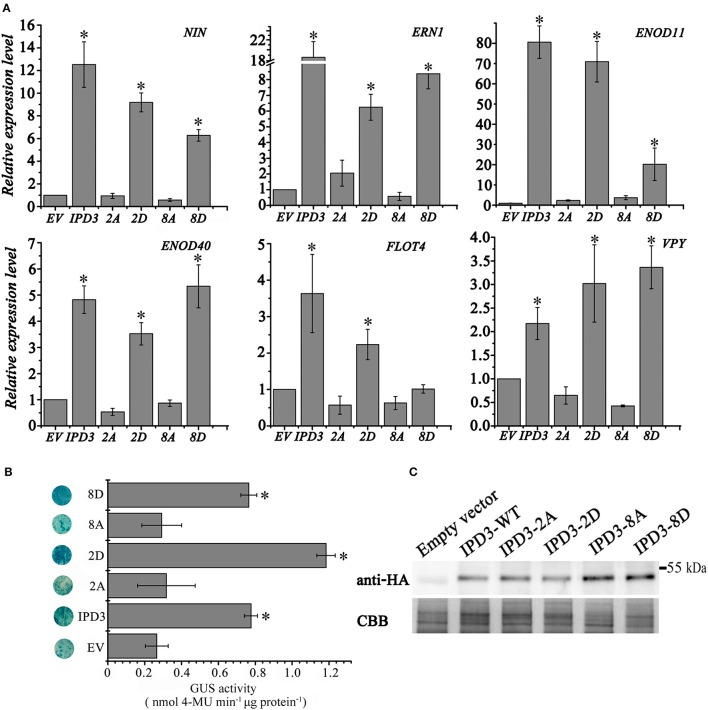
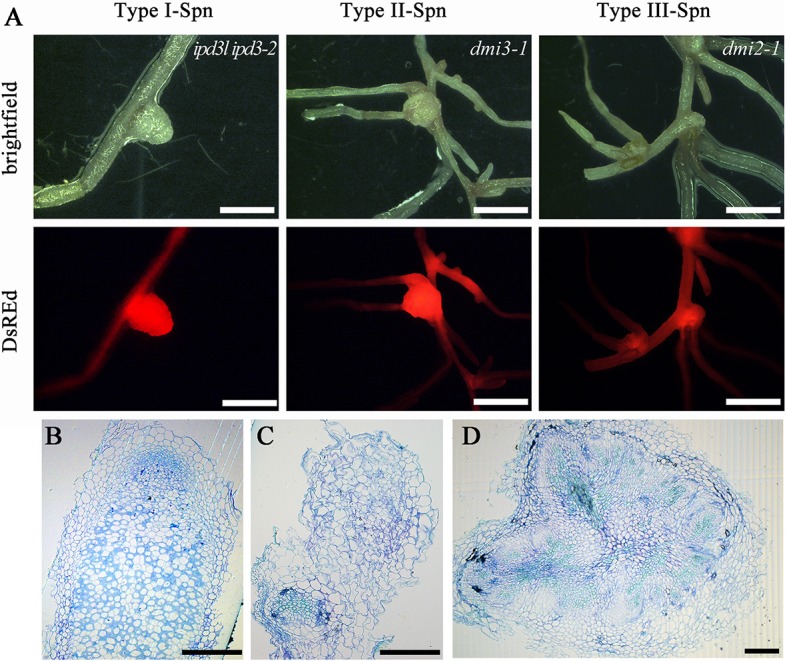
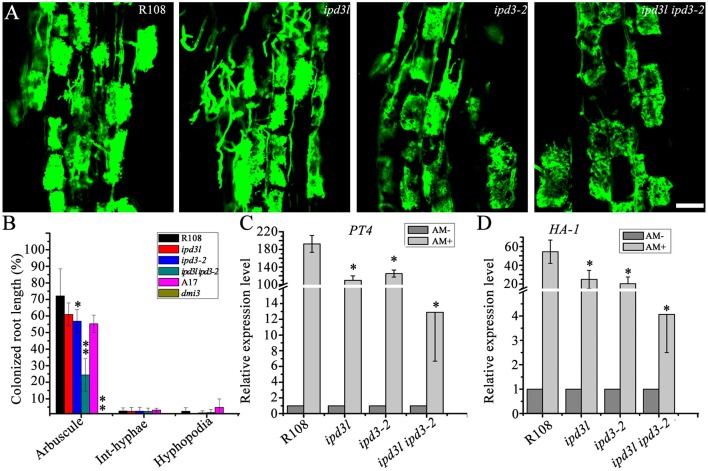
Legume plants form symbiotic associations with either nitrogen-fixing bacteria or arbuscular mycorrhizal (AM) fungi, which are regulated by a set of common symbiotic signaling pathway genes. Central to the signaling pathway is the activation of the DMI3/IPD3 protein complex by Ca oscillations, and the initiation of nodule organogenesis and mycorrhizal symbiosis. DMI3 is essential for rhizobial infection and nodule organogenesis; however, mutants have been shown to be impaired only in infection thread formation but not in root nodule organogenesis in . We identified an -like () gene in the genome. A single mutant exhibits a normal root nodule phenotype. The double mutant is completely unable to initiate infection threads and nodule primordia. can functionally replace when expressed under the control of the IPD3 promoter, indicating functional redundancy between these two transcriptional regulators. We constructed a version of IPD3 that was phosphomimetic with respect to two conserved serine residues (IPD3-2D). This was sufficient to trigger root nodule organogenesis, but the increased multisite phosphorylation of IPD3 (IPD3-8D) led to low transcriptional activity, suggesting that the phosphorylation levels of IPD3 fine-tune its transcriptional activity in the root nodule symbiosis. Intriguingly, the phosphomimetic version of IPD3 triggers spontaneous root-like nodules on the roots of and ( is an LRR-containing receptor-like kinase gene which is required for Ca spiking), but not on the roots of wild-type or plants. In addition, fully developed arbuscules were formed in the mutants but not the mutants. Collectively, our data indicate that, in addition to and , another new genetic component or other new phosphorylation sites of IPD3 function downstream of in rhizobial and mycorrhizal symbioses.
豆科植物与固氮细菌或丛枝菌根(AM)真菌形成共生关系,这由一组共同的共生信号通路基因调控。该信号通路的核心是由钙振荡激活DMI3/IPD3蛋白复合体,并启动根瘤器官发生和菌根共生。DMI3对根瘤菌感染和根瘤器官发生至关重要;然而,已表明突变体仅在感染丝形成方面受损,而在[具体植物]的根瘤器官发生中未受损。我们在[具体植物]基因组中鉴定出一个类似[基因名称]([基因名称])的基因。单个[基因名称]突变体表现出正常的根瘤表型。[基因名称]双突变体完全无法启动感染丝和根瘤原基。当在IPD3启动子控制下表达时,[基因名称]可以在功能上替代[基因名称],表明这两个转录调节因子之间存在功能冗余。我们构建了一个在两个保守丝氨酸残基方面具有拟磷酸化作用的IPD3版本(IPD3-2D)。这足以触发根瘤器官发生,但IPD3增加的多位点磷酸化(IPD3-8D)导致低转录活性,表明IPD3的磷酸化水平在根瘤共生中微调其转录活性。有趣的是,IPD3的拟磷酸化版本在[具体植物1]和[具体植物2]([基因名称]是一个含LRR的类受体激酶基因,是钙尖峰所必需的)的根上触发自发的根状瘤,但在野生型或[具体植物3]植物的根上则不会。此外,在[具体植物1]突变体中形成了完全发育的丛枝,而在[具体植物2]突变体中则没有。总体而言,我们的数据表明,除了[基因名称]和[基因名称]之外,IPD3的另一个新的遗传成分或其他新的磷酸化位点在根瘤菌和菌根共生中在[基因名称]下游起作用。