Department of Genetics & Biochemistry, Clemson University, Clemson, SC 29634, USA.
Int J Mol Sci. 2021 Jan 23;22(3):1117. doi: 10.3390/ijms22031117.
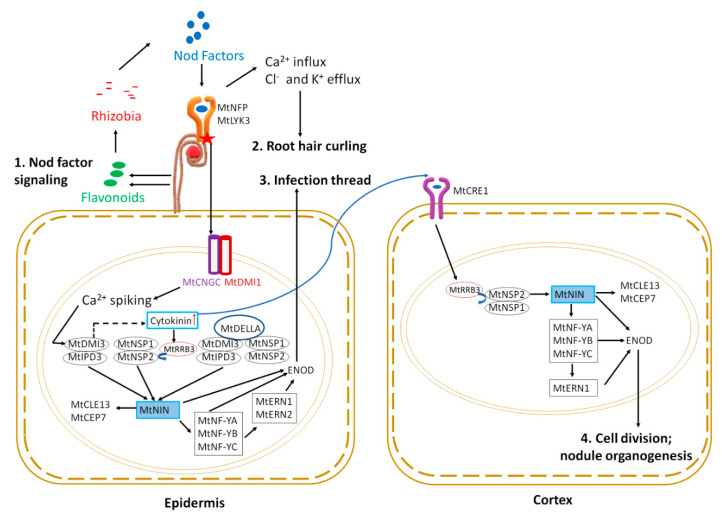
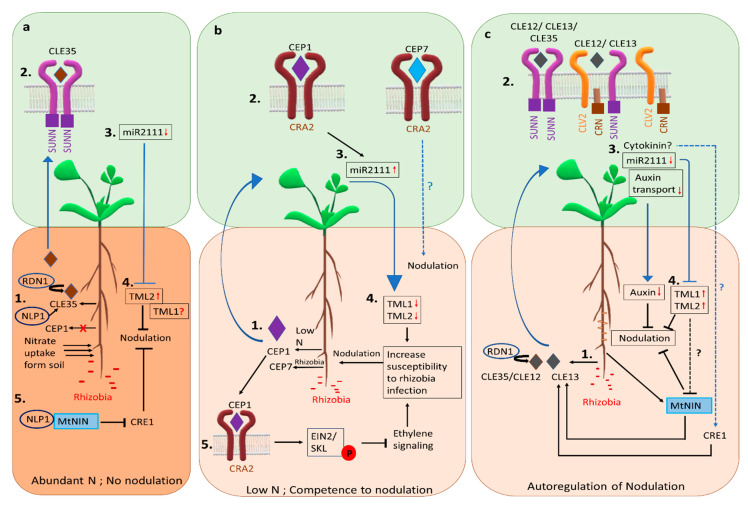
Nitrogen is a major determinant of plant growth and productivity and the ability of legumes to form a symbiotic relationship with nitrogen-fixing rhizobia bacteria allows legumes to exploit nitrogen-poor niches in the biosphere. But hosting nitrogen-fixing bacteria comes with a metabolic cost, and the process requires regulation. The symbiosis is regulated through three signal transduction pathways: in response to available nitrogen, at the initiation of contact between the organisms, and during the development of the nodules that will host the rhizobia. Here we provide an overview of our knowledge of how the three signaling pathways operate in space and time, and what we know about the cross-talk between symbiotic signaling for nodule initiation and organogenesis, nitrate dependent signaling, and autoregulation of nodulation. Identification of common components and points of intersection suggest directions for research on the fine-tuning of the plant's response to rhizobia.
氮是植物生长和生产力的主要决定因素,豆科植物与固氮根瘤菌形成共生关系的能力使豆科植物能够在生物圈中利用贫氮生境。但是,宿主固氮细菌需要付出代谢代价,这个过程需要调控。共生关系通过三个信号转导途径进行调控:对可用氮的响应,在生物体接触的开始,以及在将容纳根瘤菌的根瘤发育期间。在这里,我们概述了我们对三个信号通路如何在空间和时间上运作的了解,以及我们对共生信号通路对根瘤起始和器官发生、硝酸盐依赖信号通路和根瘤形成的自身调控之间的交叉对话的了解。共同成分和交叉点的识别为研究植物对根瘤菌的反应的微调提供了方向。