Sanabria Tanya, Penner Andrew
Department of Sociology, University of California, Irvine, Irvine, CA 92697, USA.
Soc Sci (Basel). 2017 Jun;6(2). doi: 10.3390/socsci6020047. Epub 2017 May 10.
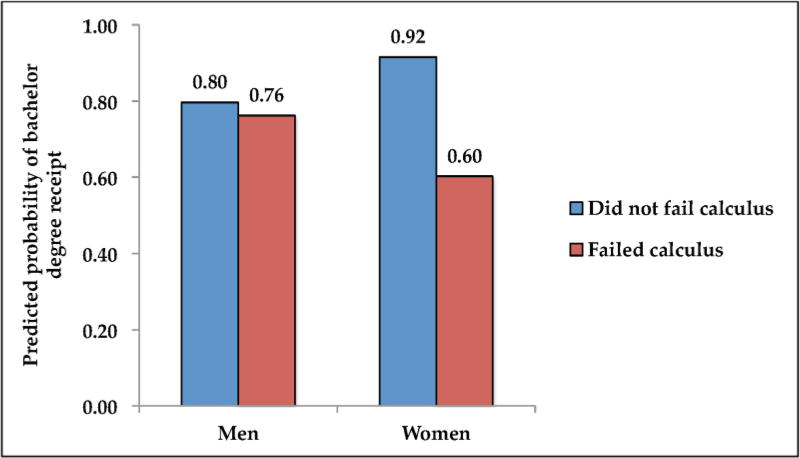
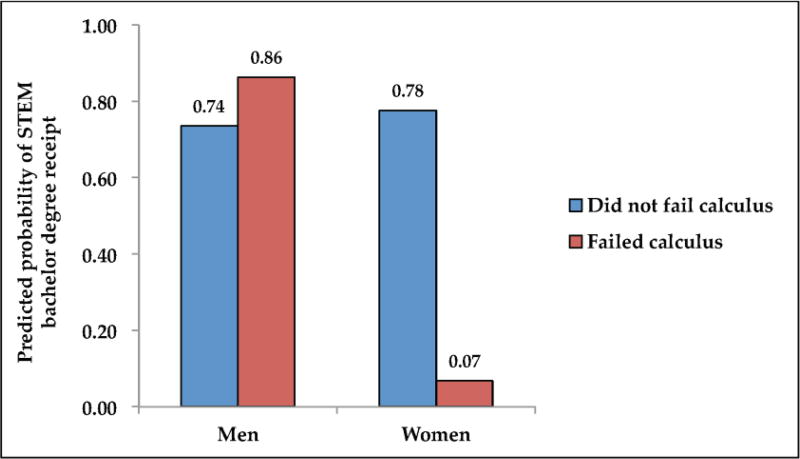
Although women graduate from college at higher rates than men, they remain underrepresented in science, technology, engineering, and mathematics (STEM) fields. This study examines whether women react to failing a STEM weed-out course by switching to a non-STEM major and graduating with a bachelor's degree in a non-STEM field. While competitive courses designed to weed out potential STEM majors are often invoked in discussions around why students exit the STEM pipeline, relatively little is known about how women and men react to failing these courses. We use detailed individual-level data from the National Educational Longitudinal Study (NELS) Postsecondary Transcript Study (PETS): 1988-2000 to show that women who failed an introductory calculus course are substantially less likely to earn a bachelor's degree in STEM. In doing so, we provide evidence that weed-out course failure might help us to better understand why women are less likely to earn degrees.
尽管女性大学毕业率高于男性,但在科学、技术、工程和数学(STEM)领域,她们的占比仍然较低。本研究探讨了女性在STEM淘汰课程不及格后,是否会转而选择非STEM专业,并最终获得非STEM领域的学士学位。虽然在关于学生为何退出STEM领域的讨论中,经常会提到那些旨在淘汰潜在STEM专业学生的竞争性课程,但对于男女学生在这些课程不及格时的反应,我们了解得还比较少。我们使用了来自国家教育纵向研究(NELS)高等教育成绩单研究(PETS)(1988 - 2000年)的详细个人层面数据,结果表明,微积分入门课程不及格的女性获得STEM领域学士学位的可能性要低得多。通过这样做,我们提供了证据,证明淘汰课程不及格可能有助于我们更好地理解女性获得学位可能性较低的原因。