Vernalis Research, Granta Park, Cambridge, United Kingdom.
PLoS One. 2018 Apr 4;13(4):e0195050. doi: 10.1371/journal.pone.0195050. eCollection 2018.
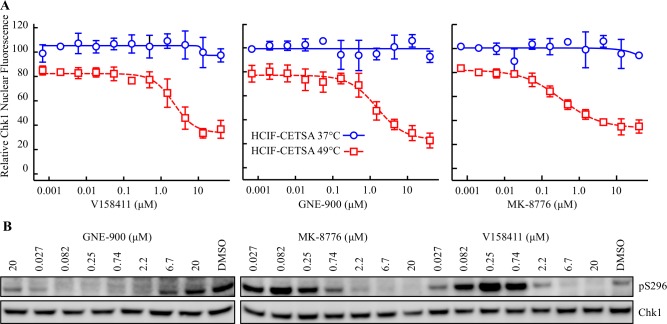
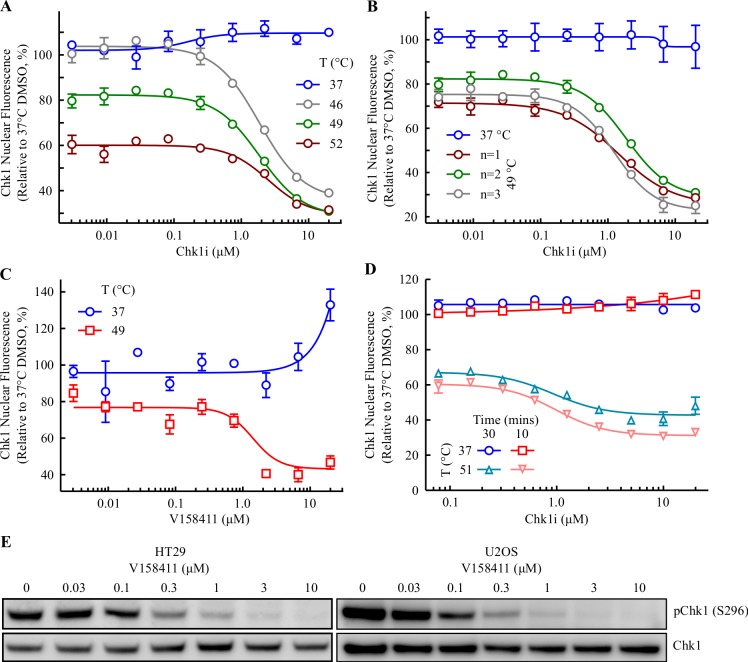
Determining and understanding drug target engagement is critical for drug discovery. This can be challenging within living cells as selective readouts are often unavailable. Here we describe a novel method for measuring target engagement in living cells based on the principle of altered protein thermal stabilization / destabilization in response to ligand binding. This assay (HCIF-CETSA) utilizes high content, high throughput single cell immunofluorescent detection to determine target protein levels following heating of adherent cells in a 96 well plate format. We have used target engagement of Chk1 by potent small molecule inhibitors to validate the assay. Target engagement measured by this method was subsequently compared to target engagement measured by two alternative methods (autophosphorylation and CETSA). The HCIF-CETSA method appeared robust and a good correlation in target engagement measured by this method and CETSA for the selective Chk1 inhibitor V158411 was observed. However, these EC50 values were 23- and 12-fold greater than the autophosphorylation IC50. The described method is therefore a valuable advance in the CETSA method allowing the high throughput determination of target engagement in adherent cells.
确定和了解药物靶点结合对于药物发现至关重要。在活细胞中,这可能具有挑战性,因为通常无法获得选择性读数。在这里,我们描述了一种基于配体结合引起的蛋白质热稳定性/不稳定性改变原理,在活细胞中测量靶点结合的新方法。该测定法(HCIF-CETSA)利用高通量、高内涵单细胞免疫荧光检测,在 96 孔板格式下加热贴壁细胞,以确定靶蛋白水平。我们使用有效的小分子抑制剂对 Chk1 的靶点结合来验证该测定法。随后,通过两种替代方法(自动磷酸化和 CETSA)测量的靶点结合与该方法测量的靶点结合进行了比较。HCIF-CETSA 方法似乎很稳健,并且观察到选择性 Chk1 抑制剂 V158411 中该方法和 CETSA 测量的靶点结合具有良好的相关性。然而,这些 EC50 值分别比自动磷酸化 IC50 大 23 倍和 12 倍。因此,所描述的方法是 CETSA 方法的重要进展,允许在贴壁细胞中高通量测定靶点结合。