1 Karnataka Health Promotion Trust, Bangalore, India.
2 University of Manitoba, Winnipeg, Manitoba, Canada.
Health Educ Behav. 2018 Oct;45(5):824-835. doi: 10.1177/1090198118763934. Epub 2018 Apr 4.
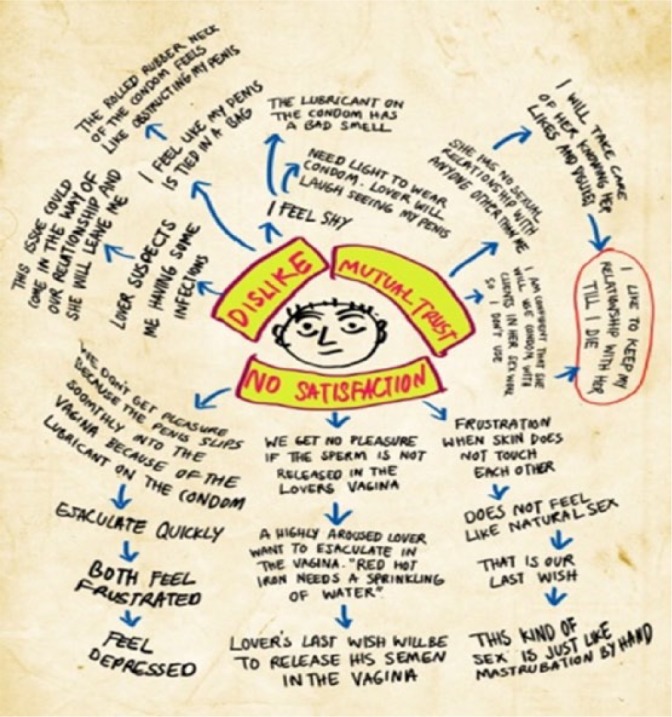
While traditional HIV prevention programs with female sex workers (FSWs) in Karnataka, India, have focused on reducing HIV transmission between FSWs and clients through increased condom use, these programs have not fully addressed the transmission risk between FSWs and their nonpaying intimate partners (IPs). Condom use is infrequent and violence is recurrent in these relationships: Furthermore, there is little evidence on the precise nature of FSW-IP relationships. Our study addresses this knowledge gap to inform HIV programs targeted at FSWs. A series of workshops, using participatory tools, was held to explore FSW-IP relationships; 31 FSWs and 37 IPs participated. Three aspects of FSW-IP relationships were examined: how FSWs and IPs understand and interpret their relationships, factors influencing condom use, and the role of violence and its consequences. FSWs wish to be perceived as their IPs' wives, while IPs expect their FSW partners to accept their dominance in the relationship. Nonuse of condoms signals fidelity and elevates the status of the relationship almost to that of marriage, which helps FSWs enter the category of "good" (married) women. Tolerating and accepting violence in these relationships is normative, as in other marital relationships; IPs justify violence as necessary to establish and maintain their power within the relationship. Both FSWs and IPs value their relationships despite the high degree of risk posed by low condom use and high levels of violence. Implications for program design include addressing current norms around masculinity and gender roles, and improving communication within relationships.
虽然印度卡纳塔克邦的传统女性性工作者(FSW)艾滋病毒预防项目侧重于通过增加 condom 的使用来减少 FSW 和客户之间的 HIV 传播,但这些项目并未完全解决 FSW 和其非付费亲密伴侣(IP)之间的传播风险。在这些关系中, condom 的使用并不频繁,暴力行为经常发生:此外,关于 FSW-IP 关系的确切性质的证据很少。我们的研究旨在填补这一知识空白,为针对 FSW 的艾滋病毒项目提供信息。我们使用参与式工具举办了一系列研讨会,以探讨 FSW-IP 关系;31 名 FSW 和 37 名 IP 参加了研讨会。研讨会考察了 FSW-IP 关系的三个方面:FSW 和 IP 如何理解和解释他们的关系、影响 condom 使用的因素以及暴力及其后果的作用。FSW 希望被视为 IP 的妻子,而 IP 则期望他们的 FSW 伴侣接受他们在关系中的主导地位。不使用 condom 表示忠诚,并使关系的地位几乎等同于婚姻,这有助于 FSW 进入“好”(已婚)女人的范畴。在这些关系中容忍和接受暴力是正常的,就像在其他婚姻关系中一样;IP 认为暴力是在关系中建立和维护权力所必需的。尽管 condom 使用频率低和暴力水平高带来了高度风险,但 FSW 和 IP 都重视他们的关系。项目设计的影响包括解决当前围绕男性气质和性别角色的规范,并改善关系中的沟通。