Guha Goutam, Chatterjee Dipmalya, Biswas Siddhartha, Das Kaushik, Bhattacharya Rupnarayan, Sarkar Tapan
Department of Plastic and Reconstructive Surgery, R. G. Kar Medical College, Kolkata, West Bengal, India.
Indian J Plast Surg. 2017 Sep-Dec;50(3):266-272. doi: 10.4103/ijps.IJPS_91_16.
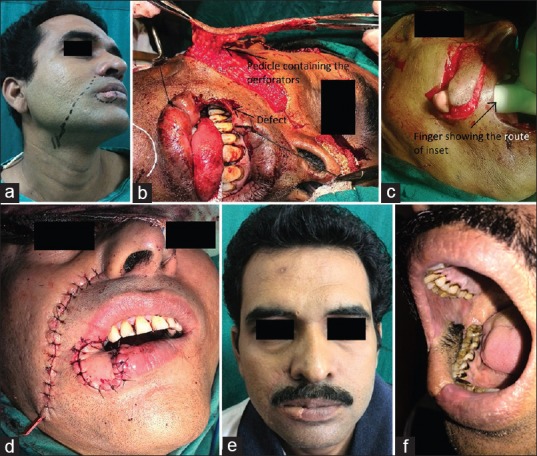
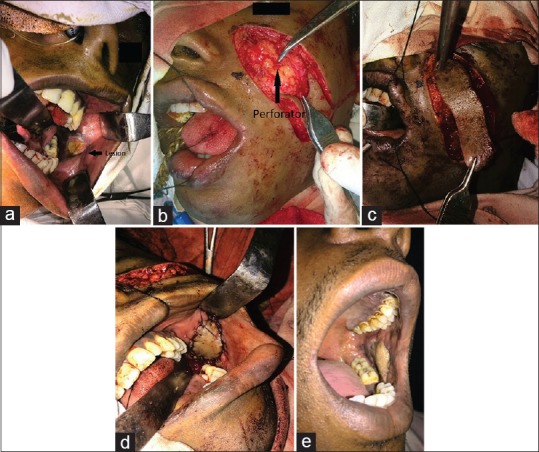
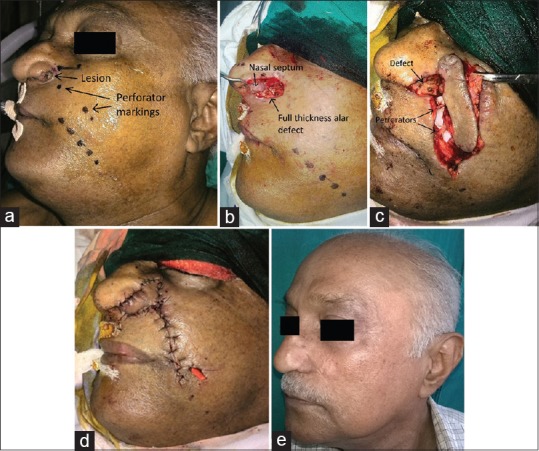
Several flaps have been described for reconstructing facial or oral defects. Flaps such as forehead and pectoralis major are often too bulky for small-to-moderate-sized defects, for which nasolabial flaps are often ideal. However, nasolabial flaps have limited mobility and reach and may need two stages, particularly for intraoral defects. According to recent literatures, facial artery provides numerous small cutaneous perforators, based on which skin flaps can be islanded, with greater mobility and reach for reconstruction of small-to-moderate-sized intraoral and facial defects in one stage. Our study aims to evaluate the reliability and versatility of facial artery perforator-based flaps in the reconstruction of such defects.
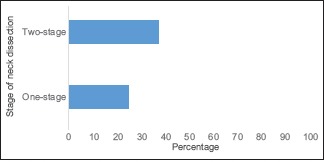
A ethical committee-approved retrospective study was conducted on data of the patients attending our outpatient department between February 2014 and October 2015 with small-to-moderate-sized facial/oral lesions. The total sample size was 23. We studied the relation of flap survival with size of flap, route of inset and neck dissection, functional and aesthetic outcomes and feasibility of adjuvant therapy in cases of malignancies.
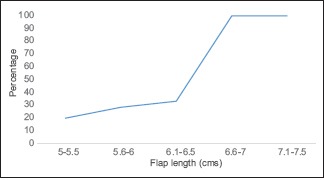
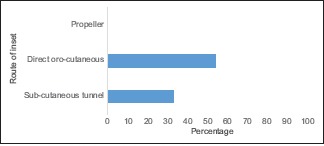
A wide range of facial defects, especially intraoral defects, could be reconstructed in one stage using facial artery perforator-based flaps. The flaps were reliable. Complications included only partial skin loss of the flaps in a few cases. Complications were directly related to the length of the flaps and the route of inset. Functional and aesthetic outcomes were satisfactory and none of the flaps showed any significant post-radiotherapy changes.
We concluded that facial artery perforator flap can be a simple, safe, versatile and one-stage alternative to the traditional flaps in the reconstruction of small-to-moderate-sized facial defects. Neck dissection can be safely done in the same sitting.
已有多种皮瓣用于修复面部或口腔缺损。前额皮瓣和胸大肌皮瓣等对于中小型缺损而言往往过于臃肿,而鼻唇沟皮瓣通常是这类缺损的理想选择。然而,鼻唇沟皮瓣的活动度和覆盖范围有限,可能需要分两期进行,特别是对于口腔内缺损。根据近期文献,面动脉发出许多细小的皮肤穿支,基于这些穿支可制成岛状皮瓣,其活动度和覆盖范围更大,能够一期修复中小型口腔内及面部缺损。本研究旨在评估基于面动脉穿支的皮瓣在修复此类缺损中的可靠性和通用性。
对2014年2月至2015年10月在我院门诊就诊的患有中小型面部/口腔病变的患者数据进行了一项经伦理委员会批准的回顾性研究。总样本量为23例。我们研究了皮瓣存活与皮瓣大小、植入途径和颈部清扫的关系,以及恶性肿瘤病例中辅助治疗的功能和美学效果及可行性。
基于面动脉穿支的皮瓣能够一期修复多种面部缺损,尤其是口腔内缺损。这些皮瓣可靠。并发症仅包括少数病例中皮瓣部分皮肤坏死。并发症与皮瓣长度和植入途径直接相关。功能和美学效果令人满意,且所有皮瓣放疗后均未出现明显变化。
我们得出结论,在修复中小型面部缺损时,面动脉穿支皮瓣可成为一种比传统皮瓣更简单、安全、通用且一期完成的替代方法。颈部清扫可在同一手术中安全进行。