Tan Zaigao, Yoon Jong Moon, Chowdhury Anupam, Burdick Kaitlin, Jarboe Laura R, Maranas Costas D, Shanks Jacqueline V
1Department of Chemical and Biological Engineering, Iowa State University, 3031 Sweeney, Ames, IA 50011 USA.
2Department of Chemical Engineering, The Pennsylvania State University, University Park, PA 16802 USA.
Biotechnol Biofuels. 2018 Apr 2;11:87. doi: 10.1186/s13068-018-1078-z. eCollection 2018.
As a versatile platform chemical, construction of microbial catalysts for free octanoic acid production from biorenewable feedstocks is a promising alternative to existing petroleum-based methods. However, the bio-production strategy has been restricted by the low capacity of inherent fatty acid biosynthesis. In this study, a combination of integrated computational and experimental approach was performed to manipulate the existing metabolic network, with the objective of improving bio-octanoic acid production.
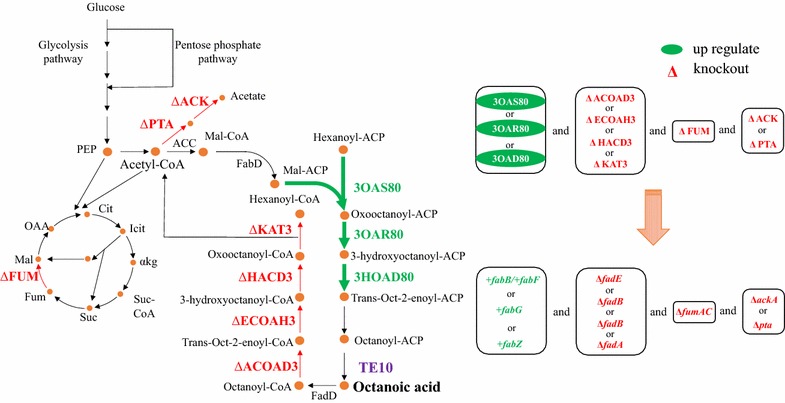
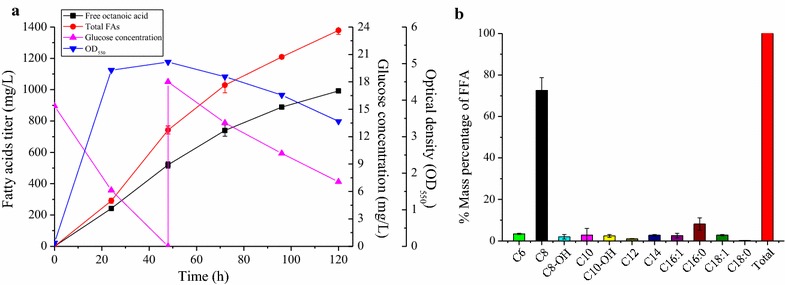
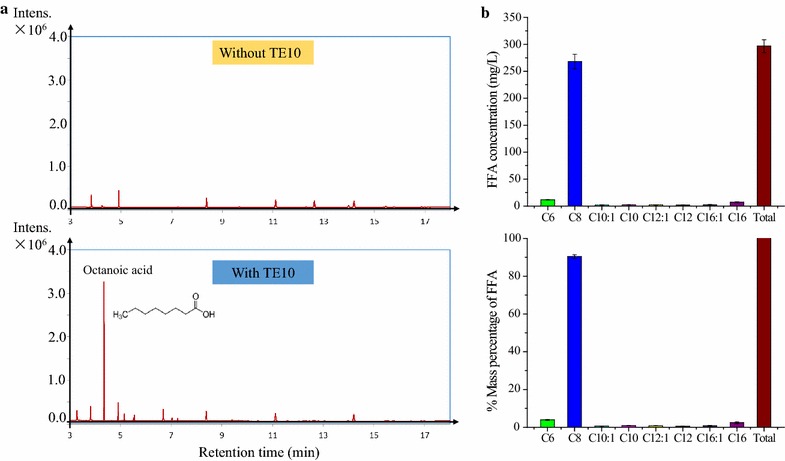
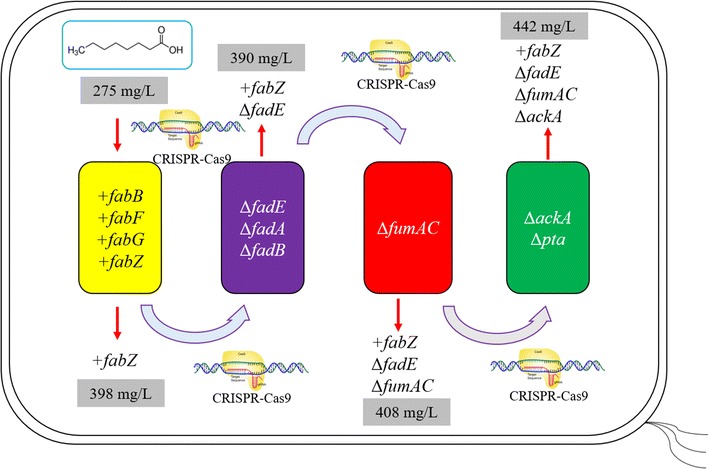
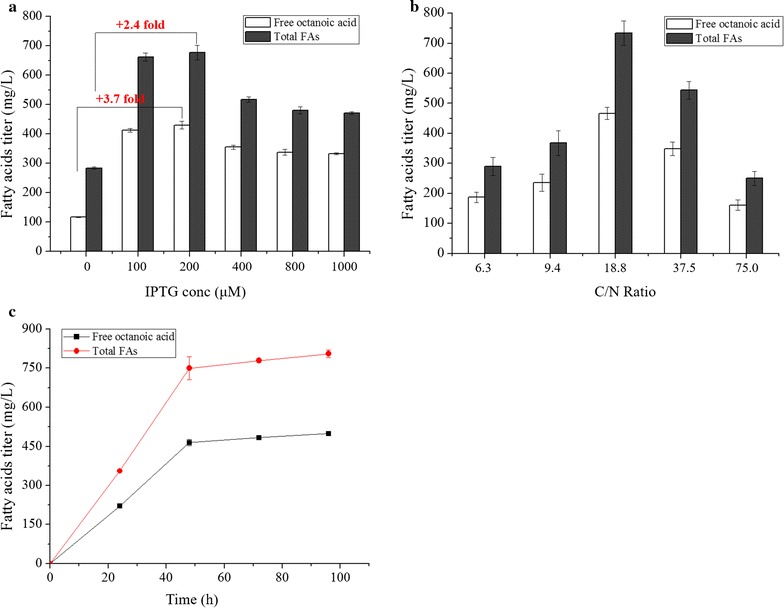
First, a customized OptForce methodology was run to predict a set of four genetic interventions required for production of octanoic acid at 90% of the theoretical yield. Subsequently, all the ten candidate proteins associated with the predicted interventions were regulated individually, as well as in contrast to the combination of interventions as suggested by the OptForce strategy. Among these enzymes, increased production of 3-hydroxy-acyl-ACP dehydratase (FabZ) resulted in the highest increase (+ 45%) in octanoic acid titer. But importantly, the combinatorial application of FabZ with the other interventions as suggested by OptForce further improved octanoic acid production, resulting in a high octanoic acid-producing strain + Δ Δ Δ (TE10) (+ 61%). Optimization of expression, medium pH, and C:N ratio resulted in the identified strain producing 500 mg/L of C8 and 805 mg/L of total FAs, an 82 and 155% increase relative to wild-type MG1655 (TE10) in shake flasks. The best engineered strain produced with high selectivity (> 70%) and extracellularly (> 90%) up to 1 g/L free octanoic acid in minimal medium fed-batch culture.
This work demonstrates the effectiveness of integration of computational strain design and experimental characterization as a starting point in rewiring metabolism for octanoic acid production. This result in conjunction with the results of other studies using OptForce in strain design demonstrates that this strategy may be also applicable to engineering for other customized bioproducts.
作为一种用途广泛的平台化学品,构建用于从生物可再生原料生产游离辛酸的微生物催化剂是现有石油基方法的一种有前景的替代方案。然而,生物生产策略受到固有脂肪酸生物合成能力低下的限制。在本研究中,采用综合计算和实验方法相结合的方式来操纵现有的代谢网络,目的是提高生物辛酸的产量。
首先,运行定制的OptForce方法来预测以90%的理论产量生产辛酸所需的一组四个基因干预措施。随后,对与预测干预措施相关的所有十种候选蛋白质进行了单独调节,以及与OptForce策略建议的干预措施组合进行对比调节。在这些酶中,3-羟基酰基-ACP脱水酶(FabZ)产量的增加导致辛酸滴度增加最多(+45%)。但重要的是,将FabZ与OptForce建议的其他干预措施联合应用进一步提高了辛酸产量,产生了高产辛酸菌株+ΔΔΔ(TE10)(+61%)。对表达、培养基pH值和碳氮比进行优化后,所鉴定的菌株在摇瓶中产生了500mg/L的C8和805mg/L的总脂肪酸,相对于野生型MG1655(TE10)分别增加了82%和155%。最佳工程菌株在最小培养基补料分批培养中以高选择性(>70%)和细胞外(>90%)产生高达1g/L的游离辛酸。
这项工作证明了将计算菌株设计与实验表征相结合作为重新构建代谢以生产辛酸的起点的有效性。这一结果与其他在菌株设计中使用OptForce的研究结果相结合表明,该策略也可能适用于其他定制生物产品的工程设计。