Ahmed Husnain, Destgeer Ghulam, Park Jinsoo, Jung Jin Ho, Sung Hyung Jin
Department of Mechanical Engineering KAIST Daejeon 34141 South Korea.
Adv Sci (Weinh). 2017 Dec 22;5(2):1700285. doi: 10.1002/advs.201700285. eCollection 2018 Feb.
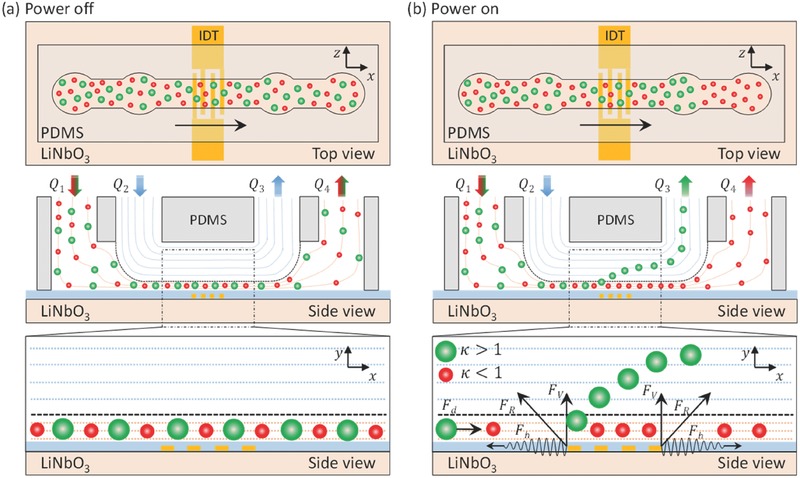
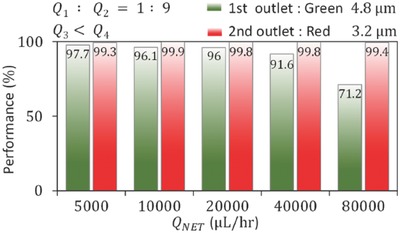
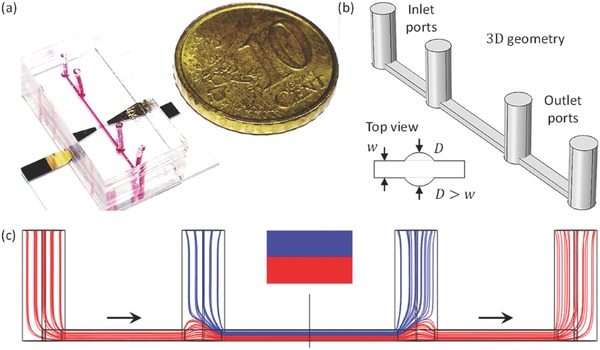
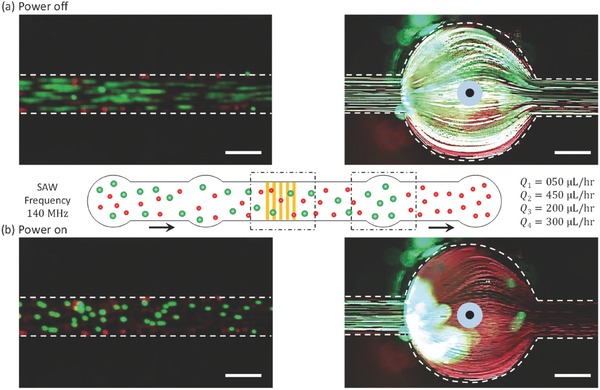
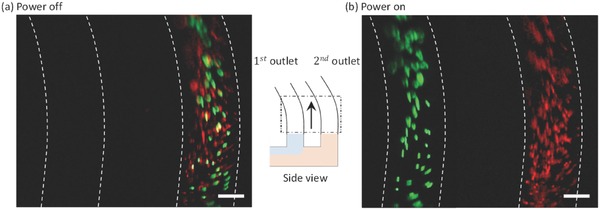
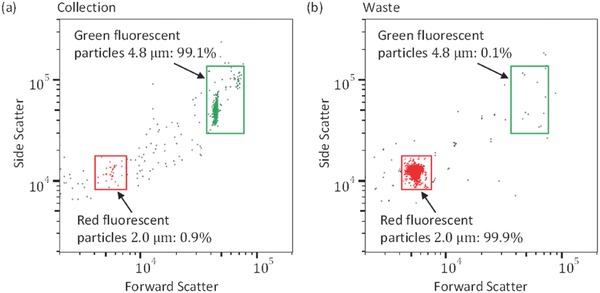
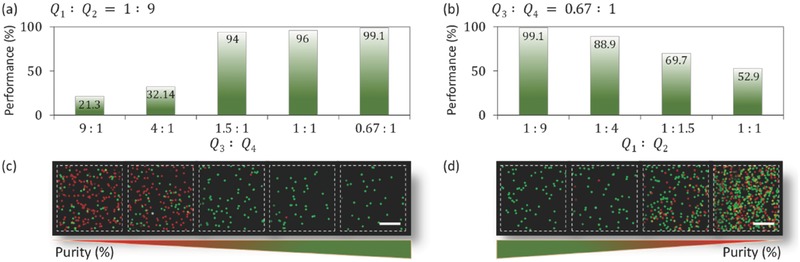
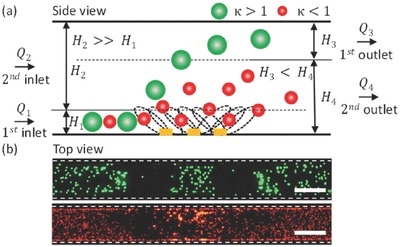
A particle suspended in a fluid within a microfluidic channel experiences a direct acoustic radiation force (ARF) when traveling surface acoustic waves (TSAWs) couple with the fluid at the Rayleigh angle, thus producing two components of the ARF. Most SAW-based microfluidic devices rely on the horizontal component of the ARF to migrate prefocused particles laterally across a microchannel width. Although the magnitude of the vertical component of the ARF is more than twice the magnitude of the horizontal component, it is long ignored due to polydimethylsiloxane (PDMS) microchannel fabrication limitations and difficulties in particle focusing along the vertical direction. In the present work, a single-layered PDMS microfluidic chip is devised for hydrodynamically focusing particles in the vertical plane while explicitly taking advantage of the horizontal ARF component to slow down the selected particles and the stronger vertical ARF component to push the particles in the upward direction to realize continuous particle separation. The proposed particle separation device offers high-throughput operation with purity >97% and recovery rate >99%. It is simple in its fabrication and versatile due to the single-layered microchannel design, combined with vertical hydrodynamic focusing and the use of both the horizontal and vertical components of the ARF.
当在微流体通道内的流体中悬浮的粒子与以瑞利角与流体耦合的行进表面声波(TSAW)相互作用时,该粒子会受到直接声辐射力(ARF),从而产生ARF的两个分量。大多数基于表面声波的微流体装置依靠ARF的水平分量将预聚焦的粒子横向迁移穿过微通道宽度。尽管ARF垂直分量的大小是水平分量大小的两倍多,但由于聚二甲基硅氧烷(PDMS)微通道制造的局限性以及沿垂直方向进行粒子聚焦的困难,它长期以来一直被忽视。在本工作中,设计了一种单层PDMS微流体芯片,用于在垂直平面内通过流体动力学聚焦粒子,同时明确利用水平ARF分量来减慢选定粒子的速度,并利用更强的垂直ARF分量将粒子向上推动,以实现连续的粒子分离。所提出的粒子分离装置具有高通量操作,纯度>97%,回收率>99%。由于采用单层微通道设计,结合垂直流体动力学聚焦以及ARF水平和垂直分量的使用,其制造简单且用途广泛。