Javaheri Behzad, Caetano-Silva Soraia P, Kanakis Ioannis, Bou-Gharios George, Pitsillides Andrew A
Skeletal Biology Group, Comparative Biomedical Sciences, The Royal Veterinary College, London, United Kingdom.
Institute of Ageing and Chronic Disease, University of Liverpool, Liverpool, United Kingdom.
Front Bioeng Biotechnol. 2018 Mar 21;6:28. doi: 10.3389/fbioe.2018.00028. eCollection 2018.
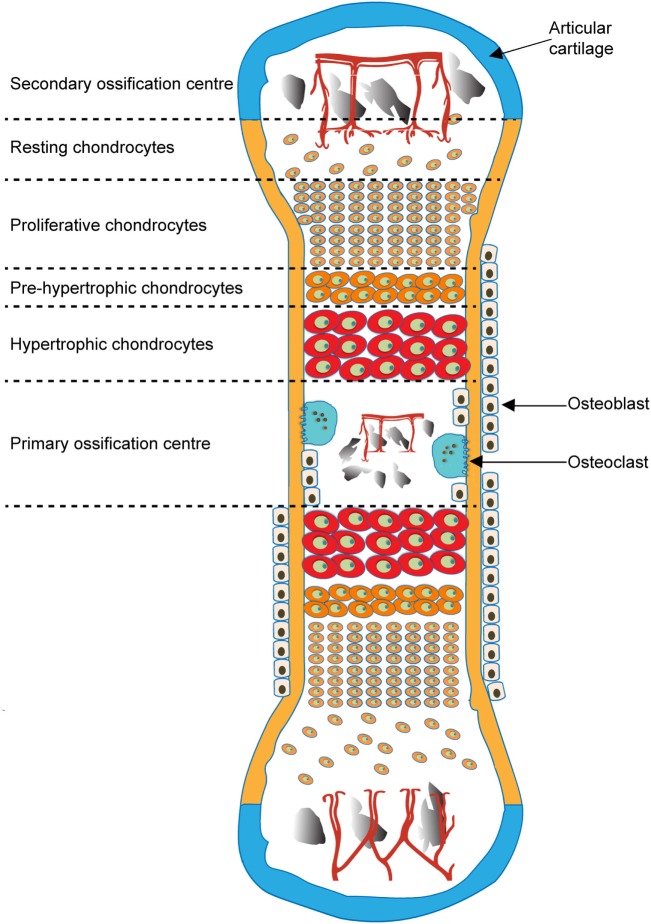
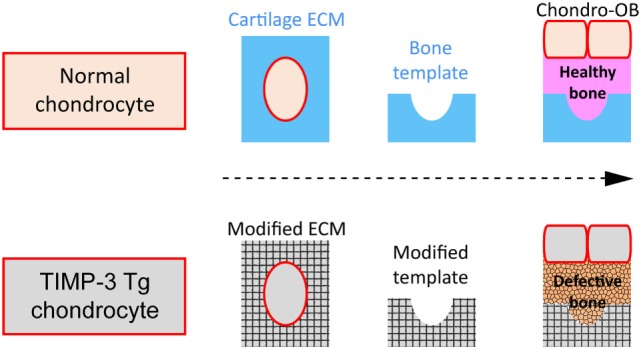
Endochondral ossification (EO), by which long bones of the axial skeleton form, is a tightly regulated process involving chondrocyte maturation with successive stages of proliferation, maturation, and hypertrophy, accompanied by cartilage matrix synthesis, calcification, and angiogenesis, followed by osteoblast-mediated ossification. This developmental sequence reappears during fracture repair and in osteoarthritic etiopathology. These similarities suggest that EO, and the cells involved, are of great clinical importance for bone regeneration as it could provide novel targeted approaches to increase specific signaling to promote fracture healing, and if regulated appropriately in the treatment of osteoarthritis. The long-held accepted dogma states that hypertrophic chondrocytes are terminally differentiated and will eventually undergo apoptosis. In this mini review, we will explore recent evidence from experiments that revisit the idea that hypertrophic chondrocytes have pluripotent capacity and may instead transdifferentiate into a specific sub-population of osteoblast cells. There are multiple lines of evidence, including our own, showing that local, selective alterations in cartilage extracellular matrix (ECM) remodeling also indelibly alter bone quality. This would be consistent with the hypothesis that osteoblast behavior in long bones is regulated by a combination of their lineage origins and the epigenetic effects of chondrocyte-derived ECM which they encounter during their recruitment. Further exploration of these processes could help to unlock potential novel targets for bone repair and regeneration and in the treatment of osteoarthritis.
软骨内成骨(EO)是轴骨骼长骨形成的过程,是一个严格调控的过程,涉及软骨细胞成熟以及增殖、成熟和肥大的连续阶段,伴随着软骨基质合成、钙化和血管生成,随后是成骨细胞介导的骨化。这种发育序列在骨折修复和骨关节炎病因学中会再次出现。这些相似性表明,EO及其相关细胞对骨再生具有重要临床意义,因为它可以提供新的靶向方法来增强特定信号以促进骨折愈合,并且在骨关节炎治疗中如果调控得当也有作用。长期以来被广泛接受的观点认为,肥大软骨细胞是终末分化的,最终会发生凋亡。在这篇小型综述中,我们将探讨近期实验的证据,这些证据重新审视了肥大软骨细胞具有多能性这一观点,即肥大软骨细胞可能会转分化为特定亚群的成骨细胞。有多项证据,包括我们自己的研究,表明软骨细胞外基质(ECM)重塑的局部、选择性改变也会不可磨灭地改变骨质量。这与以下假设一致,即长骨中成骨细胞的行为受其谱系起源以及它们在募集过程中遇到的软骨细胞衍生ECM的表观遗传效应的共同调节。对这些过程的进一步探索可能有助于找到骨修复和再生以及骨关节炎治疗的潜在新靶点。