Department of Pediatrics, University Hospital Tulln, Karl-Landsteiner University of Health Sciences, Tulln, Austria.
Department of Anaesthesia, General Intensive Care and Pain Medicine, Medical University of Vienna, Vienna, Austria.
Eur J Pediatr. 2018 Jun;177(6):871-878. doi: 10.1007/s00431-018-3134-x. Epub 2018 Apr 5.
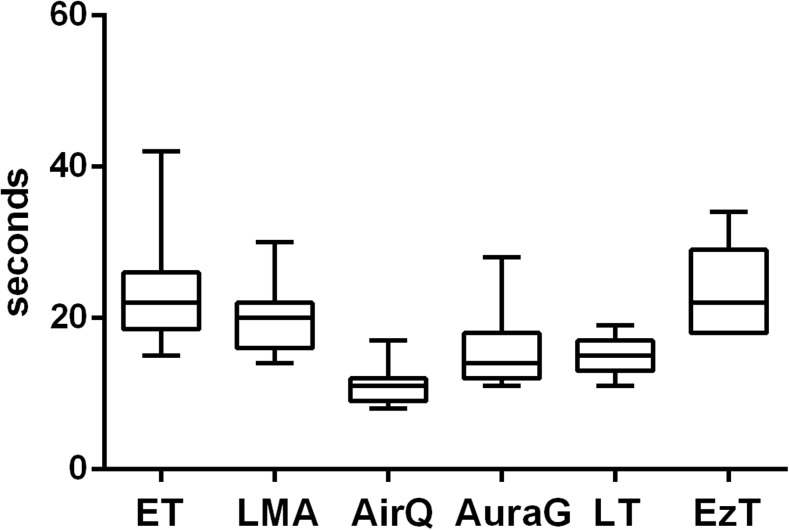
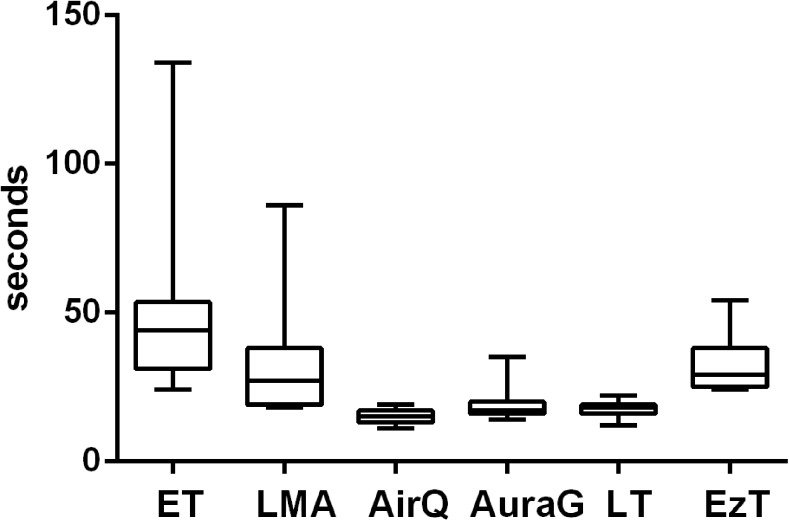
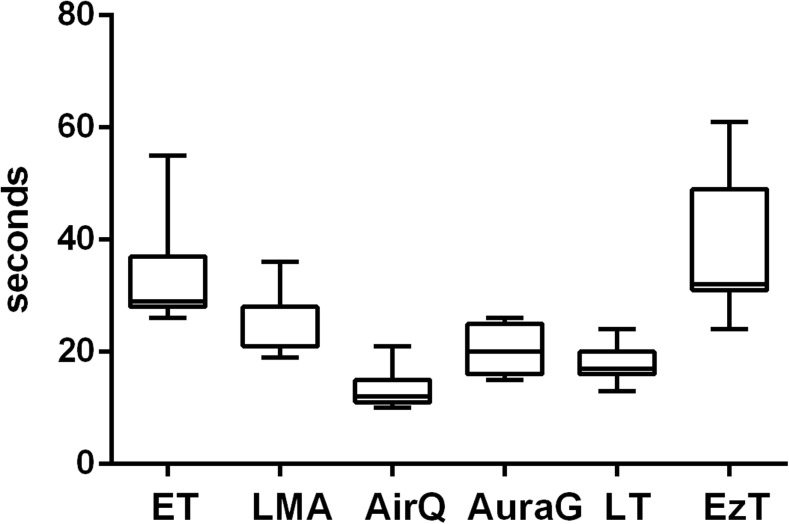
Supraglottic airway devices (SADs) have been introduced to assist medical professionals in emergency situations with limited experience in securing airways via conventional endotracheal intubation (ETI). Literature on the use of SADs for securing an airway during pediatric critical settings is scarce, and there is a lack of studies comparing different SADs to each other and to conventional ETI. We conducted a study comparing five different SADs to ETI with regard to success rate, time to first ventilation, and personal rating in a pediatric manikin under simulated physiologic and pathologic airway conditions in 41 pediatricians of varying clinical experience and training. Only the AirQ, AuraG, and laryngeal tube (LT) were inserted within 30 s correctly by all participants under physiologic conditions. In tongue edema (TE), AirQ and LT had the highest success rate. In limited mobility of the cervical spine (CS), AirQ, AuraG, and LT again all were inserted within 30 s. In a multivariate analysis, factors influencing the success were experience with the respective device and level of medical education. Under TE conditions, there were significantly longer insertion times for the ETI, laryngeal mask airway (LMA), and EzT. Under CS conditions, there were significantly longer insertion times for the ETI, LMA, LT, and EzT. A multivariate analysis showed experience with the respective device to be the only factor of influence on time to first ventilation.
LT, AuraG, and AirQ were superior in providing fast and effective ventilation during simulated difficult airway situations in pediatricians. What is Known: • Supraglottic airway devices have been introduced for medical professionals who lack experience for managing difficult airway situations. • A variety of these devices have been developed so far, but not compared to each other yet. What is New: • We compared five different supraglottic airway devices with regard to success rate, time to first ventilation, and personal rating in a pediatric manikin under simulated physiologic and pathologic airway conditions. • Laryngeal tube, AuraG, and AirQ were superior in providing fast and effective ventilation during simulated difficult airway situations in pediatricians with varying clinical experience.
已引入声门上气道装置 (SAD) 以协助医疗专业人员在通过传统气管内插管 (ETI) 确保气道方面经验有限的紧急情况下进行操作。关于在儿科危急情况下使用 SAD 来确保气道的文献很少,并且缺乏对不同 SAD 之间以及与传统 ETI 之间进行比较的研究。我们在 41 名不同临床经验和培训水平的儿科医生的小儿模型中,在模拟生理和病理气道条件下,比较了五种不同的 SAD 与 ETI 的成功率、首次通气时间和个人评分。只有在生理条件下,所有参与者都在 30 秒内正确插入 AirQ、AuraG 和喉管 (LT)。在舌肿胀 (TE) 中,AirQ 和 LT 的成功率最高。在颈椎活动度受限 (CS) 中,AirQ、AuraG 和 LT 再次在 30 秒内插入。在多变量分析中,影响成功率的因素是对各自设备的经验和医学教育水平。在 TE 条件下,ETI、喉罩气道 (LMA) 和 EzT 的插入时间明显更长。在 CS 条件下,ETI、LMA、LT 和 EzT 的插入时间明显更长。多变量分析显示,首次通气时间的唯一影响因素是对各自设备的经验。
在小儿模拟困难气道情况下,LT、AuraG 和 AirQ 在提供快速有效的通气方面表现优越。 已知: • 已引入声门上气道装置,供缺乏管理困难气道情况经验的医疗专业人员使用。 • 迄今为止已经开发了多种此类设备,但尚未对其进行相互比较。 新内容: • 我们在小儿模拟生理和病理气道条件下的模型中,比较了五种不同的声门上气道装置在成功率、首次通气时间和个人评分方面的差异。 • 在不同临床经验的儿科医生中,LT、AuraG 和 AirQ 在模拟困难气道情况下提供快速有效的通气方面表现优越。