Department of Nutrition, Harvard T.H. Chan School of Public Health, Room 371, Bldg. 2, 665 Huntington Avenue, Boston, MA, 02115, USA.
Department of Epidemiology and Biostatistics, Jiangsu Key Lab of Cancer Biomarkers, Prevention and Treatment, Collaborative Innovation Center for Cancer Personalized Medicine, School of Public Health, Nanjing Medical University, Nanjing, China.
Eur J Epidemiol. 2018 May;33(5):485-495. doi: 10.1007/s10654-018-0382-z. Epub 2018 Apr 4.
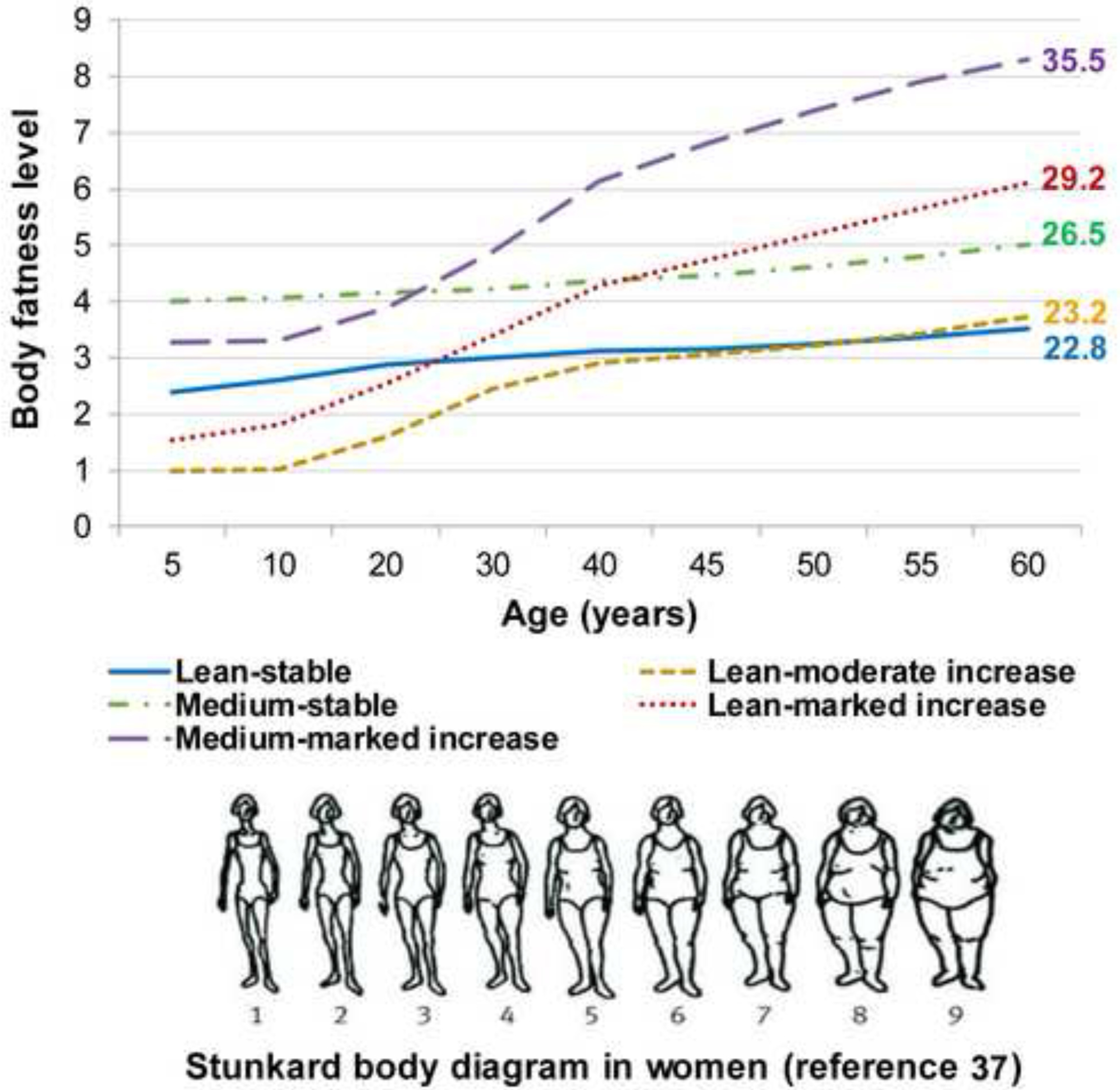
Adiposity may cause adverse health outcomes by increasing oxidative stress and systemic inflammation, which can be reflected by altered telomere length (TL) and mitochondrial DNA copy number (mtCN) in peripheral blood leukocytes. However, little is known about the influence of lifetime adiposity on TL and mtCN in later life. This study was performed to investigate the associations of lifetime adiposity with leukocyte TL and mtCN in 9613 participants from the Nurses' Health Study. A group-based trajectory modelling approach was used to create trajectories of body shape from age 5 through 60 years, and a genetic risk score (GRS) was created based on 97 known adiposity susceptibility variants. Associations of body shape trajectories and GRS with dichotomized TL and mtCN were assessed by logistic regression models. After adjustment for lifestyle and dietary factors, compared with the lean-stable group, the lean-marked increase group had higher odds of having below-median TL (OR = 1.18, 95% CI 1.04, 1.35; P = 0.01), and the medium-marked increase group had higher odds of having below-median mtCN (OR = 1.28, 95% CI 1.00, 1.64; P = 0.047). There was a suggestive trend toward lower mtCN across the GRS quartiles (P for trend = 0.07). In conclusion, telomere attrition may be accelerated by marked weight gain in middle life, whereas mtCN is likely to be reduced persistently by adiposity over the life course. The findings indicate the importance of lifetime weight management to preserve functional telomeres and mitochondria.
肥胖可能通过增加氧化应激和全身炎症导致不良健康后果,这可以通过外周血白细胞中端粒长度(TL)和线粒体 DNA 拷贝数(mtCN)的改变来反映。然而,人们对终生肥胖对晚年 TL 和 mtCN 的影响知之甚少。本研究旨在调查一生中肥胖与护士健康研究 9613 名参与者白细胞 TL 和 mtCN 的关系。采用基于群组的轨迹建模方法从 5 岁到 60 岁创建体型轨迹,并基于 97 个已知的肥胖易感性变体创建遗传风险评分(GRS)。通过逻辑回归模型评估体型轨迹和 GRS 与 TL 和 mtCN 的二分法之间的关联。在调整生活方式和饮食因素后,与瘦稳定组相比,瘦明显增加组具有较低中位数 TL 的可能性更高(OR=1.18,95%CI 1.04,1.35;P=0.01),而中明显增加组具有较低中位数 mtCN 的可能性更高(OR=1.28,95%CI 1.00,1.64;P=0.047)。随着 GRS 四分位数的增加,mtCN 呈下降趋势(P 趋势=0.07)。综上所述,中年体重明显增加可能加速端粒损耗,而肥胖可能持续降低 mtCN。研究结果表明,终生体重管理对于维持功能端粒和线粒体具有重要意义。