Department of General Surgery, The Fourth Affiliated Hospital, Zhejiang University School of Medicine, Yiwu, Zhejiang 322000, P.R. China.
Mol Med Rep. 2018 Jun;17(6):7672-7682. doi: 10.3892/mmr.2018.8860. Epub 2018 Apr 5.
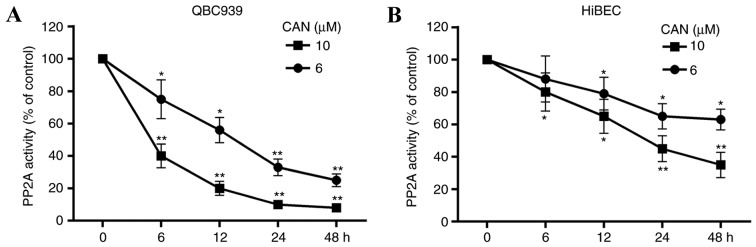
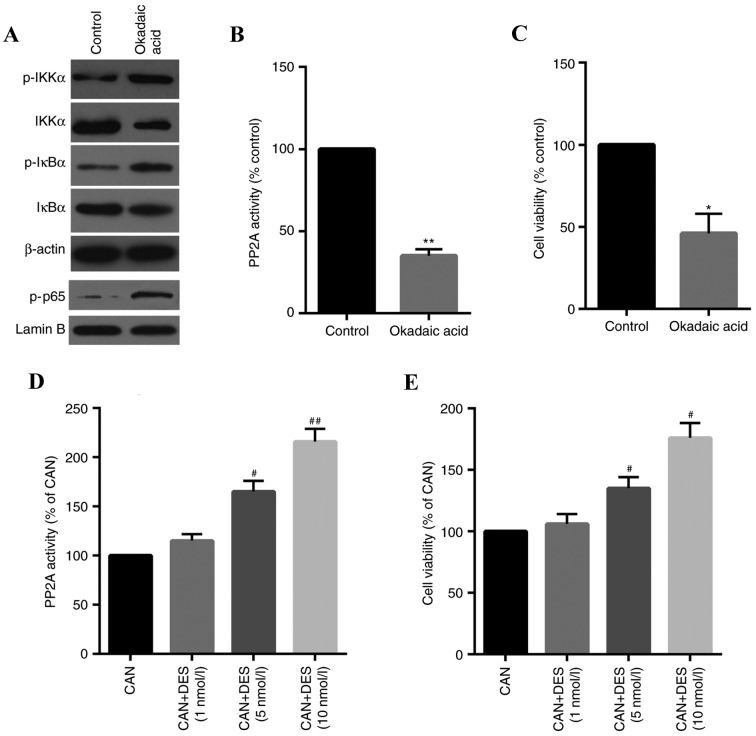
Cantharidin (CAN), a potent inhibitor of serine/threonine‑protein phosphatase 2A (PP2A), is widely used in clinical practice, particularly in the treatment of advanced cancer due to its specific action on these types of cancer. In the present study, the inhibitory effect of CAN was examined in two cholangiocarcinoma cell lines (QBC939 and Hucc‑t1). Following treatment with CAN, cell viability was effectively reduced in QBC939 and Hucc‑t1 cells and normal human intrahepatic biliary epithelial cells. However, a slight increase in reactive oxygen species levels in QBC939 cells treated with CAN was observed post‑treatment. CAN significantly inhibited cell migration and invasion in a dose‑dependent manner. Western blot analysis demonstrated that the nuclear factor‑κB (NF‑κB) pathway was stimulated by CAN, which was confirmed by the upregulated phosphorylation levels of inhibitor of NF‑κB kinase subunit α (IKKα) and NF‑κB inhibitor α (IκBα) in cells, and an increased NF‑κB p65 subunit level in the nucleus. The expression levels of 72 kDa type IV collagenase (MMP2) and matrix metalloproteinase 9 (MMP9) were downregulated by CAN. Notably, there was a negative association between MMP2 and MMP9 expression levels, and NF‑κB p65, although NF‑κB p65 regulates the expression of MMP2 and MMP9 and has a positive association with these proteins in various types of cancer. Notably, it was observed that CAN exerted specific inhibition on PP2A activity and thereby resulted in the activation of the IKKα/IκBα/NF‑κB pathway. Therefore, CAN‑induced cell inhibition maybe partially dependent on the activation of the IKKα/IκBα/NF‑κB pathway. In conclusion, it was demonstrated that CAN selectively and effectively inhibited cholangiocarcinoma cell migration and invasion. The present study may provide a novel insight into the use of CAN as a therapeutic candidate in the treatment of cholangiocarcinoma.
斑蝥素 (CAN) 是丝氨酸/苏氨酸蛋白磷酸酶 2A (PP2A) 的有效抑制剂,由于其对这些类型癌症的特定作用,已广泛应用于临床实践,特别是在治疗晚期癌症方面。在本研究中,研究人员在两种胆管癌细胞系 (QBC939 和 Hucc-t1) 中检测了 CAN 的抑制作用。用 CAN 处理后,QBC939 和 Hucc-t1 细胞及正常人类肝内胆管上皮细胞的活力均显著降低,但 CAN 处理后的 QBC939 细胞中的活性氧水平略有升高。CAN 以剂量依赖性方式显著抑制细胞迁移和侵袭。Western blot 分析表明,CAN 刺激核因子-κB (NF-κB) 通路,这通过细胞中抑制剂κB 激酶亚单位α (IKKα) 和 NF-κB 抑制剂α (IκBα) 的磷酸化水平上调以及核中 NF-κB p65 亚基水平的增加得到证实。72 kDa 型 IV 胶原酶 (MMP2) 和基质金属蛋白酶 9 (MMP9) 的表达水平被 CAN 下调。值得注意的是,尽管 MMP2 和 MMP9 的表达水平与 NF-κB p65 呈负相关,但 NF-κB p65 调节 MMP2 和 MMP9 的表达,并与各种类型癌症中的这些蛋白呈正相关。值得注意的是,观察到 CAN 对 PP2A 活性具有特异性抑制作用,从而导致 IKKα/IκBα/NF-κB 通路的激活。因此,CAN 诱导的细胞抑制可能部分依赖于 IKKα/IκBα/NF-κB 通路的激活。综上所述,CAN 选择性且有效地抑制胆管癌细胞的迁移和侵袭。本研究可能为将 CAN 用作胆管癌治疗的候选药物提供新的见解。