Center for Complementary and Integrative Medicine, Division of Rheumatology, Tufts Medical Center, 800 Washington St., #406, Boston, MA 02111; Center for Treatment Comparison and Integrative Analysis, Division of Rheumatology, Tufts Medical Center, Boston, MA.
Center for Treatment Comparison and Integrative Analysis, Division of Rheumatology, Tufts Medical Center, Boston, MA.
Semin Arthritis Rheum. 2018 Dec;48(3):416-429. doi: 10.1016/j.semarthrit.2018.03.001. Epub 2018 Mar 10.
The unfavorable safety profiles of commonly prescribed knee osteoarthritis (OA) treatments have led clinicians and patients to seek safer alternatives. Research has suggested that curcuminoid and boswellia formulations could moderate key inflammatory pathways that are associated with worsening symptoms and disease progression. We conducted a systematic review and meta-analysis to assess the efficacy and safety of these treatments vs. placebo or NSAIDs for knee OA.
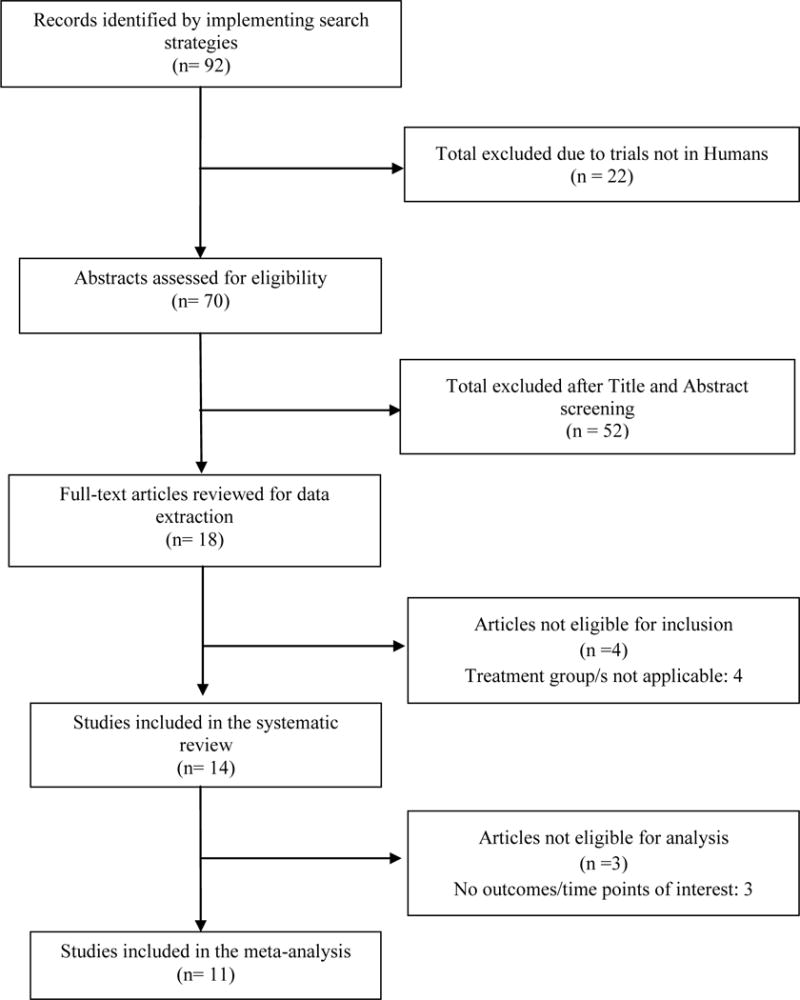
We searched Medline, EMBASE, Google Scholar, Web of Science and the Cochrane database from inception to February 21, 2018. We also hand searched reference lists and reviewed conference proceedings. We included randomized clinical trials (RCTs) comparing curcuminoid or boswellia formulations with placebo or NSAIDs for knee OA. We calculated standardized mean differences (SMD) or risk ratios (RR) for all relevant outcomes. Meta-analyses were conducted using random effects models. Heterogeneity was assessed using the I statistic.
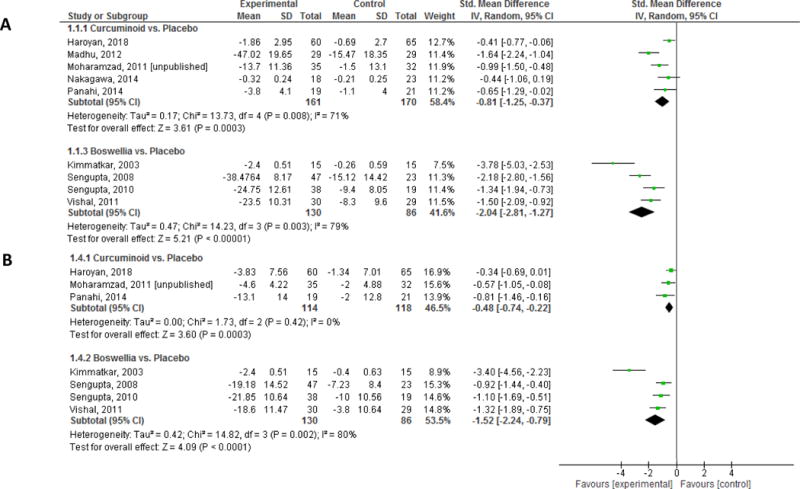
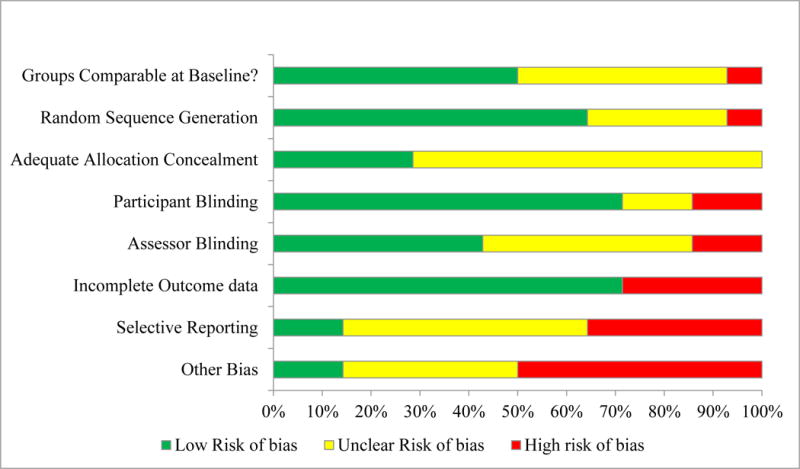
Eleven RCTs (N = 1009) were eligible for analysis. Study quality was low overall, and most included RCTs were conducted on fewer than 100 participants. Both curcuminoid and boswellia formulations were statistically significantly more effective than placebo for pain relief and functional improvement. There were no significant differences between curcuminoids or boswellia and placebo in safety outcomes. Curcuminoids showed no statistically significant differences in efficacy outcomes compared to NSAIDs; patients receiving curcuminoids were significantly less likely to experience gastrointestinal adverse events. No RCTs compared boswellia against approved NSAIDs.
The results of our study suggest that curcuminoid and boswellia formulations could be a valuable addition to the knee OA treatment regimens by relieving symptoms while reducing safety risks. The current body of evidence is not adequate in size or quality to make any meaningful clinical practice recommendations. Further research through large, high quality RCTs probably investigating the synergistic effect of these products with other OA treatments is warranted.
常用的膝关节骨关节炎(OA)治疗方法存在不利的安全性,这促使临床医生和患者寻求更安全的替代方法。有研究表明,姜黄素和乳香酸制剂可能调节与症状恶化和疾病进展相关的关键炎症途径。我们进行了一项系统评价和荟萃分析,以评估这些治疗方法与安慰剂或 NSAIDs 治疗膝关节 OA 的疗效和安全性。
我们检索了 Medline、EMBASE、Google Scholar、Web of Science 和 Cochrane 数据库,检索时间截至 2018 年 2 月 21 日。我们还手动检索了参考文献列表和会议论文集。我们纳入了比较姜黄素或乳香酸制剂与安慰剂或 NSAIDs 治疗膝关节 OA 的随机临床试验(RCT)。我们计算了所有相关结局的标准化均数差(SMD)或风险比(RR)。使用随机效应模型进行荟萃分析。使用 I ² 评估异质性。
11 项 RCT(N = 1009)符合分析标准。总体而言,研究质量较低,大多数纳入的 RCT 纳入的参与者少于 100 人。姜黄素和乳香酸制剂在缓解疼痛和改善功能方面均显著优于安慰剂。姜黄素或乳香酸与安慰剂在安全性结局方面无显著差异。与 NSAIDs 相比,姜黄素在疗效结局方面无显著差异;接受姜黄素的患者发生胃肠道不良事件的可能性显著降低。没有 RCT 比较乳香酸与已批准的 NSAIDs。
我们的研究结果表明,姜黄素和乳香酸制剂可能是膝关节 OA 治疗方案的有价值的补充,可缓解症状,同时降低安全性风险。目前的证据在规模或质量上都不足以提出任何有意义的临床实践建议。需要通过大型、高质量的 RCT 进一步研究这些产品与其他 OA 治疗方法的协同作用。