Pat McPherson Centre for Pharmacogenetics and Pharmacogenomics, University of Dundee School of Medicine, Ninewells Hospital and Medical School, Dundee, DD1 9SY, UK.
Ninewells Hospital and Medical School, University of Dundee, Dundee, UK.
Diabetologia. 2018 Jun;61(6):1344-1353. doi: 10.1007/s00125-018-4601-7. Epub 2018 Apr 6.
AIMS/HYPOTHESIS: The aim of the study was to examine the association between lipoprotein-associated phospholipase A (Lp-PLA) activity levels and incident diabetic retinopathy and change in retinopathy grade.
This was a cohort study of diabetic participants with serum collected at baseline and routinely collected diabetic retinal screening data. Participants with type 2 diabetes from the GoDARTS (Genetics of Diabetes Audit and Research in Tayside Scotland) cohort were used. This cohort is composed of individuals of white Scottish ancestry from the Tayside region of Scotland. Survival analysis accounting for informative censoring by modelling death as a competing risk was performed for the development of incident diabetic retinopathy from a disease-free state in a 3 year follow-up period (n = 1364) by stratified Lp-PLA activity levels (in quartiles). The same analysis was performed for transitions to more severe grades.
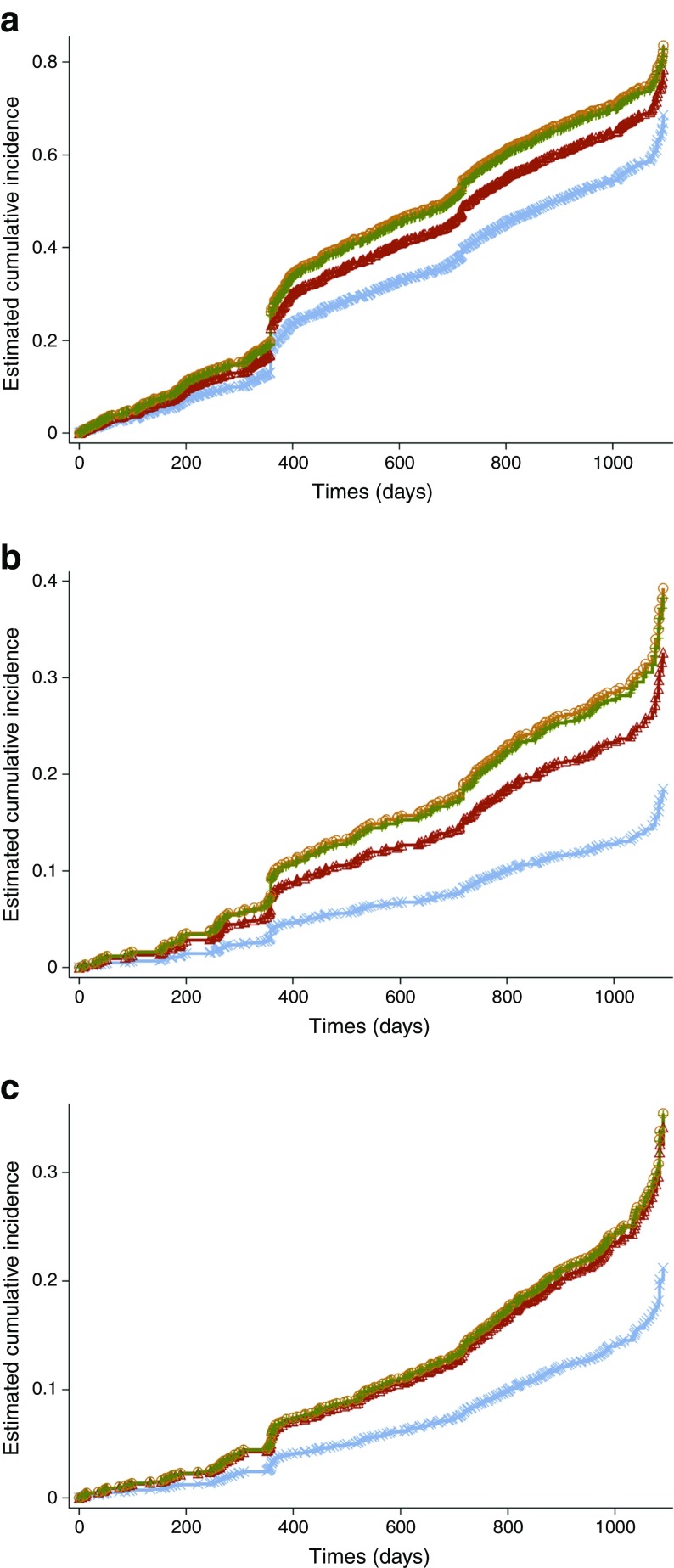
The hazard of developing incident diabetic retinopathy was 2.08 times higher (95% CI 1.64, 2.63) for the highest quartile of Lp-PLA activity compared with the lowest. Higher Lp-PLA activity levels were associated with a significantly increased risk for transitions to all grades. The hazards of developing observable (or more severe) and referable (or more severe) retinopathy were 2.82 (95% CI 1.71, 4.65) and 1.87 (95% CI 1.26, 2.77) times higher for the highest quartile of Lp-PLA activity compared with the lowest, respectively.
CONCLUSIONS/INTERPRETATION: Higher Lp-PLA levels are associated with increased risk of death and the development of incident diabetic retinopathy, as well as transitions to more severe grades of diabetic retinopathy. These associations are independent of calculated LDL-cholesterol and other traditional risk factors. Further, this biomarker study shows that the association is temporally sensitive to the proximity of the event to measurement of Lp-PLA
目的/假设:本研究旨在探讨脂蛋白相关磷脂酶 A(Lp-PLA)活性水平与糖尿病视网膜病变的发生和病变程度变化之间的关系。
这是一项队列研究,纳入了基线时采集血清并常规收集糖尿病视网膜筛查数据的糖尿病患者。该研究使用了来自 GoDARTS(苏格兰泰赛德遗传学糖尿病审计和研究)队列的 2 型糖尿病患者。该队列由苏格兰泰赛德地区的白种苏格兰血统个体组成。在 3 年的随访期间(n=1364),对无糖尿病视网膜病变的个体进行生存分析,通过分层 Lp-PLA 活性水平(四分位数)来评估 3 年内新发糖尿病视网膜病变的发病情况,并将死亡视为竞争风险进行信息性 censoring 建模。对更严重的病变程度的转变也进行了同样的分析。
与最低四分位组相比,Lp-PLA 活性最高四分位组发生新发糖尿病视网膜病变的风险高 2.08 倍(95%CI 1.64, 2.63)。较高的 Lp-PLA 活性水平与所有病变程度转变的风险显著增加相关。Lp-PLA 活性最高四分位组发展为可观察(或更严重)和可转诊(或更严重)视网膜病变的风险分别是最低四分位组的 2.82 倍(95%CI 1.71, 4.65)和 1.87 倍(95%CI 1.26, 2.77)。
结论/解释:较高的 Lp-PLA 水平与死亡风险增加以及糖尿病视网膜病变的发生和更严重的病变程度转变相关。这些关联独立于计算的 LDL 胆固醇和其他传统危险因素。此外,这项生物标志物研究表明,这种关联对 Lp-PLA 测量与事件之间的时间敏感性敏感。