Musculoskeletal Research Unit, Translational Health Sciences, Bristol Medical School, Southmead Hospital, University of Bristol, Southmead Road, Bristol, BS10 5NB, UK.
National Institute for Health Research Bristol Biomedical Research Centre, University of Bristol, Bristol, UK.
Eur J Epidemiol. 2018 Oct;33(10):933-946. doi: 10.1007/s10654-018-0377-9. Epub 2018 Apr 5.
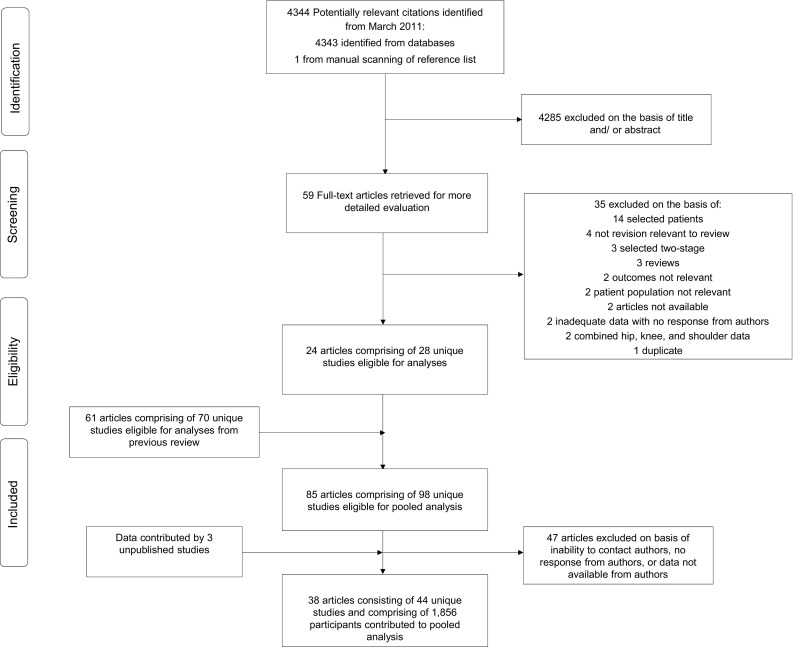
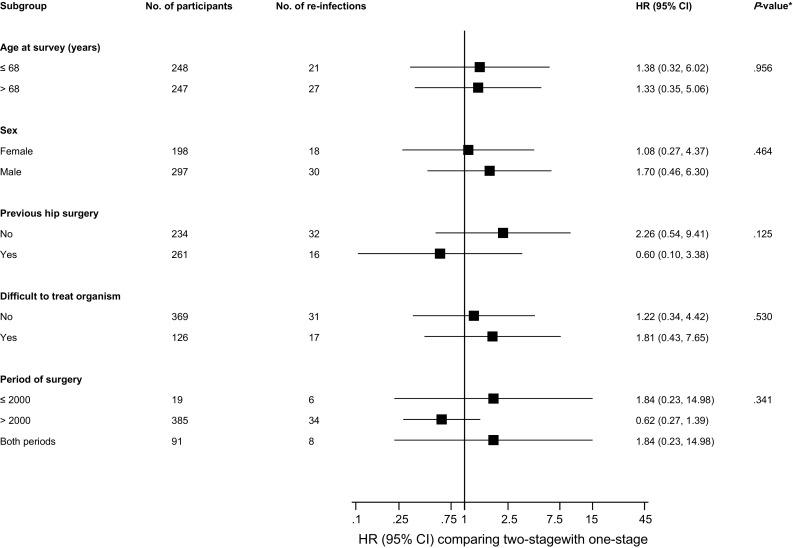
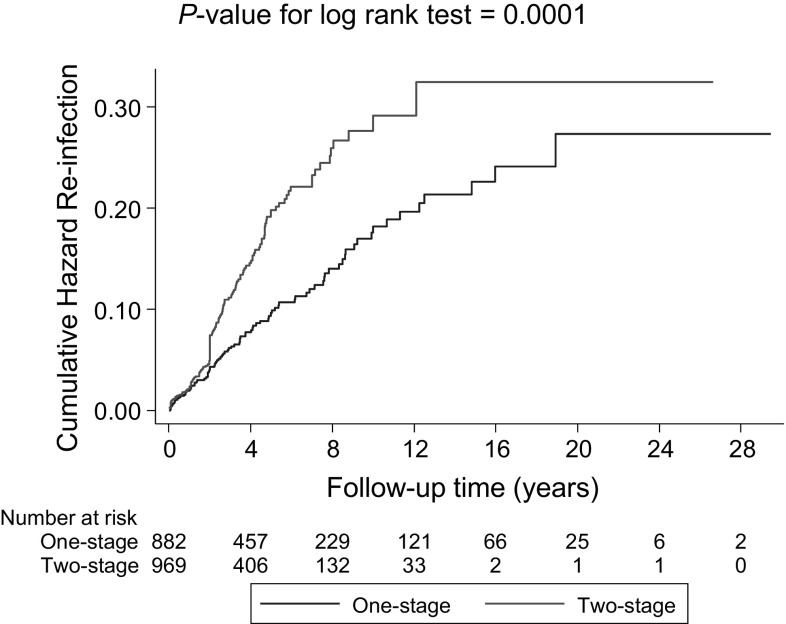
One-stage and two-stage revision strategies are the two main options for treating established chronic peri-prosthetic joint infection (PJI) of the hip; however, there is uncertainty regarding which is the best treatment option. We aimed to compare the risk of re-infection between the two revision strategies using pooled individual participant data (IPD). Observational cohort studies with PJI of the hip treated exclusively by one- or two-stage revision and reporting re-infection outcomes were retrieved by searching MEDLINE, EMBASE, Web of Science, The Cochrane Library, and the WHO International Clinical Trials Registry Platform; as well as email contact with investigators. We analysed IPD of 1856 participants with PJI of the hip from 44 cohorts across four continents. The primary outcome was re-infection (recurrence of infection by the same organism(s) and/or re-infection with a new organism(s)). Hazard ratios (HRs) for re-infection were calculated using Cox proportional frailty hazards models. After a median follow-up of 3.7 years, 222 re-infections were recorded. Re-infection rates per 1000 person-years of follow-up were 16.8 (95% CI 13.6-20.7) and 32.3 (95% CI 27.3-38.3) for one-stage and two-stage strategies respectively. The age- and sex-adjusted HR of re-infection for two-stage revision was 1.70 (0.58-5.00) when compared with one-stage revision. The association remained consistently absent after further adjustment for potential confounders. The HRs did not vary importantly in clinically relevant subgroups. Analysis of pooled individual patient data suggest that a one-stage revision strategy may be as effective as a two-stage revision strategy in treating PJI of the hip.
一期和两期翻修策略是治疗已确诊的慢性髋关节假体周围关节感染(PJI)的两种主要选择;然而,对于哪种治疗方案最佳,仍存在不确定性。我们旨在使用汇总个体参与者数据(IPD)比较两种翻修策略的再感染风险。通过检索 MEDLINE、EMBASE、Web of Science、Cochrane 图书馆和世界卫生组织国际临床试验注册平台以及与研究者的电子邮件联系,检索了专门采用一期或两期翻修治疗髋关节 PJI 的观察性队列研究,并报告了再感染结果。我们分析了来自四大洲 44 个队列的 1856 名髋关节 PJI 参与者的 IPD。主要结局是再感染(相同病原体的感染复发和/或新病原体的再感染)。使用 Cox 比例风险脆弱性模型计算再感染的风险比(HR)。中位随访 3.7 年后,记录了 222 例再感染。一期和两期策略的每 1000 人年随访再感染率分别为 16.8(95%CI 13.6-20.7)和 32.3(95%CI 27.3-38.3)。与一期翻修相比,两期翻修的再感染年龄和性别调整 HR 为 1.70(0.58-5.00)。进一步调整潜在混杂因素后,这种关联仍然不存在。在有临床意义的亚组中,HR 没有重要变化。汇总个体患者数据的分析表明,一期翻修策略在治疗髋关节 PJI 方面可能与两期翻修策略同样有效。