Kunutsor Setor K, Beswick Andrew D, Peters Tim J, Gooberman-Hill Rachael, Whitehouse Michael R, Blom Ashley W, Moore Andrew J
Musculoskeletal Research Unit, School of Clinical Sciences, University of Bristol, Bristol, United Kingdom.
PLoS One. 2017 Jan 3;12(1):e0169068. doi: 10.1371/journal.pone.0169068. eCollection 2017.
Hip and knee arthroplasty are common interventions for the treatment of joint conditions, most notably osteoarthritis. Although many patients benefit from surgery, approximately 1% of patients develop infection afterwards known as deep prosthetic joint infection (PJI), which often requires further major surgery.
To assess support needs of patients undergoing treatment for PJI following hip or knee arthroplasty and to identify and evaluate what interventions are routinely offered to support such patients.
Systematic review.
MEDLINE, EMBASE, Web of Science, PsycINFO, Cinahl, Social Science Citation Index, The Cochrane Library, and reference lists of relevant studies from January 01, 1980 to October 05, 2016.
Observational (prospective or retrospective cohort, nested case-control or case-control) studies, qualitative studies, or clinical trials conducted in patients treated for PJI and/or other major adverse occurrences following hip or knee arthroplasty.
Data were extracted by two independent investigators and consensus was reached with involvement of a third. Given the heterogeneous nature of study designs, methods, and limited number of studies, a narrative synthesis is presented.
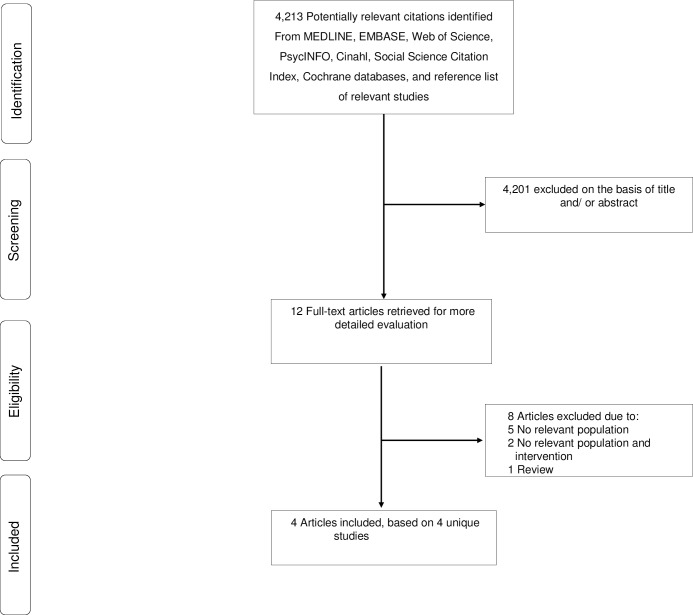
Of 4,213 potentially relevant citations, we identified one case-control, one prospective cohort and two qualitative studies for inclusion in the synthesis. Patients report that PJI and treatment had a profoundly negative impact affecting physical, emotional, social and economic aspects of their lives. No study evaluated support interventions.
The findings demonstrate that patients undergoing treatment for PJI have extensive physical, psychological, social and economic support needs. The interpretation of study results is limited by variation in study design, outcome measures and the small number of relevant eligible studies. However, our review highlights a lack of evidence about support strategies for patients undergoing treatment for PJI and other adverse occurrences following hip or knee arthroplasty. There is a need to design, implement and evaluate interventions to support these patients.
PROSPERO 2015: CRD42015027175.
髋关节和膝关节置换术是治疗关节疾病(最显著的是骨关节炎)的常见干预措施。尽管许多患者从手术中获益,但约1%的患者术后会发生感染,即深部假体周围感染(PJI),这通常需要进一步进行大手术。
评估髋关节或膝关节置换术后接受PJI治疗的患者的支持需求,并确定和评估常规提供哪些干预措施来支持此类患者。
系统评价。
MEDLINE、EMBASE、科学引文索引、心理学文摘数据库、护理学与健康领域数据库、社会科学引文索引、考克兰图书馆以及1980年1月1日至2016年10月5日相关研究的参考文献列表。
针对接受PJI治疗和/或髋关节或膝关节置换术后其他主要不良事件治疗的患者进行的观察性(前瞻性或回顾性队列研究、巢式病例对照研究或病例对照研究)、定性研究或临床试验。
由两名独立研究人员提取数据,并在第三名研究人员参与下达成共识。鉴于研究设计、方法的异质性以及研究数量有限,采用叙述性综合分析。
在4213条潜在相关引文中,我们确定了1项病例对照研究、l项前瞻性队列研究和2项定性研究纳入综合分析。患者报告称,PJI及其治疗对他们生活的身体、情感、社会和经济方面产生了深远的负面影响。没有研究评估支持性干预措施。
研究结果表明,接受PJI治疗的患者有广泛的身体、心理、社会和经济支持需求。研究结果的解释受到研究设计、结局测量的差异以及相关合格研究数量较少的限制。然而,我们的综述强调,缺乏关于髋关节或膝关节置换术后接受PJI治疗及其他不良事件治疗的患者支持策略的证据。有必要设计、实施和评估支持这些患者的干预措施。
PROSPERO 2015:CRD42015027175。