San Raffaele Scientific Institute, Milan, Italy.
CNRS UMR 5235, DIMNP, University of Montpellier, Montpellier, France.
mSphere. 2018 Apr 4;3(2). doi: 10.1128/mSphere.00110-18. Print 2018 Apr 25.
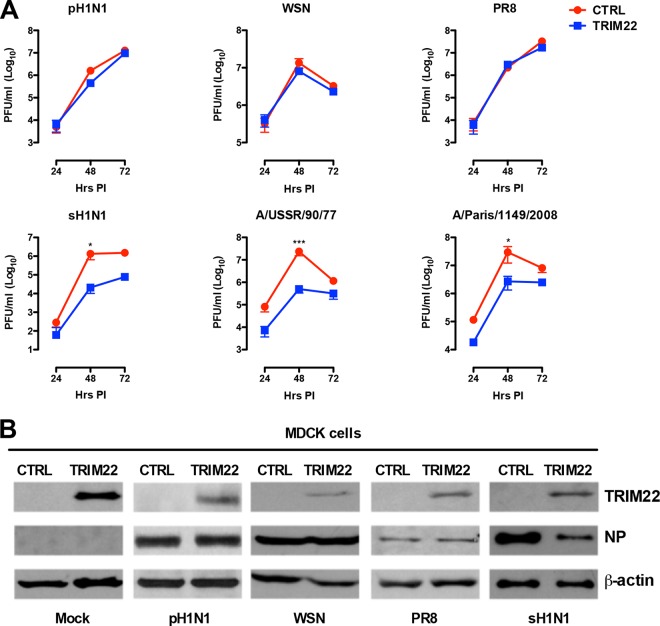
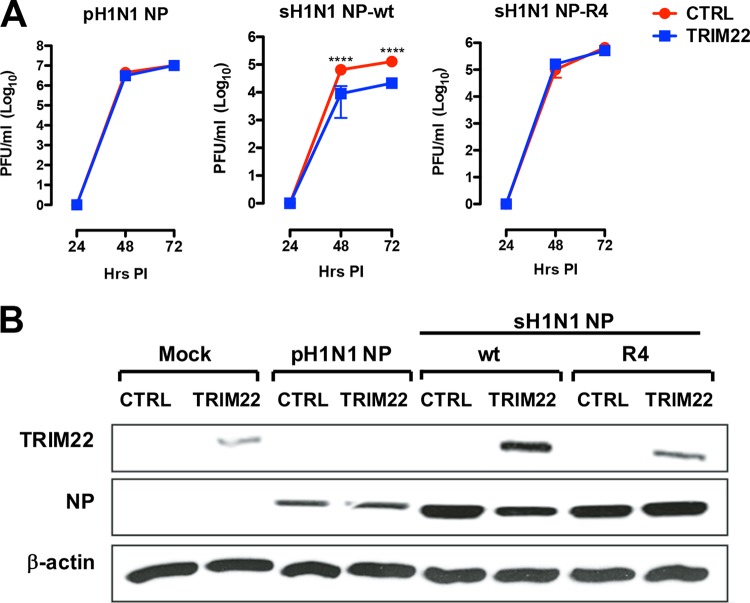
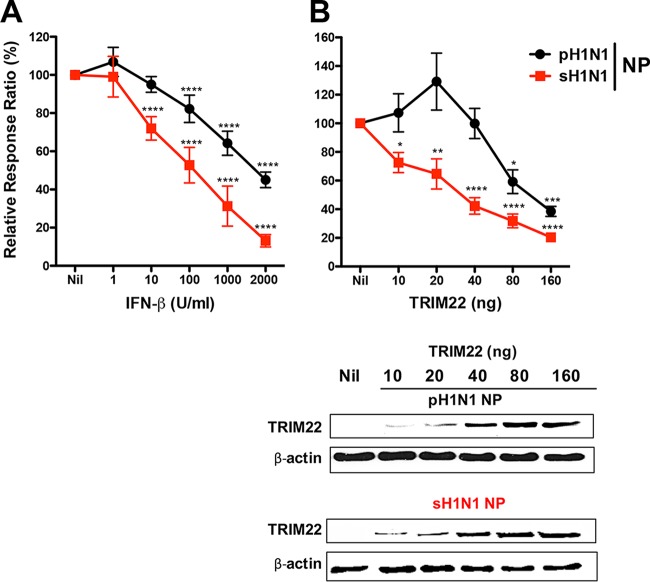
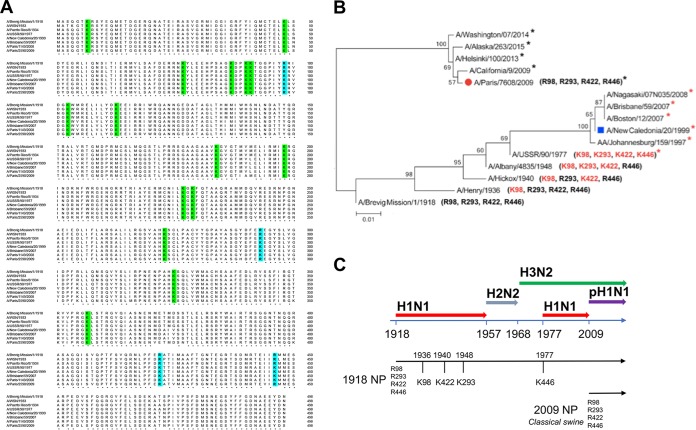
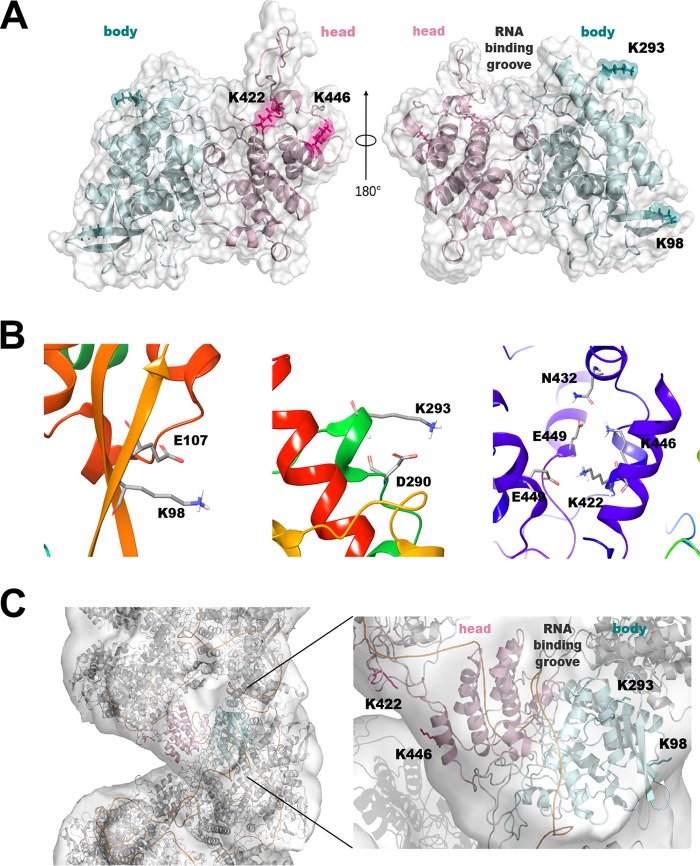
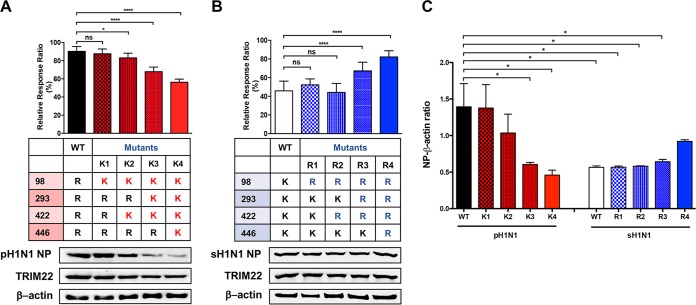
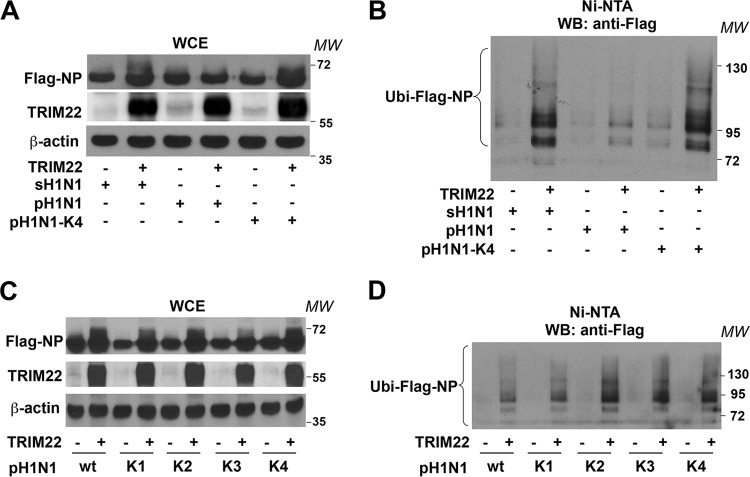
Influenza A viruses (IAVs) can cause zoonotic infections with pandemic potential when most of the human population is immunologically naive. After a pandemic, IAVs evolve to become seasonal in the human host by acquiring adaptive mutations. We have previously reported that the interferon (IFN)-inducible tripartite motif 22 (TRIM22) protein restricts the replication of seasonal IAVs by direct interaction with the viral nucleoprotein (NP), leading to its polyubiquitination and proteasomal degradation. Here we show that, in contrast to seasonal H1N1 IAVs, the 2009 pandemic H1N1 strain as well as H1N1 strains from the 1930s are resistant to TRIM22 restriction. We demonstrate that arginine-to-lysine substitutions conferring an increased sensitivity to TRIM22-dependent ubiquitination accumulated progressively in the NP of seasonal influenza A (H1N1) viruses between 1918 and 2009. Our findings suggest that during long-term circulation and evolution of IAVs in humans, adaptive mutations are favored at the expense of an increased sensitivity to some components of the innate immune response. We have uncovered that long-term circulation of seasonal influenza A viruses (IAV) in the human population resulted in the progressive acquisition of increased sensitivity to a component of the innate immune response: the type I interferon-inducible TRIM22 protein, which acts as a restriction factor by inducing the polyubiquitination of the IAV nucleoprotein (NP). We show that four arginine residues present in the NP of the 1918 H1N1 pandemic strain and early postpandemic strains were progressively substituted for by lysines between 1918 and 2009, rendering NP more susceptible to TRIM22-mediated ubiquitination. Our observations suggest that during long-term evolution of IAVs in humans, variants endowed with increased susceptibility to TRIM22 restriction emerge, highlighting the complexity of selection pressures acting on the NP.
甲型流感病毒(IAV)在大多数人群缺乏免疫性时,可能引发具有大流行潜力的人畜共患感染。大流行后,IAV 通过获得适应性突变,在人类宿主中进化为季节性病毒。我们之前曾报道过,干扰素(IFN)诱导的三联基序蛋白 22(TRIM22)通过与病毒核蛋白(NP)直接相互作用来限制季节性 IAV 的复制,从而导致其多泛素化和蛋白酶体降解。在这里,我们发现与季节性 H1N1 IAV 相反,2009 年大流行的 H1N1 株以及 20 世纪 30 年代的 H1N1 株对 TRIM22 的限制具有抗性。我们证明,在 1918 年至 2009 年期间,NP 中Arg 到 Lys 的取代导致季节性流感 A(H1N1)病毒对 TRIM22 依赖性泛素化的敏感性逐渐增加。我们的研究结果表明,在 IAV 在人类中长期循环和进化过程中,适应性突变逐渐占据优势,而对先天免疫反应的某些成分的敏感性增加则被牺牲。我们发现,季节性流感 A 病毒(IAV)在人群中的长期循环导致对先天免疫反应的一个组成部分的敏感性逐渐增加:I 型干扰素诱导的 TRIM22 蛋白,该蛋白通过诱导 IAV 核蛋白(NP)的多泛素化而起限制因子的作用。我们发现,1918 年大流行 H1N1 株和大流行后早期株 NP 中的四个 Arg 残基在 1918 年至 2009 年期间逐渐被 Lys 取代,使 NP 更容易受到 TRIM22 介导的泛素化。我们的观察结果表明,在 IAV 在人类中的长期进化过程中,出现了对 TRIM22 限制更敏感的变异体,突出了作用于 NP 的选择压力的复杂性。