Eawag: Swiss Federal Institute of Aquatic Science and Technology, Department of Aquatic Ecology, Dübendorf, Switzerland.
Institute of Evolutionary Biology and Environmental Studies, University of Zurich, Zürich, Switzerland.
PLoS One. 2018 Apr 6;13(4):e0195529. doi: 10.1371/journal.pone.0195529. eCollection 2018.
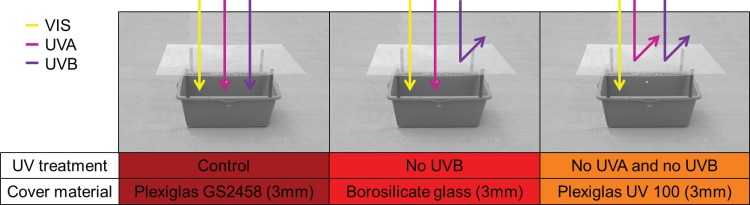
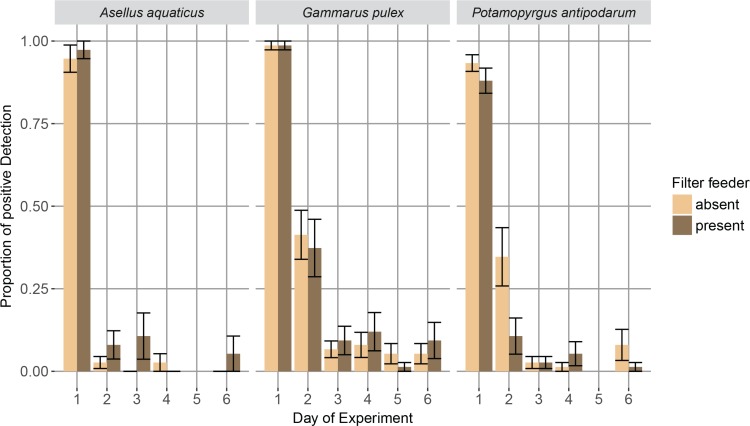
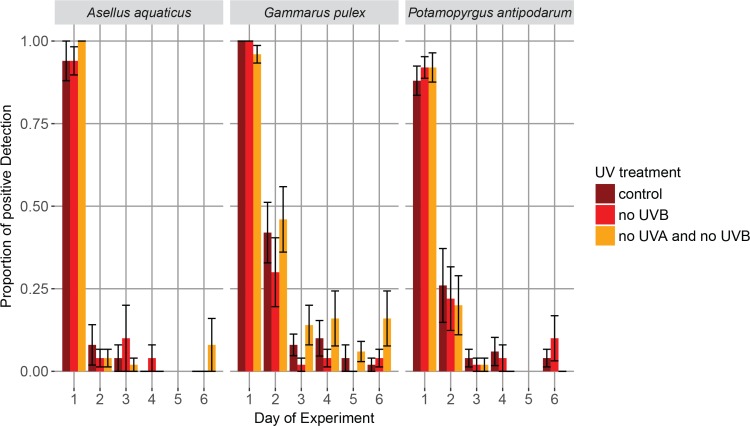
The use of environmental DNA (eDNA) as a species detection tool is attracting attention from both scientific and applied fields, especially for detecting invasive or rare species. In order to use eDNA as an efficient and reliable tool, however, we need to understand its origin and state as well as factors affecting its degradation. Various biotic and abiotic environmental factors have been proposed to affect degradation of eDNA in aquatic environments and thus to influence detection rates of species. Here, we were interested in two of them, namely UV light, which can break down DNA, and the presence of filter feeders, which can remove DNA and DNA-bound particles. A few, mostly laboratory-based studies have found minor effects of UVB on the degradation of eDNA. Ultraviolet A radiation (UVA), however, has been neglected although it also causes DNA lesions and is 10- to 100-fold more prevalent than UVB when reaching the earth's surface. Filter feeders are common in aquatic ecosystem, but their effects on eDNA has hitherto been ignored. We conducted a full-factorial aquatic mesocosm experiment under near-natural outdoor conditions manipulating UV radiation as well as the presence of Dreissena polymorpha, a strong filter feeder capable of filtering cells or organelles containing DNA. Surprisingly, we found that neither UV radiation nor the presence of the filter feeder affected eDNA-based detection rates of macroinvertebrates, even though the experiment took place in summer when UV radiation intensity and filtration activity is high for the chosen experimental site and conditions. These results, in combination with studies from marine or laboratory settings finding no effect of sunlight and its UV components on the detectability of eDNA, suggest that eDNA based species assessments could be relatively robust with respect to our two factors studied.
环境 DNA(eDNA)作为一种物种检测工具,正受到科学界和应用领域的关注,尤其是在检测入侵物种或稀有物种方面。然而,为了使 eDNA 成为一种高效可靠的工具,我们需要了解其来源和状态以及影响其降解的因素。各种生物和非生物环境因素已被提出会影响水生环境中 eDNA 的降解,从而影响物种的检测率。在这里,我们对其中两个因素感兴趣,即紫外线,它可以分解 DNA,以及滤食者的存在,它们可以去除 DNA 和与 DNA 结合的颗粒。少数基于实验室的研究发现,UVB 对 eDNA 的降解有较小的影响。然而,尽管紫外线 A 辐射(UVA)也会导致 DNA 损伤,并且当到达地球表面时,其强度是 UVB 的 10-100 倍,但它却被忽视了。滤食者在水生生态系统中很常见,但它们对 eDNA 的影响迄今被忽视。我们在近自然的户外条件下进行了全面的水生中观实验,通过操纵紫外线辐射以及多形德累斯顿(Dreissena polymorpha)的存在来进行实验,后者是一种能够过滤含有 DNA 的细胞或细胞器的强滤食者。令人惊讶的是,我们发现,无论是紫外线辐射还是滤食者的存在,都没有影响基于 eDNA 的大型无脊椎动物检测率,即使实验是在夏季进行的,此时选择的实验地点和条件下的紫外线辐射强度和过滤活性都很高。这些结果,结合来自海洋或实验室的研究结果,即阳光及其紫外线成分对 eDNA 可检测性没有影响,表明基于 eDNA 的物种评估可能对我们研究的两个因素具有相对稳健性。