Pan Yue, Lu Lingyun, Chen Junquan, Zhong Yong, Dai Zhehao
Department of Spine Surgery, the Second Xiangya Hospital, Central South University, Changsha, 410011, China.
Department of orthopaedics, the Fifth Hospital of Xiamen, Xiamen, 361101, China.
J Orthop Surg Res. 2018 Apr 6;13(1):76. doi: 10.1186/s13018-018-0784-3.
Spinal chordomas are rare primary osseous tumors that arise from the remnants of the notochord. They are commonly considered slow-growing, locally invasive neoplasms with little tendency to metastasize, but the high recurrent rate of spinal chordomas may seriously affect the survival rate and quality of life of patients. The aim of the study is to describe the epidemiological data and determine the prognostic factors for decreased survival in patients with primary spinal chordoma.
The Surveillance, Epidemiology, and End Results (SEER) Registry database, a US population-based cancer registry database, was used to identify all patients diagnosed with primary spinal chordoma from 1973 to 2014. We utilized Kaplan-Meier method and Cox proportional hazards regression analysis to evaluate the association between patients overall survival and relevant characteristics, including age, gender, race, disease stage, treatment methods, primary tumor site, marital status, and urban county background.
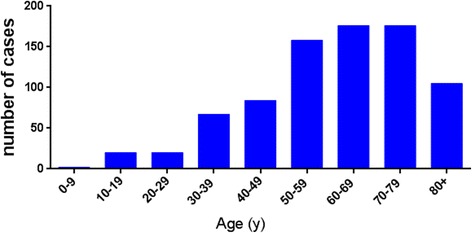
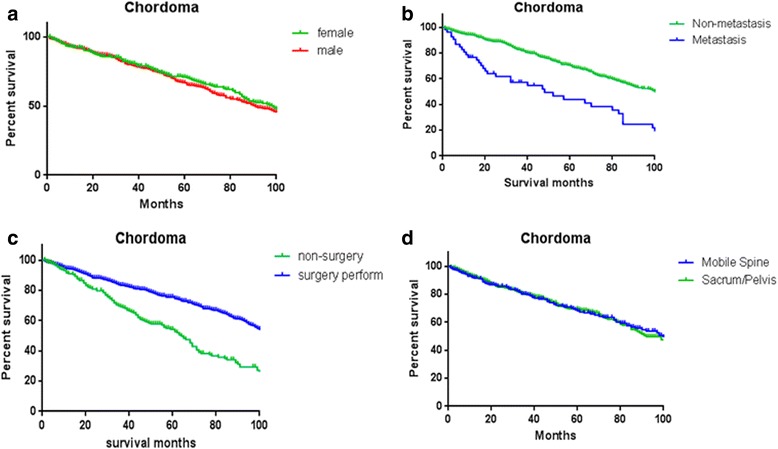
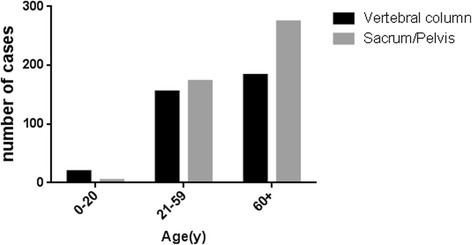
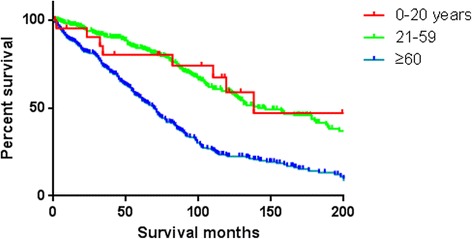
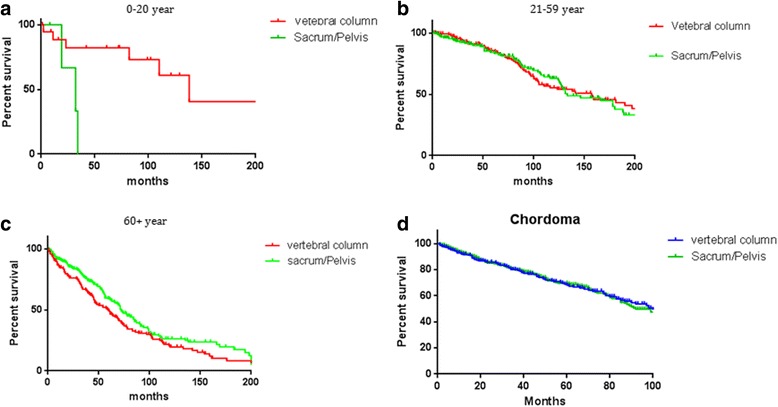
In the data set between 1973 and 2014, a total of 808 patients were identified with primary spinal chordoma. The overall rate of distant metastatic cases in our cohort was only 7.7%. Spinal chordoma was more common occurred in men (62.6%) than women (37.3%). Majority of neoplasms were found in the White (87.9%), while the incidence of the Black is relatively infrequent (3.3%). Three hundred fifty-seven spinal chordomas (44.2%) were located in the vertebral column, while 451 patients' tumor (55.8%) was located in the sacrum or pelvis. Age ≥ 60 years (HR = 2.72; 95%CI, 1.71 to 2.89), distant metastasis (HR = 2.16; 95%CI, 1.54 to 3.02), and non-surgical therapy (HR = 2.14; 95%CI, 1.72 to 2.69) were independent risk factors for survival reduction in analysis. Survival did not significantly differ as a factor of tumor site (vertebrae vs sacrum/pelvis) for primary spinal chordoma (HR = 0.93, P = 0.16). Race (P = 0.52), gender (P = 0.11), marital status (P = 0.94), and urban background (P = 0.72) were not main factors which affected overall survival rate.
There was no significant difference in overall survival rate between chordomas located in the sacrum and vertebral column. Spinal chordoma patients with an elderly age (age ≥ 60), performing non-surgical therapy, and distant metastasis were associated with worse overall survival. Performing surgery was an effective and reliable treatment method for patients with spinal chordoma, and public health efforts should pay more attention to the elderly patients with spinal chordoma prior to distant metastasis.
脊索瘤是一种罕见的原发性骨肿瘤,起源于脊索残余组织。它们通常被认为是生长缓慢、具有局部侵袭性的肿瘤,转移倾向较小,但脊索瘤的高复发率可能严重影响患者的生存率和生活质量。本研究的目的是描述流行病学数据,并确定原发性脊索瘤患者生存率降低的预后因素。
利用监测、流行病学和最终结果(SEER)登记数据库,这是一个基于美国人群的癌症登记数据库,来识别1973年至2014年期间所有诊断为原发性脊索瘤的患者。我们采用Kaplan-Meier方法和Cox比例风险回归分析来评估患者总生存与相关特征之间的关联,这些特征包括年龄、性别、种族、疾病分期、治疗方法、原发肿瘤部位、婚姻状况和城乡背景。
在1973年至2014年的数据集里,共识别出808例原发性脊索瘤患者。我们队列中远处转移病例的总体发生率仅为7.7%。脊索瘤在男性(62.6%)中比女性(37.3%)更常见。大多数肿瘤发生在白人(87.9%)中,而黑人的发病率相对较低(3.3%)。357例脊索瘤(44.2%)位于脊柱,而451例患者的肿瘤(55.8%)位于骶骨或骨盆。年龄≥60岁(HR = 2.72;95%CI,1.71至2.89)、远处转移(HR = 2.16;95%CI,1.54至3.02)和非手术治疗(HR = 2.14;95%CI,1.72至2.69)在分析中是生存率降低的独立危险因素。对于原发性脊索瘤,生存作为肿瘤部位(脊柱与骶骨/骨盆)的一个因素没有显著差异(HR = 0.93,P = 0.16)。种族(P = 0.52)、性别(P = 0.11)、婚姻状况(P = 0.94)和城乡背景(P = 0.72)不是影响总生存率的主要因素。
位于骶骨和脊柱的脊索瘤的总生存率没有显著差异。年龄较大(年龄≥60岁)、接受非手术治疗和发生远处转移的脊索瘤患者的总生存情况较差。手术是脊索瘤患者一种有效且可靠的治疗方法,公共卫生工作应在远处转移之前更加关注老年脊索瘤患者。