Department of Orthopedics, Beijing Anzhen Hospital, Capital Medical University, Beijing, China (mainland).
Department of Orthopedics, Second Affiliated Hospital of Inner Mongolia Medical University, Hohhot, Inner Mongolia, China (mainland).
Med Sci Monit. 2018 Apr 9;24:2098-2108. doi: 10.12659/msm.906945.
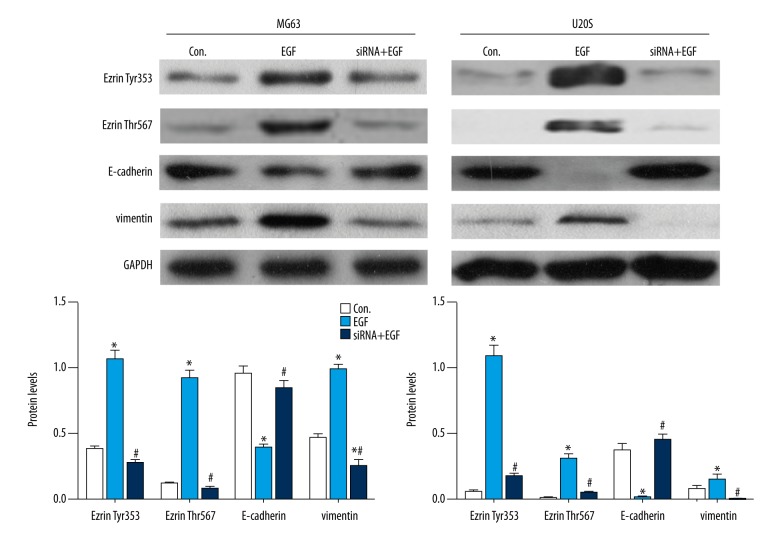
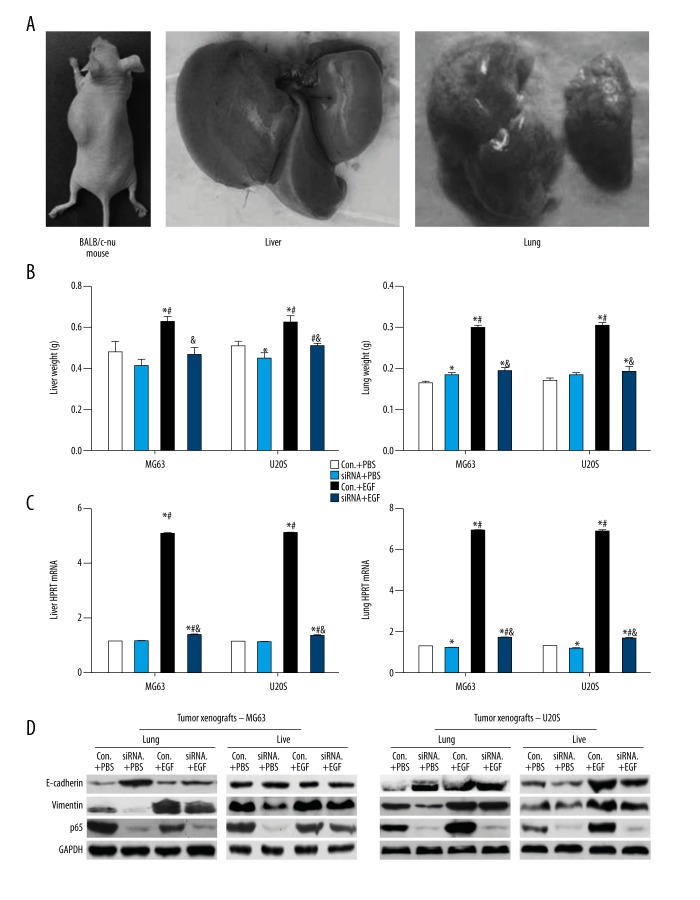
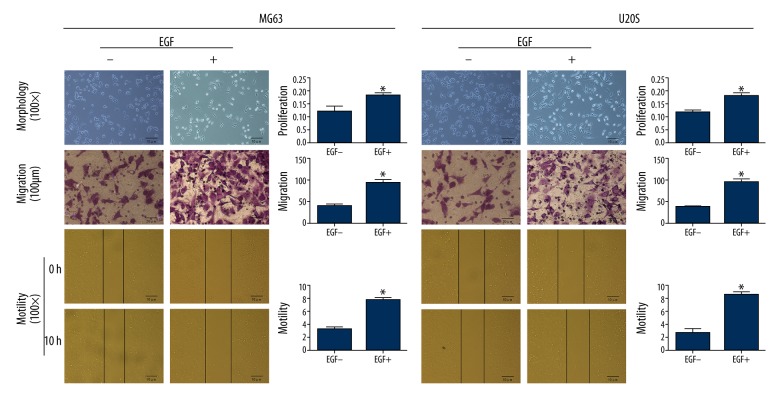
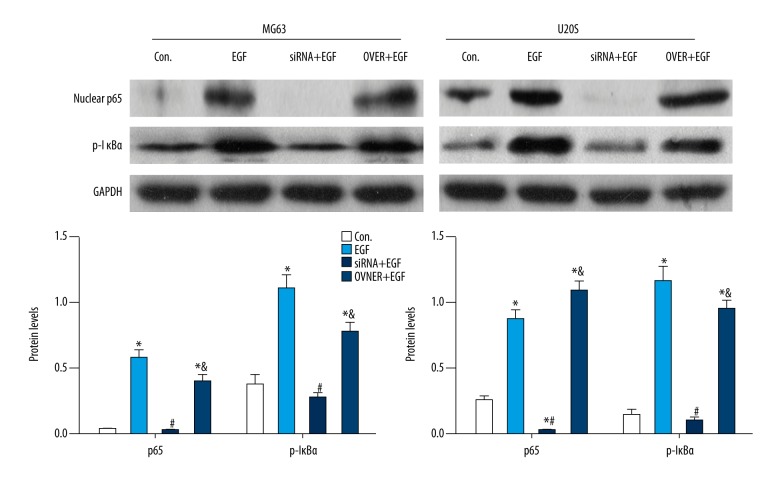
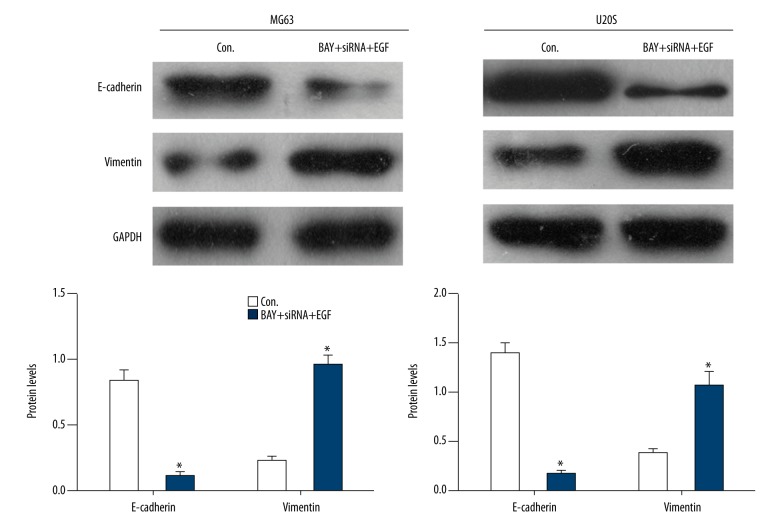
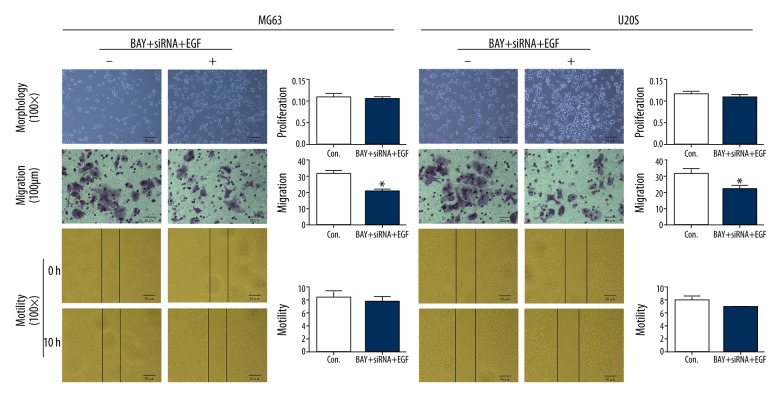
BACKGROUND Epithelial-mesenchymal transition (EMT) is responsible for metastasis of cancers, and NF-κB can promote tumor progression. Ezrin is an important molecule participating in EMT. However, whether Ezrin mediates NF-κB in EGF-induced osteosarcoma is unknown. MATERIAL AND METHODS Ezrin phosphorylation, NF-κB activation, and EGF-induced EMT were studied in MG63 and U20S cells with NF-κB inhibition, silencing, or over-expressing Ezrin. Cell morphology, proliferation, migration, and motility were analyzed. An osteosarcoma model was established in mice by injecting MG63 and U20S and reducing Ezrin. RESULTS With EGF induction in vitro, Ezrin Tyr353 and Thr567 were phosphorylated, and EMT, proliferation, migration, and motility of osteosarcoma cells were promoted. Silencing Ezrin suppressed and over-expressing Ezrin promoted the nuclear translocation of p65 and phosphorylated IκBα (p-IκBα) in EGF-induced osteosarcoma cells. NF-κB inhibitor blocked EGF-induced EMT in both cell types, as well as reserving cell morphology and suppressing proliferation, migration, and motility. In vivo, reducing Ezrin significantly suppressed metastasis of osteosarcoma xenografts, increased liver and lung weights, and activated NF-κB, which were both induced by EGF. CONCLUSIONS Ezrin/NF-κB regulated EGF-induced EMT, as well as progression and metastasis of osteosarcoma in vivo and in vitro. Ezrin/NF-κB may be a new therapeutic target to prevent osteosarcoma from deterioration.
上皮-间充质转化(EMT)是癌症转移的原因,NF-κB 可促进肿瘤进展。埃兹蛋白是参与 EMT 的重要分子。然而,埃兹蛋白是否在 EGF 诱导的骨肉瘤中介导 NF-κB 尚不清楚。
采用 NF-κB 抑制、沉默或过表达埃兹蛋白的方法,研究 MG63 和 U20S 细胞中埃兹蛋白磷酸化、NF-κB 激活和 EGF 诱导的 EMT。分析细胞形态、增殖、迁移和运动。通过注射 MG63 和 U20S 并减少埃兹蛋白在小鼠中建立骨肉瘤模型。
体外 EGF 诱导后,埃兹蛋白 Tyr353 和 Thr567 磷酸化,促进骨肉瘤细胞 EMT、增殖、迁移和运动。沉默埃兹蛋白抑制,过表达埃兹蛋白促进 EGF 诱导的骨肉瘤细胞中 p65 和磷酸化 IκBα(p-IκBα)的核易位。NF-κB 抑制剂阻断了两种细胞类型中 EGF 诱导的 EMT,保留了细胞形态并抑制了增殖、迁移和运动。体内,减少埃兹蛋白显著抑制骨肉瘤异种移植物的转移,增加肝脏和肺脏的重量,并激活 NF-κB,这些都是由 EGF 诱导的。
埃兹蛋白/NF-κB 调节 EGF 诱导的 EMT 以及骨肉瘤的体内外进展和转移。埃兹蛋白/NF-κB 可能是预防骨肉瘤恶化的新治疗靶点。