Baek Kwang Yeol, Lee Hyun-Hee, Son Geun Ju, Lee Pyeong An, Roy Nazish, Seo Young-Su, Lee Seon-Woo
Department of Applied Bioscience, Dong-A University, Busan 49315, Korea.
Department of Microbiology, Pusan National University, Busan 46241, Korea.
Plant Pathol J. 2018 Apr;34(2):104-112. doi: 10.5423/PPJ.OA.11.2017.0250. Epub 2018 Apr 1.
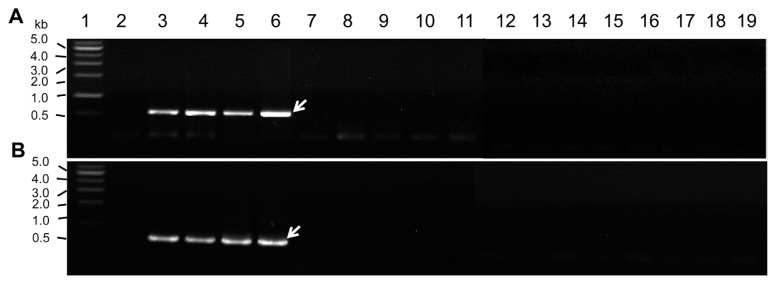
Accurate and rapid detection of bacterial plant pathogen is the first step toward disease management and prevention of pathogen spread. Bacterial plant pathogens subsp. (), subsp. (), and () cause Goss's bacterial wilt and blight of maize, Stewart's wilt of maize and spike blight of wheat and barley, respectively. The bacterial diseases are not globally distributed and not present in Korea. This study adopted comparative genomics approach and aimed to develop specific primer pairs to detect these three bacterial pathogens. Genome comparison among target pathogens and their closely related bacterial species generated 15-20 candidate primer pairs per bacterial pathogen. The primer pairs were assessed by a conventional PCR for specificity against 33 species of , , , , . The investigation for specificity and sensitivity of the primer pairs allowed final selection of one or two primer pairs per bacterial pathogens. In our assay condition, a detection limit of and was 2 pg/μl of genomic DNA per PCR reaction, while the detection limit for primers was higher. The selected primers could also detect bacterial cells up to 8.8 × 10 cfu to 7.84 × 10 cfu per gram of grain seeds artificially infected with corresponding bacterial pathogens. The primer pairs and PCR assay developed in this study provide an accurate and rapid detection method for three bacterial pathogens of grains, which can be used to investigate bacteria contamination in grain seeds and to ultimately prevent pathogen dissemination over countries.
准确快速地检测植物细菌性病原菌是病害管理和预防病原菌传播的第一步。玉米细菌性枯萎病菌亚种()、玉米斯图尔特氏病菌亚种()和()分别引起玉米的戈斯细菌性枯萎病、玉米的斯图尔特氏枯萎病以及小麦和大麦的穗枯病。这些细菌性病害并非全球分布,韩国也不存在。本研究采用比较基因组学方法,旨在开发用于检测这三种细菌病原体的特异性引物对。目标病原体与其密切相关细菌物种之间的基因组比较,每种细菌病原体产生了15 - 20对候选引物对。通过常规PCR评估这些引物对针对33种、、、、的特异性。对引物对的特异性和灵敏度进行研究后,最终为每种细菌病原体选择了一对或两对引物。在我们的检测条件下,和的检测限为每个PCR反应2 pg/μl基因组DNA,而引物的检测限更高。所选引物还能检测每克人工感染相应细菌病原体的谷物种子中高达8.8×10 cfu至7.84×10 cfu的细菌细胞。本研究开发的引物对和PCR检测方法为三种谷物细菌病原体提供了一种准确快速的检测方法,可用于调查谷物种子中的细菌污染,并最终防止病原菌在各国传播。