Helms Eric R, Byrnes Ryan K, Cooke Daniel M, Haischer Michael H, Carzoli Joseph P, Johnson Trevor K, Cross Matthew R, Cronin John B, Storey Adam G, Zourdos Michael C
Sport Performance Research Institute New Zealand, Auckland University of Technology, Auckland, New Zealand.
Muscle Physiology Laboratory, Department of Exercise Science and Health Promotion, Florida Atlantic University, Boca Raton, FL, United States.
Front Physiol. 2018 Mar 21;9:247. doi: 10.3389/fphys.2018.00247. eCollection 2018.
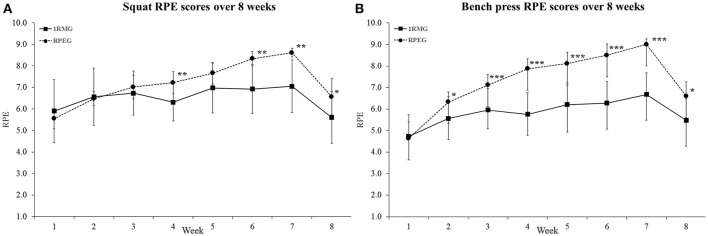
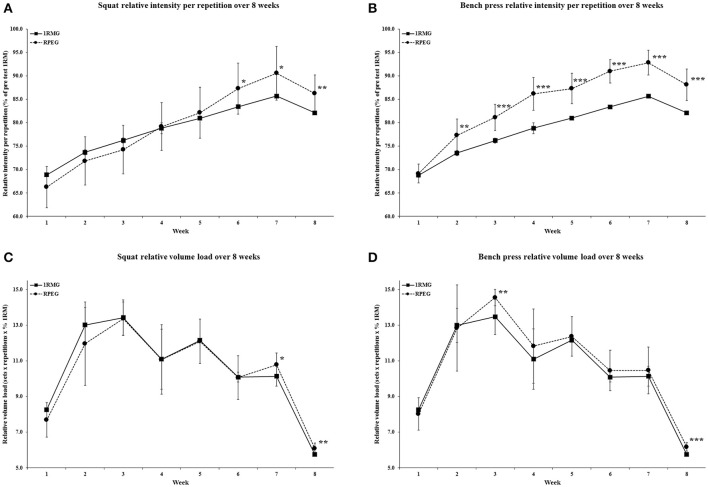
To investigate differences between rating of perceived exertion (RPE) and percentage one-repetition maximum (1RM) load assignment in resistance-trained males (19-35 years) performing protocols with matched sets and repetitions differentiated by load-assignment. Participants performed squats then bench press 3x/weeks in a daily undulating format over 8-weeks. Participants were counterbalanced by pre-test 1RM then assigned to percentage 1RM (1RMG, = 11); load-assignment via percentage 1RMs, or RPE groups (RPEG, = 10); participant-selected loads to reach target RPE ranges. Ultrasonography determined pre and post-test pectoralis (PMT), and vastus lateralis muscle thickness at 50 (VLMT50) and 70% (VLMT70) femur-length. Bench press (1RMG +9.64 ± 5.36; RPEG + 10.70 ± 3.30 kg), squat (1RMG + 13.91 ± 5.89; RPEG + 17.05 ± 5.44 kg) and their combined-total 1RMs (1RMG + 23.55 ± 10.38; RPEG + 27.75 ± 7.94 kg) increased ( < 0.05) in both groups as did PMT (1RMG + 1.59 ± 1.33; RPEG +1.90 ± 1.91 mm), VLMT50 (1RMG +2.13 ± 1.95; RPEG + 1.85 ± 1.97 mm) and VLMT70 (1RMG + 2.40 ± 2.22; RPEG + 2.31 ± 2.27 mm). Between-group differences were non-significant ( > 0.05). Magnitude-based inferences revealed 79, 57, and 72% chances of mean small effect size (ES) advantages for squat; ES 90% confidence limits (CL) = 0.50 ± 0.63, bench press; ES 90% = 0.28 ± 0.73, and combined-total; ES 90% = 0.48 ± 0.68 respectively, in RPEG. There were 4, 14, and 6% chances 1RMG had a strength advantage of the same magnitude, and 18, 29, and 22% chances, respectively of trivial differences between groups. Both loading-types are effective. However, RPE-based loading may provide a small 1RM strength advantage in a majority of individuals.
为了研究在进行负荷分配不同但组数和重复次数匹配的训练方案时,有阻力训练经验的男性(19 - 35岁)的主观用力程度(RPE)评分与单次重复最大负荷(1RM)百分比负荷分配之间的差异。参与者每周进行3次深蹲和卧推,采用每日波动训练模式,为期8周。通过预测试1RM对参与者进行平衡分组,然后将其分配到1RM百分比组(1RMG,n = 11);通过1RM百分比进行负荷分配,或RPE组(RPEG,n = 10);由参与者选择负荷以达到目标RPE范围。超声检查测定了测试前后胸大肌(PMT)以及股骨长度50%(VLMT50)和70%(VLMT70)处的股外侧肌厚度。两组的卧推(1RMG增加9.64±5.36;RPEG增加10.70±3.30 kg)、深蹲(1RMG增加13.91±5.89;RPEG增加17.05±5.44 kg)及其总1RM(1RMG增加23.55±10.38;RPEG增加27.75±7.94 kg)均有所增加(P < 0.05),PMT(1RMG增加1.59±1.33;RPEG增加1.90±1.91 mm)、VLMT50(1RMG增加2.13±1.95;RPEG增加1.85±1.97 mm)和VLMT70(1RMG增加2.40±2.22;RPEG增加2.31±2.27 mm)也增加(P < 0.05)。组间差异不显著(P > 0.05)。基于效应量的推断显示,RPEG组中深蹲、卧推和总负荷的平均小效应量(ES)优势的可能性分别为79%、57%和72%;深蹲ES的90%置信区间(CL)= 0.50±0.63,卧推ES的90%置信区间 = 0.28±0.73,总负荷ES的90%置信区间 = 0.48±0.68。1RMG组有相同效应量强度优势的可能性分别为4%、14%和6%,两组间有微小差异的可能性分别为18%、29%和22%。两种负荷类型均有效。然而,基于RPE进行负荷分配可能在大多数个体中提供小的1RM力量优势。