Hu Juan, Liu Ming-Hao, Li Ying, Tang Bo, Zhang Chun-Yang
College of Chemistry, Chemical Engineering and Materials Science , Collaborative Innovation Center of Functionalized Probes for Chemical Imaging in Universities of Shandong , Key Laboratory of Molecular and Nano Probes , Ministry of Education , Shandong Provincial Key Laboratory of Clean Production of Fine Chemicals , Shandong Normal University , Jinan 250014 , China . Email:
School of Medicine , Health Science Center , Shenzhen University , Shenzhen 518060 , China.
Chem Sci. 2017 Nov 7;9(3):712-720. doi: 10.1039/c7sc04296e. eCollection 2018 Jan 21.
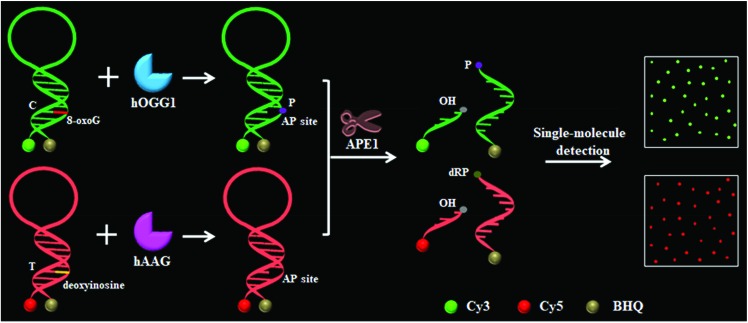
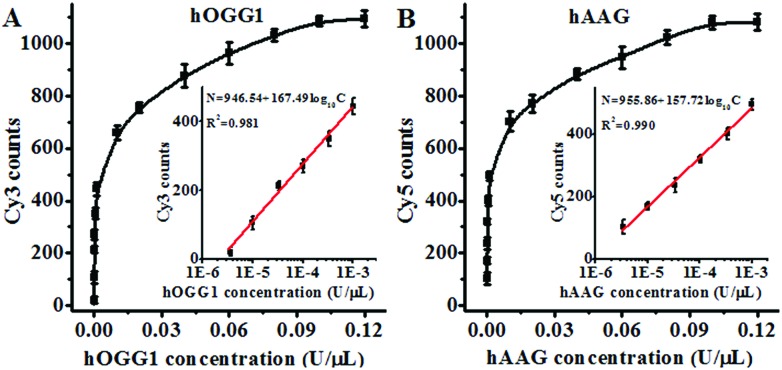
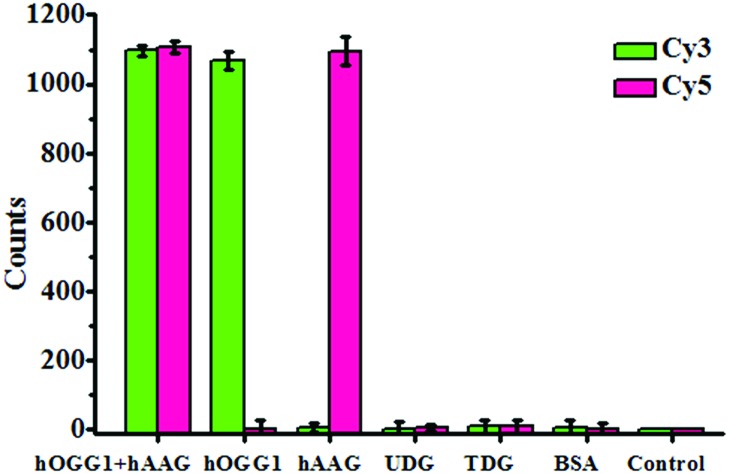
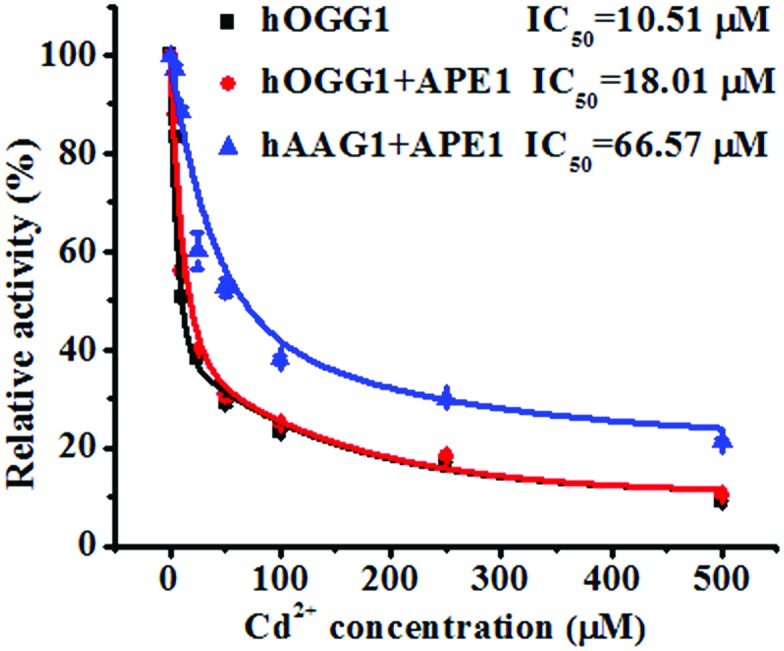
DNA glycosylases are involved in the base excision repair pathway, and all mammals express multiple DNA glycosylases to maintain genome stability. However, the simultaneous detection of multiple DNA glycosylase still remains a great challenge. Here, we develop a single-molecule detection method for the simultaneous detection of human 8-oxoguanine DNA glycosylase 1 (hOGG1) and human alkyladenine DNA glycosylase (hAAG) on the basis of DNA glycosylase-mediated cleavage of molecular beacons. We designed a Cy3-labeled molecular beacon modified with 8-oxoguanine (8-oxoG) for a hOGG1 assay and a Cy5-labeled molecular beacon modified with deoxyinosine for a hAAG assay. hOGG1 may catalyze the removal of 8-oxoG from 8-oxoG/C base pairs to generate an apurinic/apyrimidinic (AP) site, and hAAG may catalyze the removal of deoxyinosine from deoxyinosine/T base pairs to generate an AP site. With the assistance of apurinic/apyrimidinic endonuclease (APE1), the cleavage of AP sites results in the cleavage of molecular beacons, with Cy3 indicating the presence of hOGG1 and Cy5 indicating the presence of hAAG. Both of the Cy3 and Cy5 signals can be simply quantified by total internal reflection fluorescence-based single-molecule detection. This method can simultaneously detect multiple DNA glycosylases with a detection limit of 2.23 × 10 U μL for hOGG1 and 8.69 × 10 U μL for hAAG without the involvement of any target amplification. Moreover, this method can be used for the screening of enzyme inhibitors and the simultaneous detection of hOGG1 and hAAG from lung cancer cells, having great potential for further application in early clinical diagnosis.
DNA糖基化酶参与碱基切除修复途径,所有哺乳动物都表达多种DNA糖基化酶以维持基因组稳定性。然而,同时检测多种DNA糖基化酶仍然是一个巨大的挑战。在此,我们基于DNA糖基化酶介导的分子信标切割,开发了一种用于同时检测人8-氧代鸟嘌呤DNA糖基化酶1(hOGG1)和人烷基腺嘌呤DNA糖基化酶(hAAG)的单分子检测方法。我们设计了一种用8-氧代鸟嘌呤(8-oxoG)修饰的Cy3标记分子信标用于hOGG1检测,以及一种用脱氧次黄嘌呤修饰的Cy5标记分子信标用于hAAG检测。hOGG1可催化从8-oxoG/C碱基对中去除8-oxoG,产生无嘌呤/无嘧啶(AP)位点,hAAG可催化从脱氧次黄嘌呤/T碱基对中去除脱氧次黄嘌呤,产生AP位点。在无嘌呤/无嘧啶内切核酸酶(APE1)的协助下,AP位点的切割导致分子信标的切割,Cy3表明hOGG1的存在,Cy5表明hAAG的存在。Cy3和Cy5信号均可通过基于全内反射荧光的单分子检测简单定量。该方法可同时检测多种DNA糖基化酶,hOGG1的检测限为2.23×10 U/μL,hAAG的检测限为8.69×10 U/μL,无需任何目标扩增。此外,该方法可用于酶抑制剂的筛选以及从肺癌细胞中同时检测hOGG1和hAAG,在早期临床诊断中具有巨大的进一步应用潜力。