Castanera Diego, Belvedere Matteo, Marty Daniel, Paratte Géraldine, Lapaire-Cattin Marielle, Lovis Christel, Meyer Christian A
Bayerische Staatssammlung für Paläontologie und Geologie, GeoBioCenter, Ludwig-Maximilians-Universität, Munich, Germany.
Section d'archéologie et paléontologie, Paléontologie A16, Office de la culture, Porrentruy, Switzerland.
PeerJ. 2018 Apr 2;6:e4579. doi: 10.7717/peerj.4579. eCollection 2018.
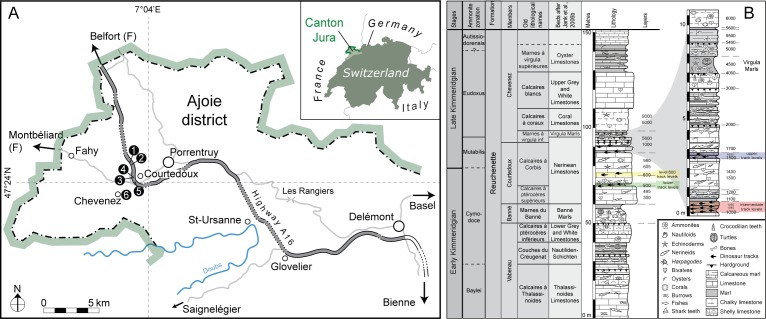
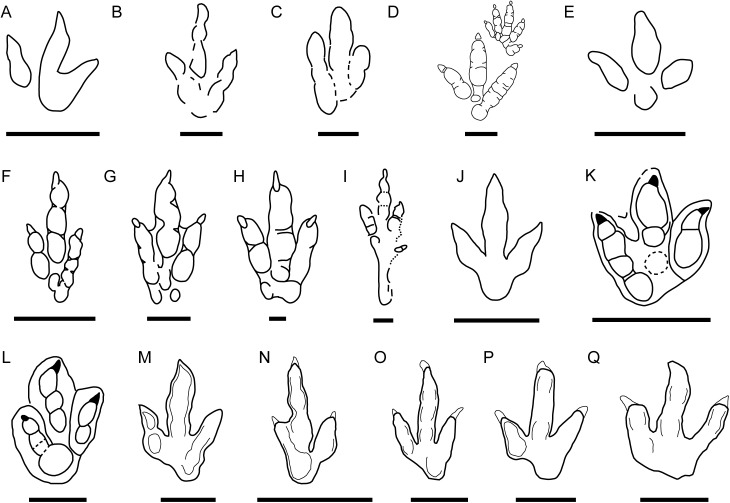
Minute to medium-sized (footprint length (FL) less than 30 cm) tridactyl dinosaur tracks are the most abundant in the Late Jurassic tracksites of Highway A16 (Reuchenette Formation, Kimmeridgian) in the Jura Mountains (NW Switzerland). During excavations, two morphotypes, one gracile and one robust, were identified in the field. Furthermore, two large-sized theropod ichnospecies ( and ) and an ornithopod-like morphotype (Morphotype II) have recently been described at these sites.
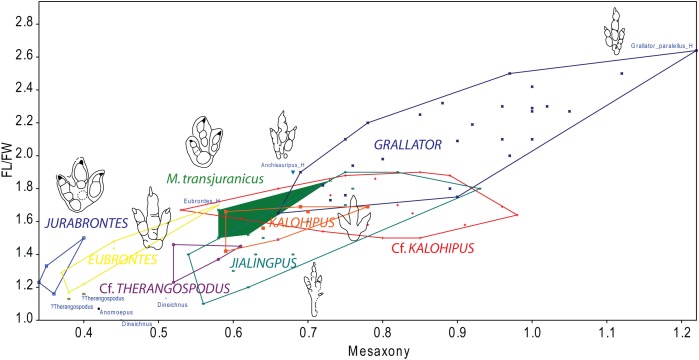
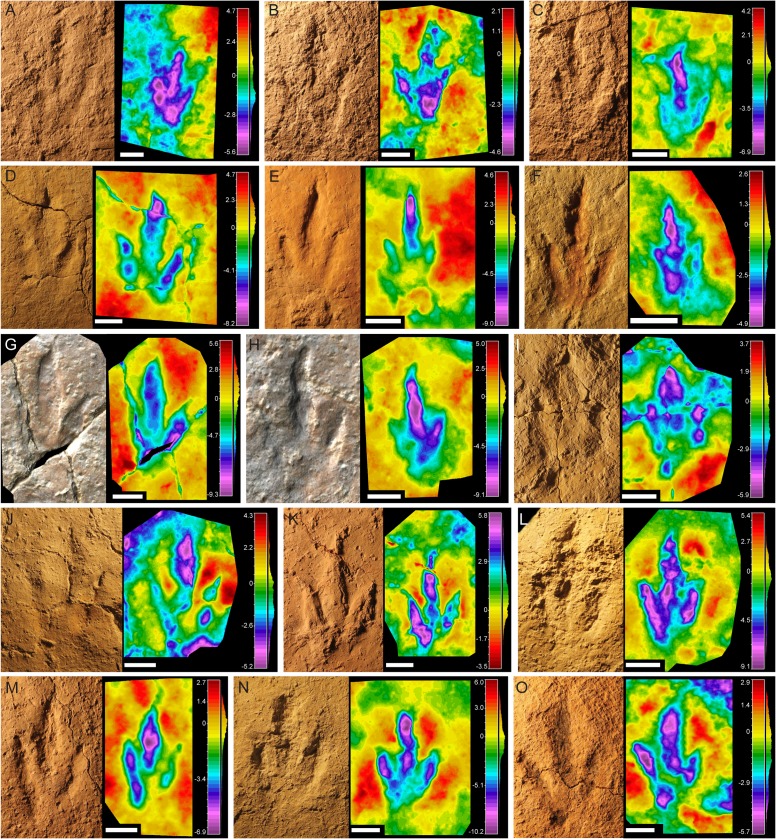
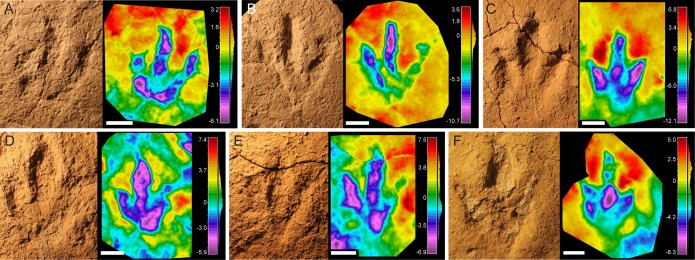
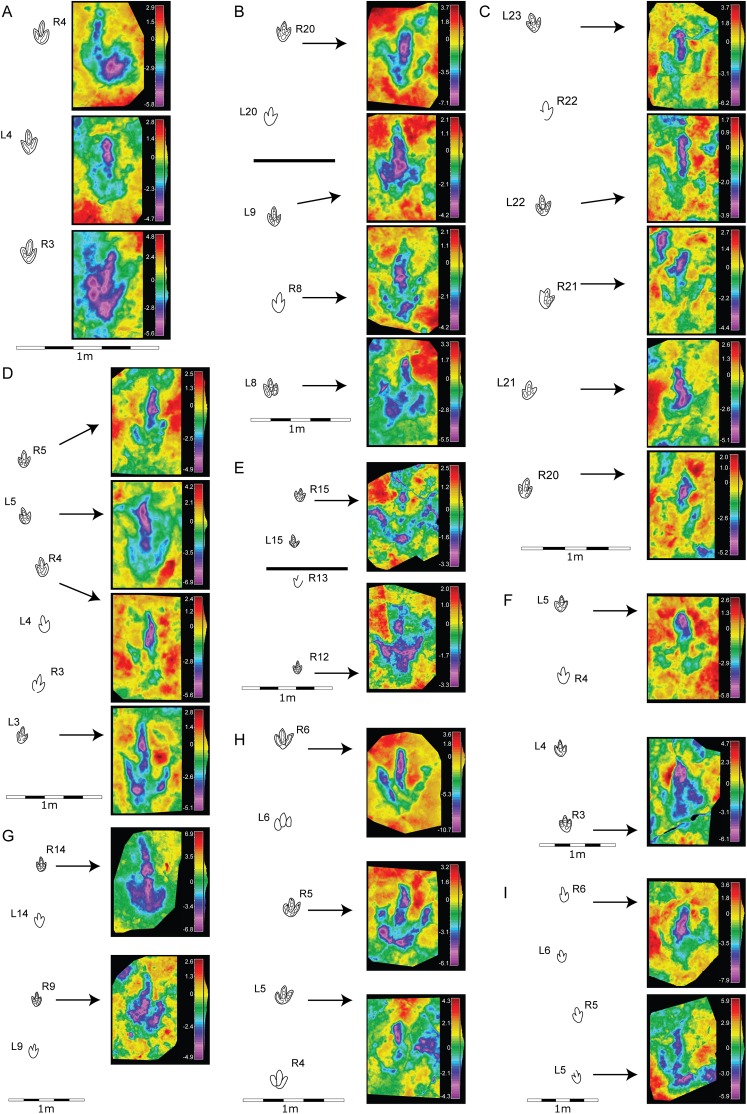
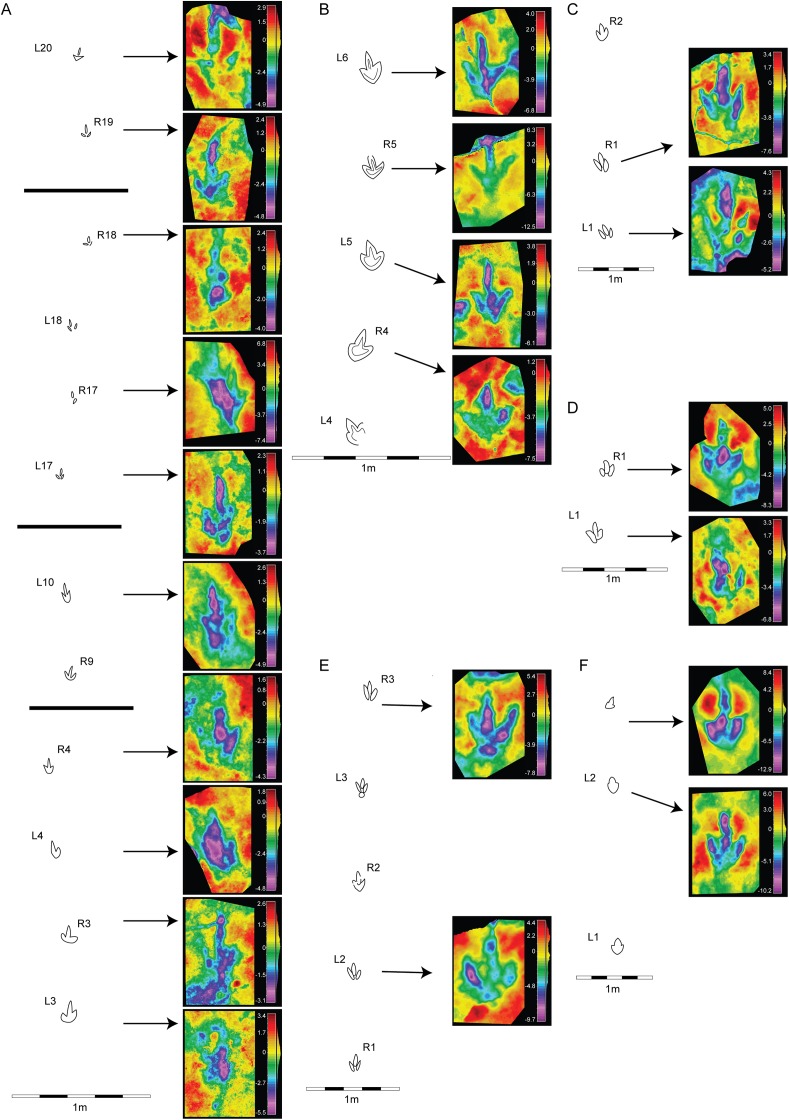
The quality of morphological preservation (preservation grade), the depth of the footprint, the shape variation, and the footprint proportions (FL/footprint width (FW) ratio and mesaxony) along the trackways have been analyzed using 3D models and false-color depth maps in order to determine the exact number of small to medium-sized morphotypes present in the tracksites.
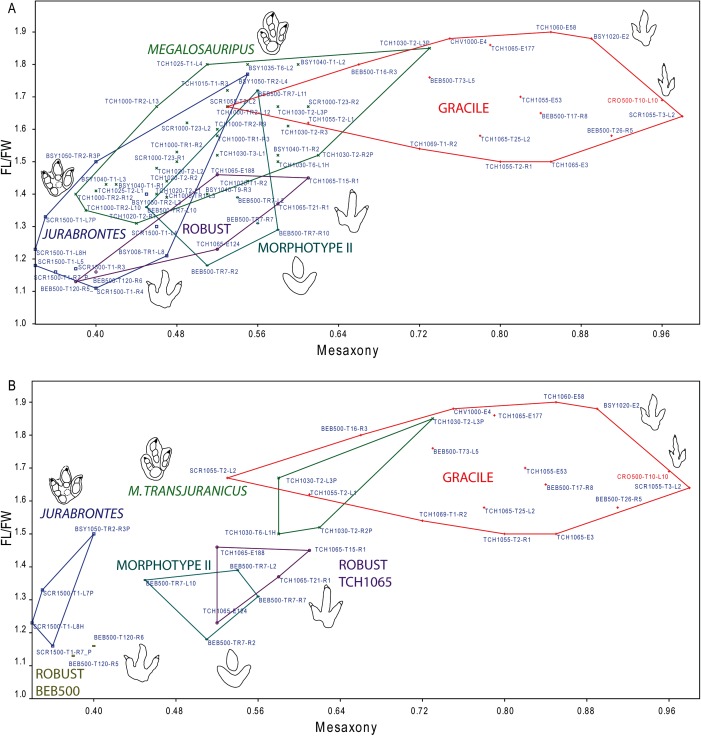
The study of footprints ( = 93) recovered during the excavations has made it possible to identify and characterize the two morphotypes distinguished in the field. The gracile morphotype is mainly characterized by a high FL/FW ratio, high mesaxony, low divarication angles and clear, sharp claw marks, and phalangeal pads (2-3-4). By contrast, the robust morphotype is characterized by a lower FL/FW ratio, weaker mesaxony, slightly higher divarication angles and clear, sharp claw marks (when preserved), whereas the phalangeal pads are not clearly preserved although they might be present.
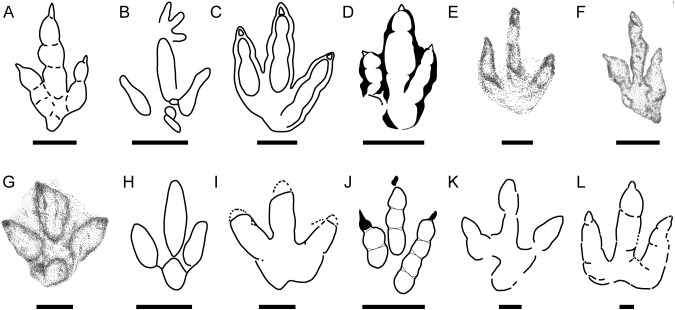
The analysis does not allow the two morphotypes to be associated within the same morphological continuum. Thus, they cannot be extramorphological variations of similar tracks produced by a single trackmaker. Comparison of the two morphotypes with the larger morphotypes described in the formation (, , and Morphotype II) and the spatio-temporal relationships of the trackways suggest that the smaller morphotypes cannot reliably be considered as small individuals of any of the larger morphotypes. The morphometric data of some specimens of the robust morphotype (even lower values for the length/width ratio and mesaxony) suggest that more than one ichnotaxon might be represented within the robust morphotype. The features of the gracile morphotype (cf. isp.) are typical of "grallatorid" ichnotaxa with low mesaxony whereas those of the robust morphotype (cf. isp. and ? isp.) are reminiscent of . This work sheds new light on combining an analysis of variations in footprint morphology through 3D models and false-color depth maps, with the study of possible ontogenetic variations and the identification of small-sized tridactyl ichnotaxa for the description of new dinosaur tracks.
小型至中型(足迹长度(FL)小于30厘米)的三趾恐龙足迹在侏罗山(瑞士西北部)A16高速公路晚侏罗世足迹遗址(瑞申内特组,启莫里阶)最为丰富。在挖掘过程中,在野外识别出两种形态类型,一种纤细型和一种粗壮型。此外,最近在这些遗址还描述了两种大型兽脚类足迹化石种(和)以及一种类似鸟脚类的形态类型(形态类型II)。
利用三维模型和假彩色深度图分析了沿足迹道的形态保存质量(保存等级)、足迹深度、形状变化以及足迹比例(FL/足迹宽度(FW)比值和中轴性),以确定足迹遗址中存在的小型至中型形态类型的确切数量。
对挖掘过程中发现的足迹(=93个)进行研究,得以识别并描述在野外区分出的两种形态类型。纤细型形态类型的主要特征是FL/FW比值高、中轴性高、分叉角度低以及清晰尖锐的爪痕和指垫(2-3-4)。相比之下,粗壮型形态类型的特征是FL/FW比值较低、中轴性较弱、分叉角度略高以及清晰尖锐的爪痕(保存时),而指垫虽然可能存在但保存不清晰。
分析结果不支持将这两种形态类型归为同一形态连续体。因此,它们不可能是由单一足迹制造者产生的相似足迹的形态外变异。将这两种形态类型与该地层中描述的较大形态类型(、和形态类型II)进行比较以及对足迹道的时空关系分析表明,较小的形态类型不能可靠地被视为任何较大形态类型的幼体。粗壮型形态类型一些标本(甚至长度/宽度比值和中轴性更低的值)的形态测量数据表明,粗壮型形态类型可能代表不止一个遗迹分类单元。纤细型形态类型(参照isp.)的特征是典型的中轴性低的“格拉拉托足迹类”遗迹分类单元,而粗壮型形态类型(参照isp.和?isp.)的特征让人联想到。这项工作通过三维模型和假彩色深度图对足迹形态变化进行分析,并结合对可能的个体发育变异的研究以及对小型三趾遗迹分类单元的识别,为新恐龙足迹的描述提供了新的思路。