Antoni Christiane H, McDuffie Yvonne, Bauer Jochen, Sleeman Jonathan P, Boehm Heike
Department of Cellular Biophysics, Max Planck Institute for Medical Research, Heidelberg, Germany.
Department of Biophysical Chemistry, University of Heidelberg, Heidelberg, Germany.
Front Bioeng Biotechnol. 2018 Mar 23;6:25. doi: 10.3389/fbioe.2018.00025. eCollection 2018.
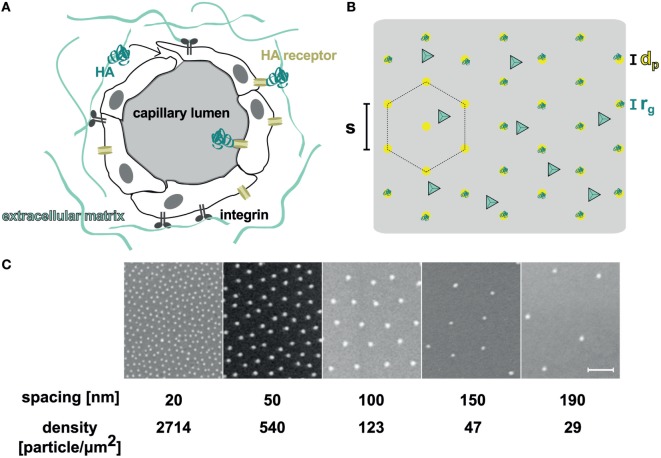
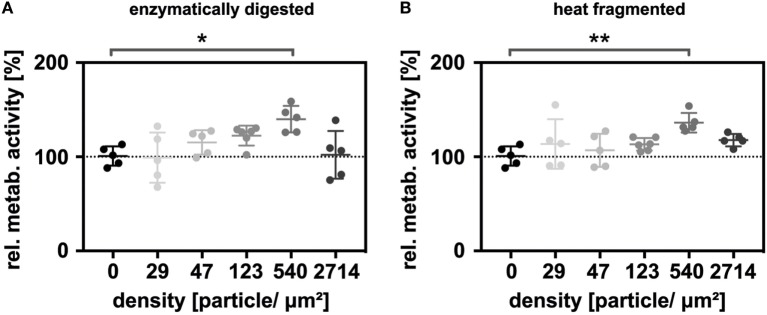
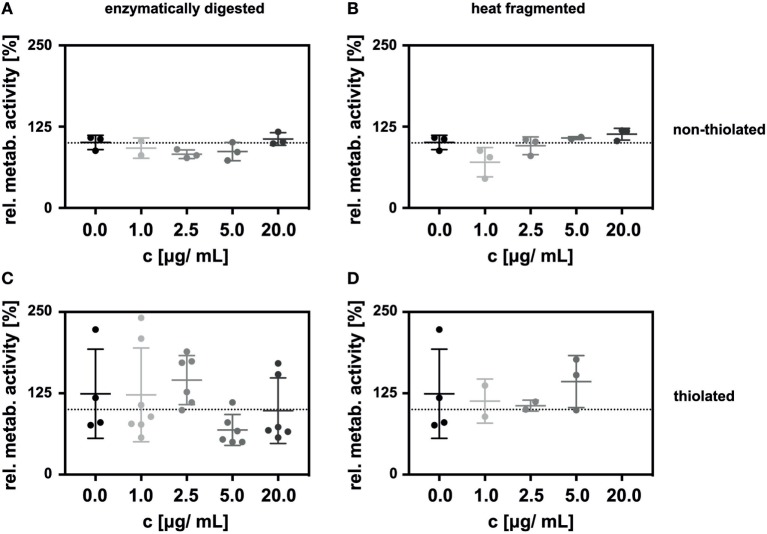
Controlled activation of lymphangiogenesis through functional biomaterials represents a promising approach to support wound healing after surgical procedures, yet remains a challenge. In a synthetic biological approach, we therefore set out to mimic the basal microenvironment of human primary dermal lymphatic endothelial cells (LECs) during lymphangiogenesis. As the extracellular matrix component hyaluronan (HA) regulates lymphangiogenesis, we designed a bifunctional surface in which adhesive peptide ligands and short HA oligosaccharides (sHA) tethered to nanoparticles are copresented to the basal side of LECs in a controlled, concentration-dependent manner. Exposure of LECs to sHA in solution to mimic luminal stimulation of the cells did not result in modified metabolic activity. However, LECs grown on the bifunctional adhesive surfaces showed a biphasic change in metabolic activity, with increased metabolic activity being observed in response to increasing nanoparticle densities up to a maximum of 540 particles/μm. Thus, interfaces that concomitantly present adhesive ligands and sHA can stimulate LEC metabolism and might be able to trigger lymphangiogenesis.
通过功能性生物材料可控激活淋巴管生成是一种支持外科手术后伤口愈合的有前景的方法,但仍然是一项挑战。因此,在合成生物学方法中,我们着手模拟淋巴管生成过程中人类原代表皮淋巴管内皮细胞(LECs)的基础微环境。由于细胞外基质成分透明质酸(HA)调节淋巴管生成,我们设计了一种双功能表面,其中与纳米颗粒相连的黏附肽配体和短链HA寡糖(sHA)以可控的、浓度依赖性方式共同呈现给LECs的基底侧。将LECs暴露于溶液中的sHA以模拟细胞的管腔刺激并未导致代谢活性的改变。然而,在双功能黏附表面上生长的LECs显示出代谢活性的双相变化,随着纳米颗粒密度增加直至最大540个颗粒/μm,代谢活性增加。因此,同时呈现黏附配体和sHA的界面可以刺激LEC代谢,并可能能够触发淋巴管生成。