Beijing Key Laboratory of Traditional Chinese Veterinary Medicine, College of Animal Science and Technology, Beijing University of Agriculture, Beijing 102206, P.R. China.
Department of Pathophysiology, College of Veterinary Medicine, China Agricultural University, Beijing 100193, P.R. China.
Mol Cells. 2018 Apr 30;41(4):271-281. doi: 10.14348/molcells.2018.2091. Epub 2018 Apr 5.
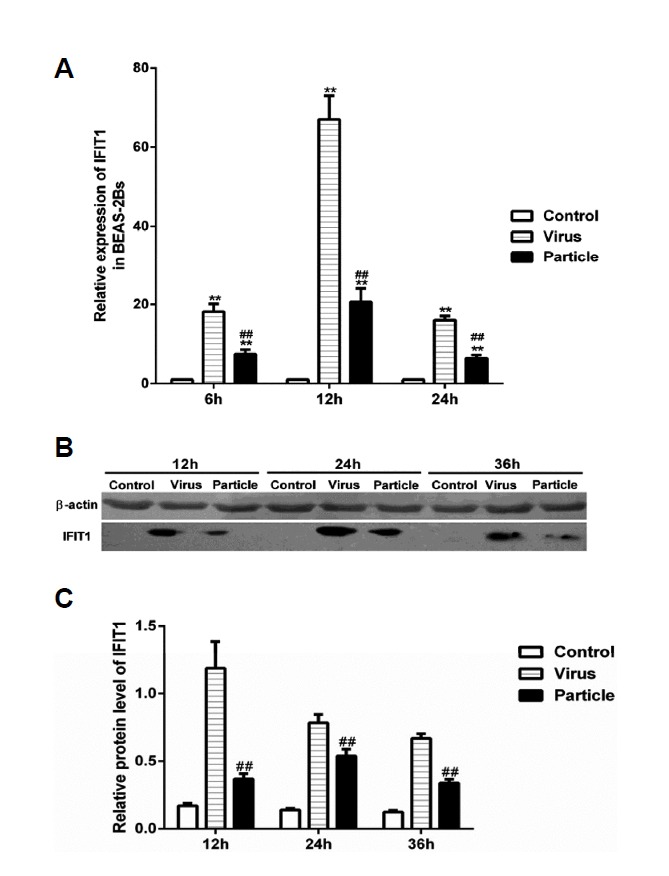
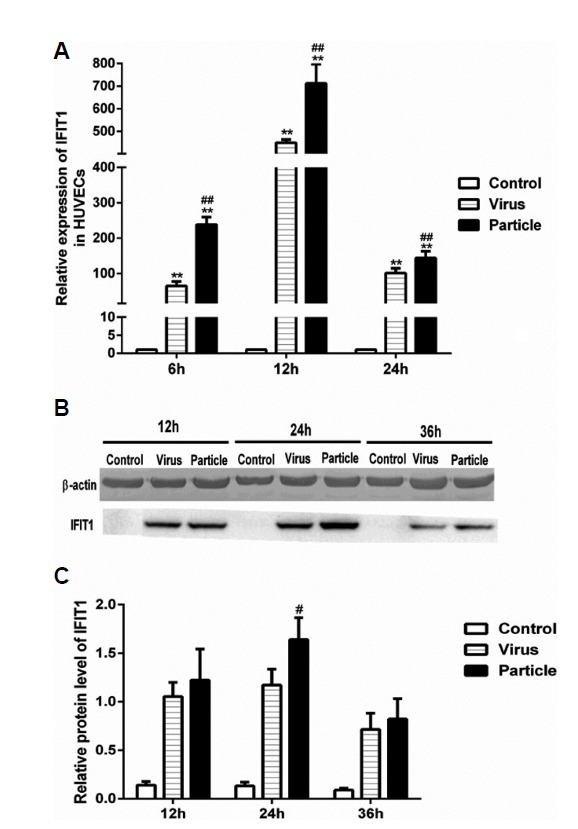
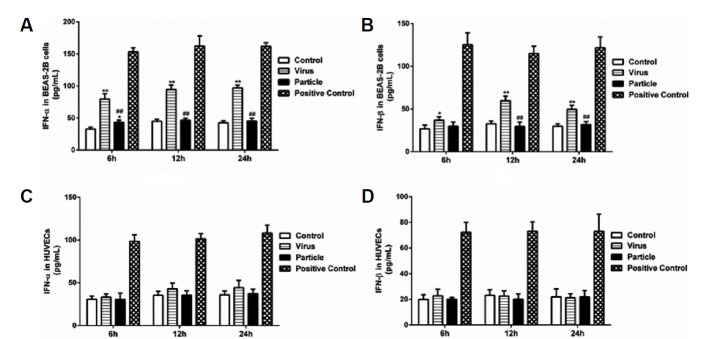
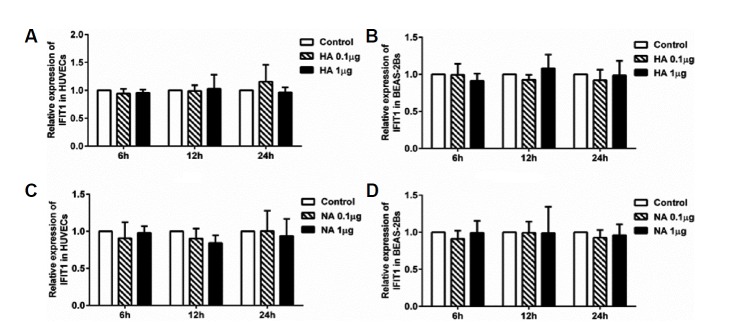
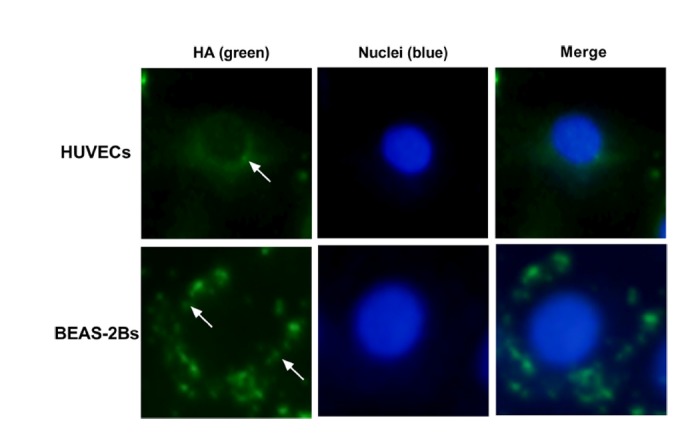
IFIT1 (also known as ISG56) is a member of the interferon-inducible protein with tetratricopeptide repeats (IFITs) family. IFITs are strongly induced by type I interferon (IFN), double-stranded RNA and virus infection. Here, we investigated IFIT1 expression in human umbilical vein endothelial cells (HUVECs) and in human bronchus epithelial cells (BEAS-2Bs) induced by the H9N2 virus and inactivated viral particle at different time points. We also investigated the effect of H9N2 virus and viral particle infection on IFN-α/β production, and assessed whether hemagglutinin or neuraminidase protein induced IFIT1 expression. Results showed that both H9N2 virus infection and viral particle inoculation induced the expression of IFIT1 at mRNA and protein levels in the two cell lines. Hemagglutinin or neuraminidase protein binding alone is not sufficient to induce IFIT1 expression. Surprisingly, the expression patterns of IFIT1 in response to H9N2 virus and viral particles in the two cell lines were opposite, and production kinetics of IFN-α/β also differed. An additional finding was that induction of IFIT1 in response to H9N2 virus infection or viral particle inoculation was more sensitive in HUVECs than in BEAS-2Bs. Our data offers new insight into the innate immune response of endothelial cells to H9N2 virus infection.
IFIT1(也称为 ISG56)是干扰素诱导的具有四肽重复的蛋白(IFITs)家族的成员。IFITs 强烈受到 I 型干扰素(IFN)、双链 RNA 和病毒感染的诱导。在这里,我们研究了 H9N2 病毒和失活病毒颗粒在不同时间点诱导的人脐静脉内皮细胞(HUVEC)和人支气管上皮细胞(BEAS-2B)中 IFIT1 的表达。我们还研究了 H9N2 病毒和病毒颗粒感染对 IFN-α/β产生的影响,并评估了血凝素或神经氨酸酶蛋白是否诱导 IFIT1 表达。结果表明,H9N2 病毒感染和病毒颗粒接种均在两种细胞系中诱导了 IFIT1 在 mRNA 和蛋白质水平上的表达。血凝素或神经氨酸酶蛋白单独结合不足以诱导 IFIT1 表达。令人惊讶的是,两种细胞系中 IFIT1 对 H9N2 病毒和病毒颗粒的表达模式相反,IFN-α/β 的产生动力学也不同。另一个发现是,HUVEC 中对 H9N2 病毒感染或病毒颗粒接种的 IFIT1 诱导比 BEAS-2B 更为敏感。我们的数据为内皮细胞对 H9N2 病毒感染的固有免疫反应提供了新的见解。