Horticultural Insects Research Laboratory, US Department of Agriculture-Agricultural Research Service, Wooster, OH 44691;
Department of Entomology, Ohio Agricultural Research and Development Center, The Ohio State University, Wooster, OH 44691.
Proc Natl Acad Sci U S A. 2018 Apr 24;115(17):4447-4452. doi: 10.1073/pnas.1716852115. Epub 2018 Apr 9.
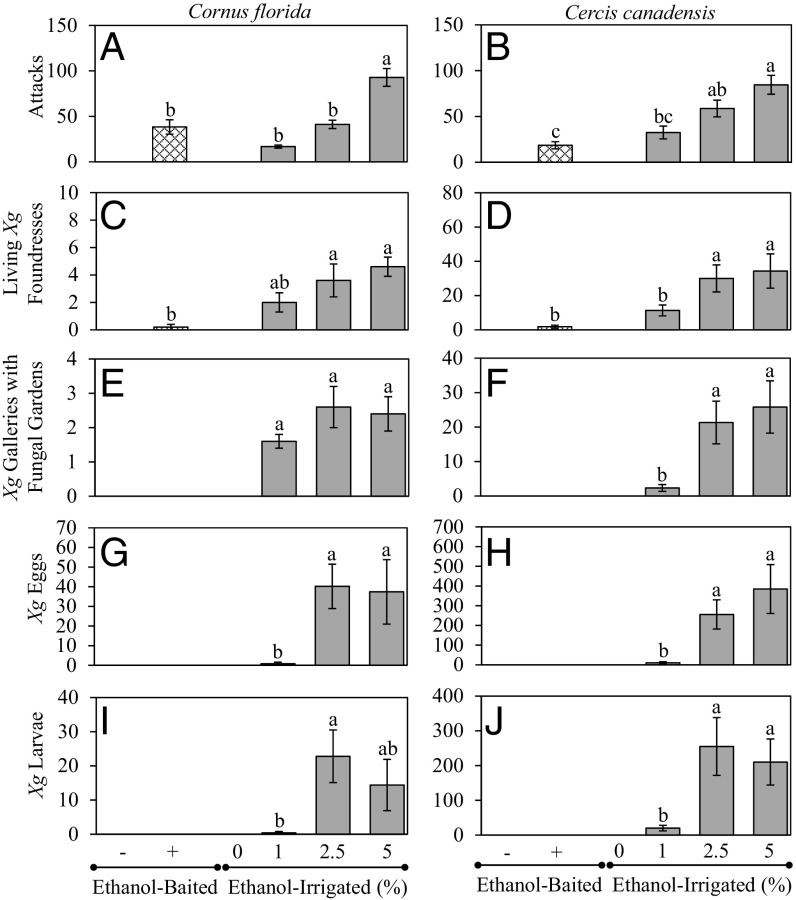
Animal-microbe mutualisms are typically maintained by vertical symbiont transmission or partner choice. A third mechanism, screening of high-quality symbionts, has been predicted in theory, but empirical examples are rare. Here we demonstrate that ambrosia beetles rely on ethanol within host trees for promoting gardens of their fungal symbiont and producing offspring. Ethanol has long been known as the main attractant for many of these fungus-farming beetles as they select host trees in which they excavate tunnels and cultivate fungal gardens. More than 300 attacks by and other species were triggered by baiting trees with ethanol lures, but none of the foundresses established fungal gardens or produced broods unless tree tissues contained in vivo ethanol resulting from irrigation with ethanol solutions. More brood were also produced in a rearing substrate containing ethanol. These benefits are a result of increased food supply via the positive effects of ethanol on food-fungus biomass. Selected and fungal isolates from ethanol-responsive ambrosia beetles profited directly and indirectly by () a higher biomass on medium containing ethanol, () strong alcohol dehydrogenase enzymatic activity, and () a competitive advantage over weedy fungal garden competitors (, ) that are inhibited by ethanol. As ambrosia fungi both detoxify and produce ethanol, they may maintain the selectivity of their alcohol-rich habitat for their own purpose and that of other ethanol-resistant/producing microbes. This resembles biological screening of beneficial symbionts and a potentially widespread, unstudied benefit of alcohol-producing symbionts (e.g., yeasts) in other microbial symbioses.
动物-微生物共生关系通常通过垂直共生体传播或伙伴选择来维持。理论上预测了第三种机制,即高质量共生体的筛选,但实证例子很少。在这里,我们证明了天牛类甲虫依赖于宿主树内的乙醇来促进其真菌共生体的花园,并产生后代。乙醇长期以来一直是许多这些真菌养殖甲虫的主要引诱剂,因为它们选择挖掘隧道和培育真菌花园的宿主树。通过用乙醇诱饵诱捕树木,超过 300 次攻击了 和其他物种,但除非树木组织中含有由于用乙醇溶液灌溉而产生的体内乙醇,否则没有发现者建立真菌花园或产生幼虫。在含有乙醇的饲养基质中也产生了更多的幼虫。这些好处是由于乙醇对食物-真菌生物量的积极影响而增加了食物供应的结果。从对乙醇有反应的天牛类甲虫中选择的 和 真菌分离物直接和间接地受益于 () 在含有乙醇的培养基上具有更高的生物量,() 强烈的醇脱氢酶酶活性,以及 () 对杂草真菌花园竞争者(、)的竞争优势,后者被乙醇抑制。由于天牛真菌既能解毒又能产生乙醇,它们可能会为了自己的目的和其他耐乙醇/产生乙醇的微生物的目的,维持其富含乙醇的栖息地的选择性。这类似于有益共生体的生物筛选,以及其他微生物共生体中(例如酵母)产生乙醇的共生体的潜在广泛而未被研究的好处。