Department of Epidemiology and Technology Assessment, University of Maastricht, Maastricht, The Netherlands.
Bayer AG, Leverkusen, Germany.
Blood Adv. 2018 Apr 10;2(7):788-796. doi: 10.1182/bloodadvances.2018017160.
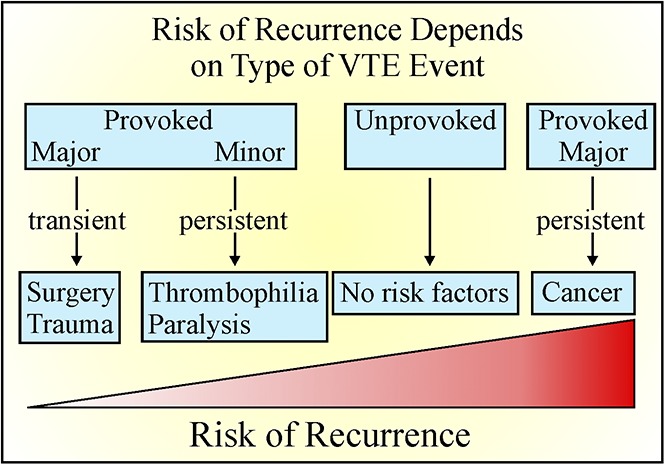
The optimal duration of anticoagulation for venous thromboembolism (VTE) is uncertain. In this prespecified analysis, we used data from 2 randomized trials, which compared once-daily rivaroxaban (20 mg or 10 mg) with aspirin (100 mg) or placebo for extended VTE treatment to estimate the risk of recurrence according to baseline risk factor profiles. Index VTE events were centrally classified as unprovoked, or provoked by major transient or persistent, or minor transient or persistent risk factors, and rates of recurrence at 1 year were calculated. A total of 2832 patients received rivaroxaban; 1131 received aspirin, and 590 received placebo. With unprovoked VTE, rates of recurrence in the 1173 patients given rivaroxaban, the 468 given aspirin, and the 243 given placebo were 2.0%, 5.9%, and 10.0%, respectively. There were no recurrences in patients with VTE provoked by major transient risk factors. With VTE provoked by minor persistent risk factors, recurrence rates in the 1184 patients given rivaroxaban, the 466 given aspirin, and the 248 given placebo were 2.4%, 4.5%, and 10.7%, respectively. For patients with minor transient risk factors, recurrence rates were 0.4% in the 268 patients given rivaroxaban, 4.2% in the 121 given aspirin, and 7.1% in the 56 given placebo. Recurrence rates in patients with VTE provoked by minor persistent or minor transient risk factors were not significantly lower than that with unprovoked VTE (hazard ratio [HR], 0.81; 95% confidence interval [CI], 0.56-1.16; and HR, 0.68; 95% CI, 0.32-1.30, respectively). Therefore, such patients may also benefit from extended anticoagulation therapy.
静脉血栓栓塞症(VTE)的抗凝最佳持续时间尚不确定。在这项预先设定的分析中,我们使用了两项比较每日一次利伐沙班(20mg 或 10mg)与阿司匹林(100mg)或安慰剂用于延长 VTE 治疗的随机试验数据,根据基线风险因素谱估计复发风险。中心分类的首发 VTE 事件为无诱因,或由重大一过性或持续性、或小的一过性或持续性危险因素引起,并计算了 1 年时的复发率。共 2832 例患者接受利伐沙班治疗;1131 例接受阿司匹林治疗,590 例接受安慰剂治疗。对于无诱因 VTE,接受利伐沙班的 1173 例、接受阿司匹林的 468 例和接受安慰剂的 243 例患者的复发率分别为 2.0%、5.9%和 10.0%。重大一过性危险因素引起的 VTE 患者无复发。对于由小的持续性危险因素引起的 VTE,接受利伐沙班的 1184 例、接受阿司匹林的 466 例和接受安慰剂的 248 例患者的复发率分别为 2.4%、4.5%和 10.7%。对于有小的一过性危险因素的患者,接受利伐沙班的 268 例患者、接受阿司匹林的 121 例患者和接受安慰剂的 56 例患者的复发率分别为 0.4%、4.2%和 7.1%。由小的持续性或小的一过性危险因素引起的 VTE 患者的复发率与无诱因 VTE 相比没有显著降低(风险比[HR],0.81;95%置信区间[CI],0.56-1.16;和 HR,0.68;95%CI,0.32-1.30)。因此,此类患者也可能从延长抗凝治疗中获益。