Neuroscience Institute, NYU Langone Health, 435 E 30h St, New York, NY, 10016, USA.
Biocircuits Institute, University of California San Diego, 9500 Gilman Dr, La Jolla, CA, USA.
Nat Commun. 2018 Apr 9;9(1):1347. doi: 10.1038/s41467-018-03837-1.
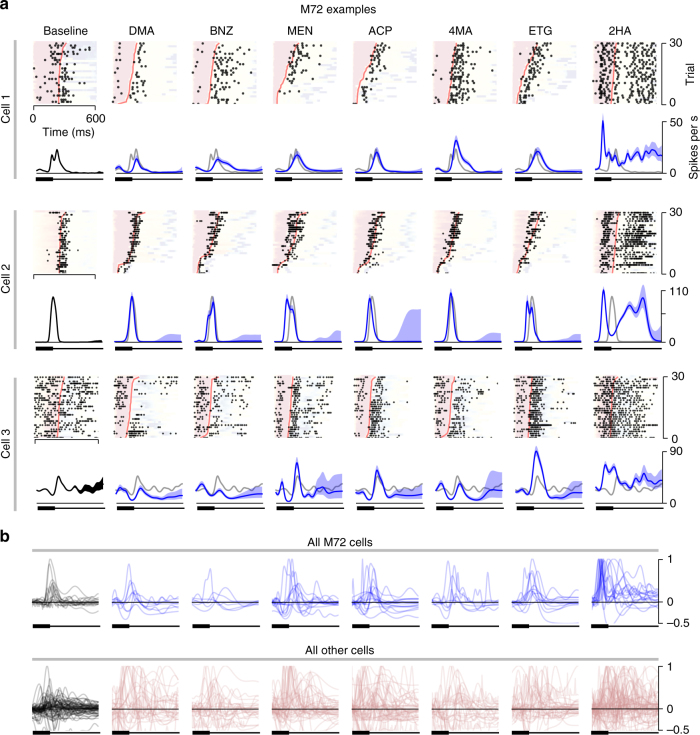
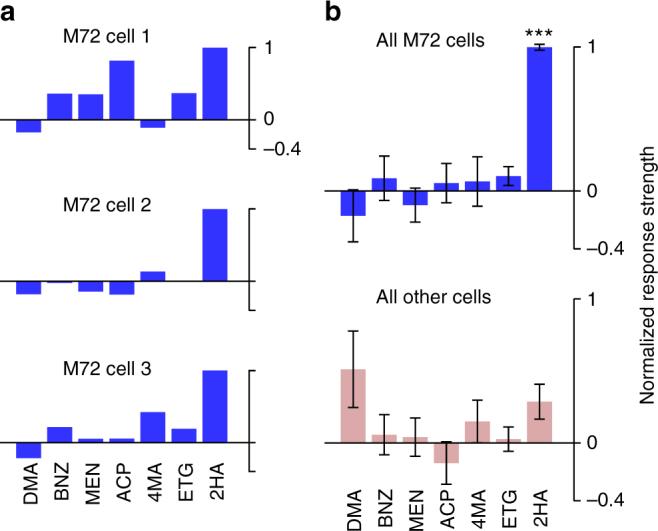
Olfactory inputs are organized in an array of functional units (glomeruli), each relaying information from sensory neurons expressing a given odorant receptor to a small population of output neurons, mitral/tufted (MT) cells. MT cells respond heterogeneously to odorants, and how the responses encode stimulus features is unknown. We recorded in awake mice responses from "sister" MT cells that receive input from a functionally characterized, genetically identified glomerulus, corresponding to a specific receptor (M72). Despite receiving similar inputs, sister MT cells exhibit temporally diverse, concentration-dependent, excitatory and inhibitory responses to most M72 ligands. In contrast, the strongest known ligand for M72 elicits temporally stereotyped, early excitatory responses in sister MT cells, consistent across a range of concentrations. Our data suggest that information about ligand affinity is encoded in the collective stereotypy or diversity of activity among sister MT cells within a glomerular functional unit in a concentration-tolerant manner.
嗅觉输入在功能单元(嗅球)的阵列中组织,每个功能单元将来自表达特定气味受体的感觉神经元的信息传递到一小群输出神经元,即僧帽细胞/丛状细胞(MT)。MT 细胞对气味剂表现出异质反应,而刺激特征的反应方式尚不清楚。我们在清醒的小鼠中记录了来自“姐妹”MT 细胞的反应,这些细胞接收来自功能上已确定、基因上已识别的嗅球的输入,对应于特定的受体(M72)。尽管接收相似的输入,但姐妹 MT 细胞对大多数 M72 配体表现出时间上多样化、浓度依赖性、兴奋和抑制反应。相比之下,M72 最强的已知配体在姐妹 MT 细胞中引发时间上刻板、早期的兴奋反应,在一系列浓度下一致。我们的数据表明,关于配体亲和力的信息以一种浓度耐受的方式在一个嗅球功能单元内的姐妹 MT 细胞之间的集体刻板或活动多样性中编码。