Krauch Marlene, Ueltzhöffer Kai, Brunner Romuald, Kaess Michael, Hensel Saskia, Herpertz Sabine C, Bertsch Katja
Department of General Psychiatry, Center for Psychosocial Medicine, University of Heidelberg, Heidelberg, Germany.
Department of Psychology, Goethe University Frankfurt, Frankfurt am Main, Germany.
Front Behav Neurosci. 2018 Mar 26;12:57. doi: 10.3389/fnbeh.2018.00057. eCollection 2018.
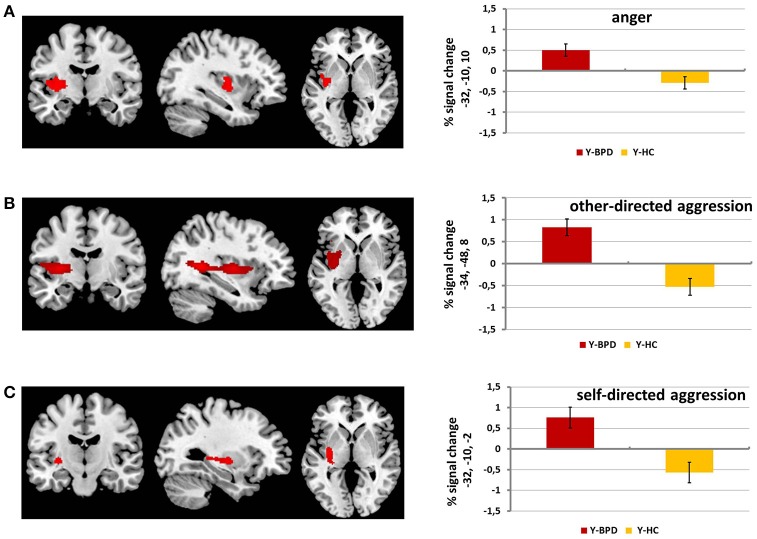
Anger and aggression belong to the core symptoms of borderline personality disorder. Although an early and specific treatment of BPD is highly relevant to prevent chronification, still little is known about anger and aggression and their neural underpinnings in adolescents with BPD. Twenty female adolescents with BPD (age 15-17 years) and 20 female healthy adolescents (age 15-17 years) took part in this functional magnetic resonance imaging (fMRI) study. A script-driven imagery paradigm was used to induce rejection-based feelings of anger, which was followed by descriptions of self-directed and other-directed aggressive reactions. To investigate the specificity of the neural activation patterns for adolescent patients, results were compared with data from 34 female adults with BPD (age 18-50 years) and 32 female healthy adults (age 18-50 years). Adolescents with BPD showed increased activations in the left posterior insula and left dorsal striatum as well as in the left inferior frontal cortex and parts of the mentalizing network during the rejection-based anger induction and the imagination of aggressive reactions compared to healthy adolescents. For the other-directed aggression phase, a significant diagnosis by age interaction confirmed that these results were specific for adolescents. The results of this very first fMRI study on anger and aggression in adolescents with BPD suggest an enhanced emotional reactivity to and higher effort in controlling anger and aggression evoked by social rejection at an early developmental stage of the disorder. Since emotion dysregulation is a known mediator for aggression in BPD, the results point to the need of appropriate early interventions for adolescents with BPD.
愤怒和攻击行为属于边缘型人格障碍的核心症状。尽管对边缘型人格障碍进行早期且针对性的治疗对于预防病情慢性化至关重要,但对于边缘型人格障碍青少年的愤怒和攻击行为及其神经基础,我们仍知之甚少。20名患有边缘型人格障碍的女性青少年(年龄在15 - 17岁)和20名健康的女性青少年(年龄在15 - 17岁)参与了这项功能磁共振成像(fMRI)研究。采用脚本驱动的意象范式来诱发基于被拒的愤怒情绪,随后描述自我导向和他人导向的攻击反应。为了研究青少年患者神经激活模式的特异性,将结果与34名患有边缘型人格障碍的成年女性(年龄在18 - 50岁)和32名健康成年女性(年龄在18 - 50岁)的数据进行了比较。与健康青少年相比,患有边缘型人格障碍的青少年在基于被拒的愤怒诱发以及攻击反应想象过程中,左侧后岛叶、左侧背侧纹状体以及左侧额下回和部分心理化网络的激活增强。对于他人导向的攻击阶段,显著的诊断与年龄交互作用证实这些结果是青少年所特有的。这项关于边缘型人格障碍青少年愤怒和攻击行为的首次fMRI研究结果表明,在该障碍的早期发展阶段,对社会拒绝引发的愤怒和攻击行为,情绪反应增强且控制这些情绪需要付出更多努力。由于情绪调节障碍是边缘型人格障碍中攻击行为的已知中介因素,这些结果表明需要对患有边缘型人格障碍的青少年进行适当的早期干预。