Liu Xin, Guan Huirui, Song Min, Fu Yanping, Han Xiaomin, Lei Meng, Ren Jingyu, Guo Bin, He Wei, Wei Yahui
College of Life Science, Northwest University, Xi'an, Shaanxi, China.
Key Laboratory of Resource Biology and Biotechnology in Western China, Northwest University, Xi'an, Shaanxi, China.
PeerJ. 2018 Apr 3;6:e4535. doi: 10.7717/peerj.4535. eCollection 2018.
Linn, an important poisonous plant of the China grassland, is toxic to humans and livestock. The rapid expansion of has greatly damaged the grassland ecology and, consequently, seriously endangered the development of animal husbandry. To draft efficient prevention and control measures, it has become more urgent to carry out research on its adaptive and expansion mechanisms in different unfavorable habitats at the genetic level. Quantitative real-time polymerase chain reaction (qRT-PCR) is a widely used technique for studying gene expression at the transcript level; however, qRT-PCR requires reference genes (RGs) as endogenous controls for data normalization and only through appropriate RG selection and qRT-PCR can we guarantee the reliability and robustness of expression studies and RNA-seq data analysis. Unfortunately, little research on the selection of RGs for gene expression data normalization in has been reported.
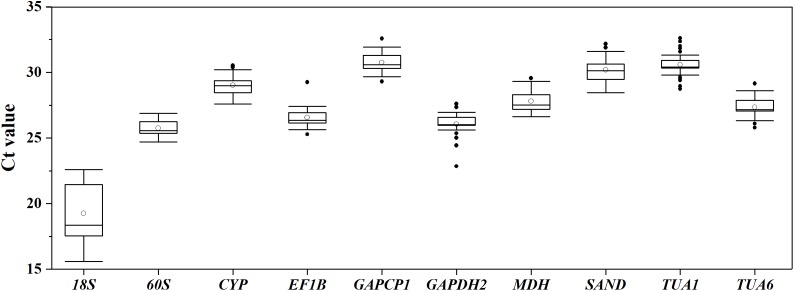
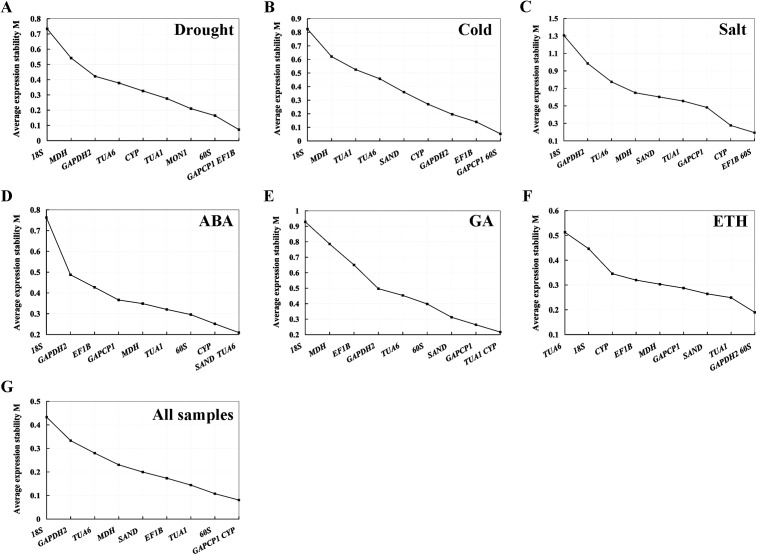
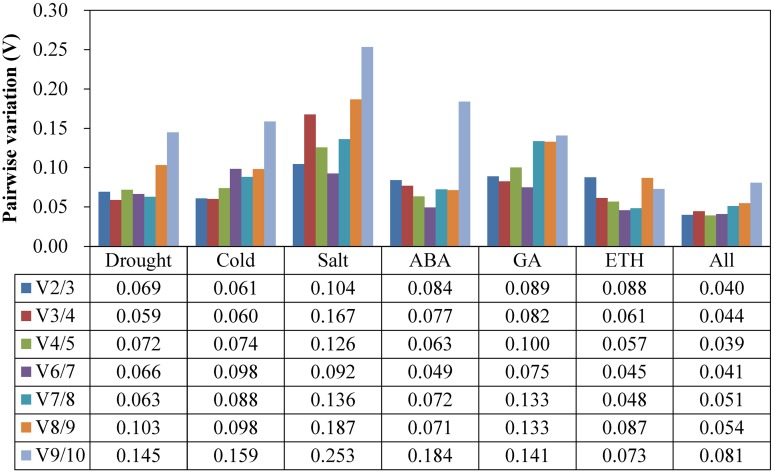
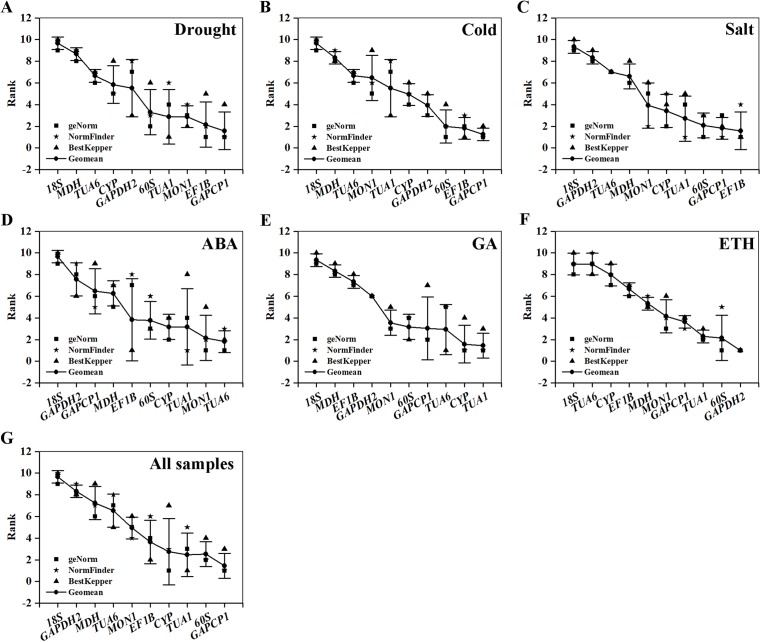
In this study, 10 candidate RGs namely, , , , , , , , , , and , were singled out from the transcriptome database of , and their expression stability under three abiotic stresses (drought, cold, and salt) and three hormone treatments (abscisic acid, ABA; gibberellin, GA; ethephon, ETH) were estimated with the programs geNorm, NormFinder, and BestKeeper.
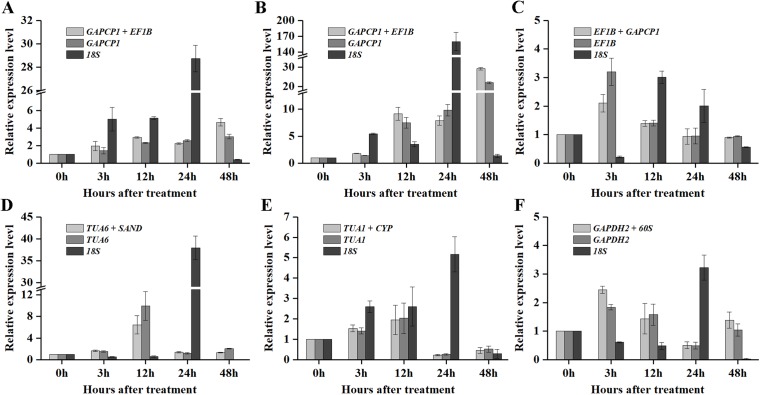
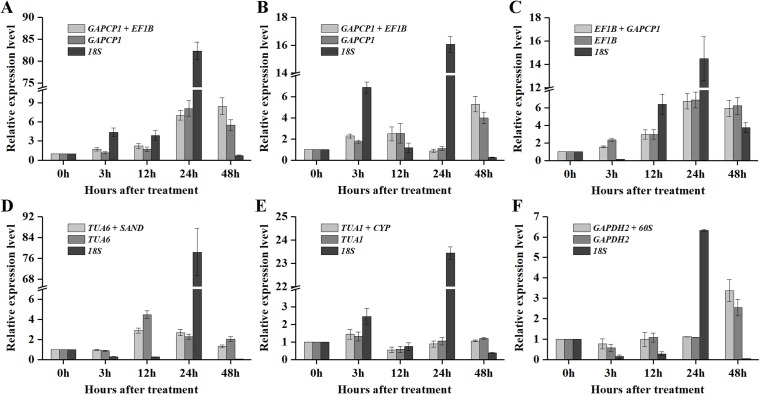
Our results showed that and were the best combination for the three abiotic stresses, whereas and , and , and were the best choices for ABA, GA, and ETH treatment, respectively. Moreover, and were assessed to be the best combination for all samples, and was the least stable RG for use as an internal control in all of the experimental subsets. The expression patterns of two target genes ( and ) further verified that the RGs that we selected were suitable for gene expression normalization.
This work is the first attempt to comprehensively estimate the stability of RGs in . Our results provide suitable RGs for high-precision normalization in qRT-PCR analysis, thereby making it more convenient to analyze gene expression under these experimental conditions.
狼毒是中国草原一种重要的有毒植物,对人畜有毒。其迅速扩张极大地破坏了草原生态,进而严重危及畜牧业发展。为制定有效的防治措施,在基因水平上开展其在不同不利生境下的适应与扩张机制研究变得更为迫切。定量实时聚合酶链反应(qRT-PCR)是一种广泛用于在转录水平研究基因表达的技术;然而,qRT-PCR需要参照基因(RGs)作为内参进行数据标准化,只有通过合适的RG选择,qRT-PCR才能保证表达研究和RNA测序数据分析的可靠性和稳健性。遗憾的是,关于狼毒基因表达数据标准化的RG选择研究报道较少。
本研究从狼毒转录组数据库中挑选出10个候选RG,即……(此处原文未给出具体基因名称),并使用geNorm、NormFinder和BestKeeper程序评估它们在三种非生物胁迫(干旱、寒冷和盐胁迫)和三种激素处理(脱落酸,ABA;赤霉素,GA;乙烯利,ETH)下的表达稳定性。
我们的结果表明,……(此处原文未给出具体基因名称)是三种非生物胁迫下的最佳组合,而……(此处原文未给出具体基因名称)分别是ABA、GA和ETH处理下的最佳选择。此外,……(此处原文未给出具体基因名称)被评估为所有样本的最佳组合,而……(此处原文未给出具体基因名称)是所有实验子集中用作内参最不稳定的RG。两个靶基因(……此处原文未给出具体基因名称)的表达模式进一步验证了我们选择的RG适用于基因表达标准化。
本研究首次全面评估了狼毒中RG的稳定性。我们的结果为qRT-PCR分析中的高精度标准化提供了合适的RG,从而便于在这些实验条件下分析基因表达。