Luck Joshua, Smith Oliver J, Mosahebi Afshin
Department of Plastic & Reconstructive Surgery, Royal Free Hospital, London, United Kingdom.
Plast Reconstr Surg Glob Open. 2017 Dec 6;5(12):e1596. doi: 10.1097/GOX.0000000000001596. eCollection 2017 Dec.
The addition of platelet-rich plasma (PRP) to adipose tissue may improve fat graft survival, although graft retention rates vary markedly between studies. To what extent this outcome heterogeneity reflects differing methodological factors remains unknown. This systematic review aims to synthesize and critically review methodological approaches to autologous PRP and fat cotransplantation in both human and animal studies.
In accordance with PRISMA guidelines, Ovid MEDLINE, Scopus, and Cochrane Library databases were searched from inception to April 2017. Data were extracted from all in vivo studies involving autologous PRP and fat cotransplantation. A secondary aim was to assess reporting of technical detail; authors were not contacted to provide missing data.
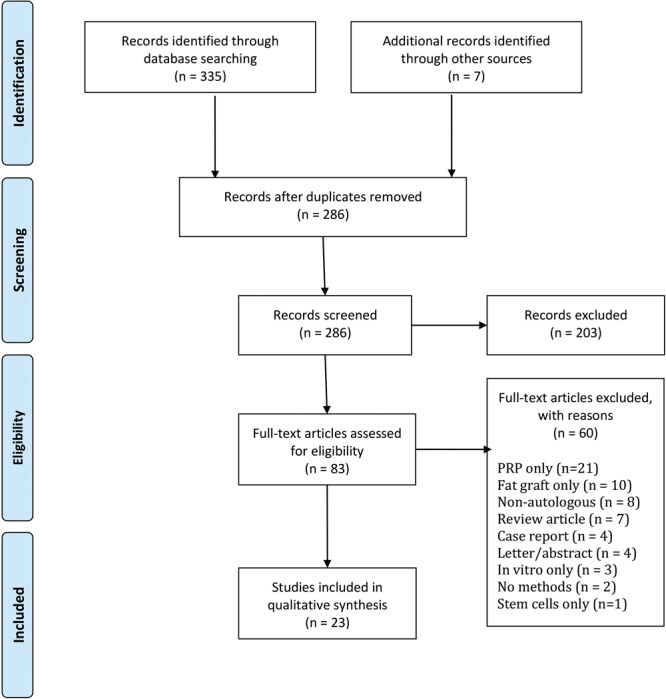
From 335 articles, 23 studies were included in the qualitative synthesis. Some 21 were performed in humans and 2 in rabbits. Six studies were randomized control trials; the remainder reported on observational data. Methods of PRP extraction and activation varied markedly between studies. Fat graft preparation was comparatively more consistent. Methods of PRP and fat mixing differed significantly, especially with regards to relative volume/volume ratios.
Our study represents the first systematic review of methodological factors in autologous PRP and fat cotransplantation. It demonstrates that technical factors in graft preparation and administration vary significantly between in vivo studies. Such methodological heterogeneity may explain observed differences in experimental and clinical outcomes. Reporting of key procedural information is inconsistent and often inadequate. These issues make meaningful evaluation of the PRP-enhanced fat grafting literature difficult and may limit its translation into clinical practice.
向脂肪组织中添加富血小板血浆(PRP)可能会提高脂肪移植的存活率,尽管不同研究之间的移植保留率差异显著。这种结果异质性在多大程度上反映了不同的方法学因素仍不清楚。本系统评价旨在综合并批判性地回顾人类和动物研究中自体PRP与脂肪联合移植的方法学。
根据PRISMA指南,检索了从数据库建立至2017年4月的Ovid MEDLINE、Scopus和Cochrane图书馆数据库。从所有涉及自体PRP与脂肪联合移植的体内研究中提取数据。第二个目的是评估技术细节的报告情况;未联系作者提供缺失数据。
从335篇文章中,23项研究纳入了定性综合分析。其中约21项在人体中进行,2项在兔子中进行。6项研究为随机对照试验;其余研究报告的是观察性数据。不同研究之间PRP提取和激活的方法差异显著。脂肪移植制备相对更一致。PRP与脂肪混合的方法差异很大,尤其是在相对体积/体积比方面。
我们的研究是对自体PRP与脂肪联合移植方法学因素的首次系统评价。结果表明,体内研究之间移植制备和给药的技术因素差异显著。这种方法学异质性可能解释了观察到的实验和临床结果差异。关键程序信息的报告不一致且往往不充分。这些问题使得对PRP增强脂肪移植文献进行有意义的评估变得困难,并可能限制其转化为临床实践。