1 Earth-Life Science Institute, Tokyo Institute of Technology , Tokyo, Japan .
2 The Institute for Advanced Study , Princeton, New Jersey, USA.
Astrobiology. 2018 Jul;18(7):897-914. doi: 10.1089/ast.2017.1700. Epub 2018 Mar 20.
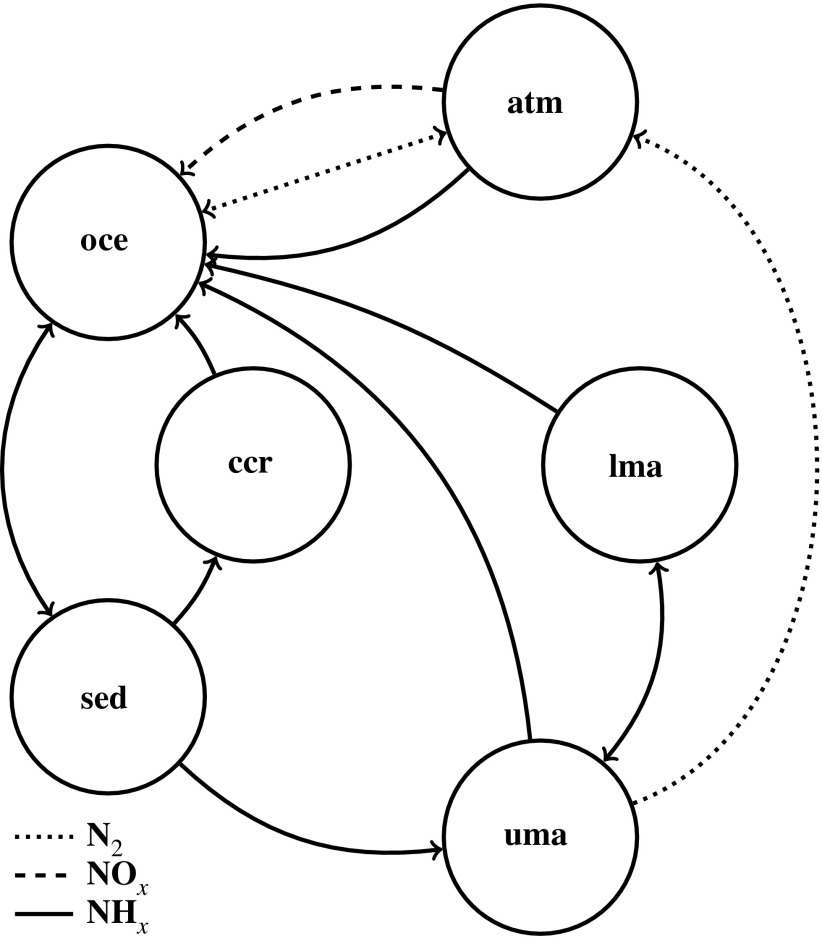
Nitrogen is the major component of Earth's atmosphere and plays important roles in biochemistry. Biological systems have evolved a variety of mechanisms for fixing and recycling environmental nitrogen sources, which links them tightly with terrestrial nitrogen reservoirs. However, prior to the emergence of biology, all nitrogen cycling was abiological, and this cycling may have set the stage for the origin of life. It is of interest to understand how nitrogen cycling would proceed on terrestrial planets with comparable geodynamic activity to Earth, but on which life does not arise. We constructed a kinetic mass-flux model of nitrogen cycling in its various major chemical forms (e.g., N, reduced (NH) and oxidized (NO) species) between major planetary reservoirs (the atmosphere, oceans, crust, and mantle) and included inputs from space. The total amount of nitrogen species that can be accommodated in each reservoir, and the ways in which fluxes and reservoir sizes may have changed over time in the absence of biology, are explored. Given a partition of volcanism between arc and hotspot types similar to the modern ones, our global nitrogen cycling model predicts a significant increase in oceanic nitrogen content over time, mostly as NH, while atmospheric N content could be lower than today. The transport timescales between reservoirs are fast compared to the evolution of the environment; thus atmospheric composition is tightly linked to surface and interior processes. Key Words: Nitrogen cycle-Abiotic-Planetology-Astrobiology. Astrobiology 18, 897-914.
氮是地球大气的主要成分,在生物化学中起着重要作用。生物系统已经进化出多种固定和回收环境氮源的机制,这使它们与陆地氮库紧密相连。然而,在生物学出现之前,所有的氮循环都是非生物的,这种循环可能为生命的起源奠定了基础。了解在与地球具有类似地球动力学活动的类地行星上,氮循环将如何进行,而这些行星上没有生命,这是很有趣的。我们构建了一个氮循环的动力学质量通量模型,其中包括各种主要化学形式(如 N、还原(NH)和氧化(NO)物种)在主要行星储层(大气、海洋、地壳和地幔)之间的循环,并包括来自太空的输入。我们探索了每个储层中可以容纳的氮物种的总量,以及在没有生物学的情况下,通量和储层大小随时间的变化方式。在假设火山作用在弧和热点类型之间的分配与现代相似的情况下,我们的全球氮循环模型预测,随着时间的推移,海洋中的氮含量会显著增加,主要以 NH 的形式存在,而大气中的 N 含量可能低于今天。储层之间的运输时间尺度与环境的演化相比是很快的;因此,大气成分与地表和内部过程紧密相连。关键词:氮循环-非生物-行星科学-天体生物学。天体生物学 18,897-914。