Department of Pathobiology, University of Guelph, Guelph, ON, Canada.
Ontario Ministry of Agriculture, Food and Rural Affairs (OMAFRA), Elora, ON, Canada.
Microbiologyopen. 2019 Jan;8(1):e00622. doi: 10.1002/mbo3.622. Epub 2018 Apr 10.
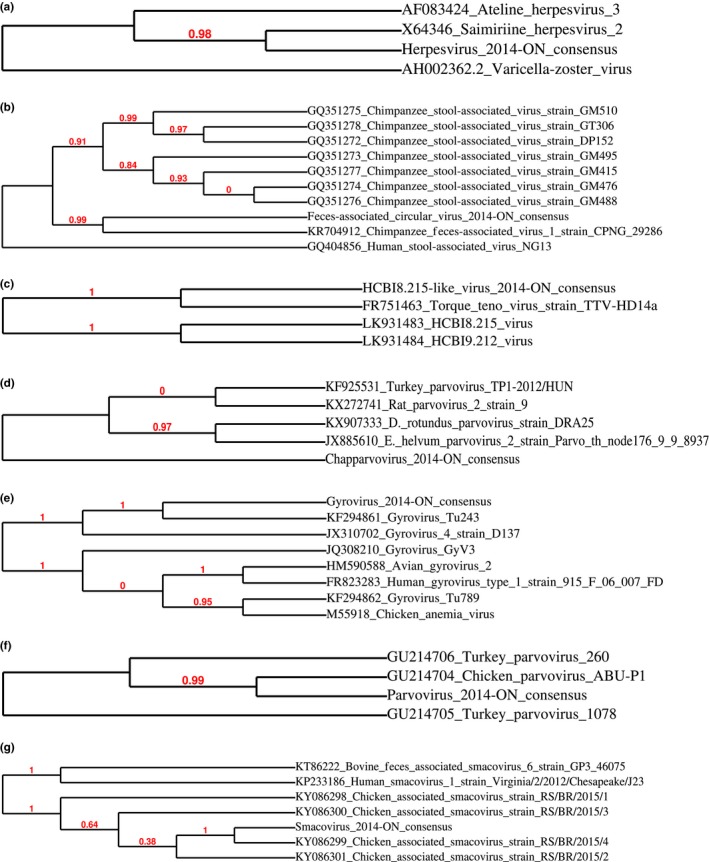
Recent viral metagenomic studies have demonstrated the diversity of eukaryotic viruses and bacteriophage shed in the feces of domestic species. Although enteric disease is a major concern in the commercial mink farming industry, few etiologic agents have been well characterized. This study aimed to identify viruses shed in the fecal matter of clinically healthy commercial mink from 40 southern Ontario farms. Viral RNA was extracted from 67 pooled fecal samples (30 adult female mink and 37 kit) and amplified for Illumina sequencing on the NextSeq platform, and the resulting contigs were trimmed and assembled using Trimmomatic 0.36.0 and Spades 3.8.0 in iVirus (CyVerse, AZ, USA) and SeqMan NGen 12 (DNAStar, WI, USA). Identification of assembled sequences >100 bp (Geneious 10.1.3) showed an abundance of bacteriophage sequences, mainly from families Siphoviridae (53%), Podoviridae (22%), Myoviridae (20%), Inoviridae (1%), Leviviridae (0.04%), Tectiviridae (0.01%), and Microviridae (0.01%). A diverse range of vertebrate viruses were detected, of which posavirus 3, mink bocavirus, gyroviruses, and avian-associated viruses were most abundant. Additionally, sequences from nonvertebrate viruses with water and soil-associated amebal and algal hosts were also highly prevalent. The results of this study show that viruses shed in the fecal matter of healthy commercial mink are highly diverse and could be closely associated with diet, and that more research is necessary to determine how the detected viruses may impact mink health.
最近的病毒宏基因组研究表明,在家庭饲养物种的粪便中存在多样性的真核病毒和噬菌体。尽管肠道疾病是商业水貂养殖行业的主要关注点,但很少有病因被很好地描述。本研究旨在鉴定来自安大略省南部 40 个商业水貂养殖场的临床健康水貂粪便中排出的病毒。从 67 个粪便样本(30 只成年雌性水貂和 37 只幼崽)中提取病毒 RNA,在 NextSeq 平台上进行 Illumina 测序扩增,使用 Trimmomatic 0.36.0 和 Spades 3.8.0 在 iVirus(CyVerse,亚利桑那州,美国)和 SeqMan NGen 12(DNAStar,威斯康星州,美国)对产生的连续序列进行修剪和组装。鉴定 >100 bp 的组装序列(Geneious 10.1.3)显示出大量噬菌体序列,主要来自 Siphoviridae 科(53%)、Podoviridae 科(22%)、Myoviridae 科(20%)、Inoviridae 科(1%)、Leviviridae 科(0.04%)、Tectiviridae 科(0.01%)和 Microviridae 科(0.01%)。还检测到多种脊椎动物病毒,其中阳性肠道病毒 3、水貂博卡病毒、回转病毒和与禽类相关的病毒最为丰富。此外,还高度存在源自与水和土壤相关的变形虫和藻类宿主的非脊椎动物病毒序列。本研究结果表明,健康商业水貂粪便中排出的病毒高度多样化,可能与饮食密切相关,需要进一步研究以确定检测到的病毒如何影响水貂健康。