Friedman School of Nutrition Science and Policy, Tufts University, Boston, MA, 02111, USA.
Yale School of Public Health, Yale University, 135 College Street, New Haven, CT, 06510, USA.
BMC Public Health. 2018 Apr 10;18(1):470. doi: 10.1186/s12889-018-5312-1.
Formal education can be a nutrition-sensitive intervention that supports the scale-up and impact of nutrition-specific actions. Maternal education has long been linked to child survival, growth, and development while adult earnings and nutrition are tied to years in school as a child. However, less is known about the relationship between maternal education and the micronutrient status of children, women and the general population.
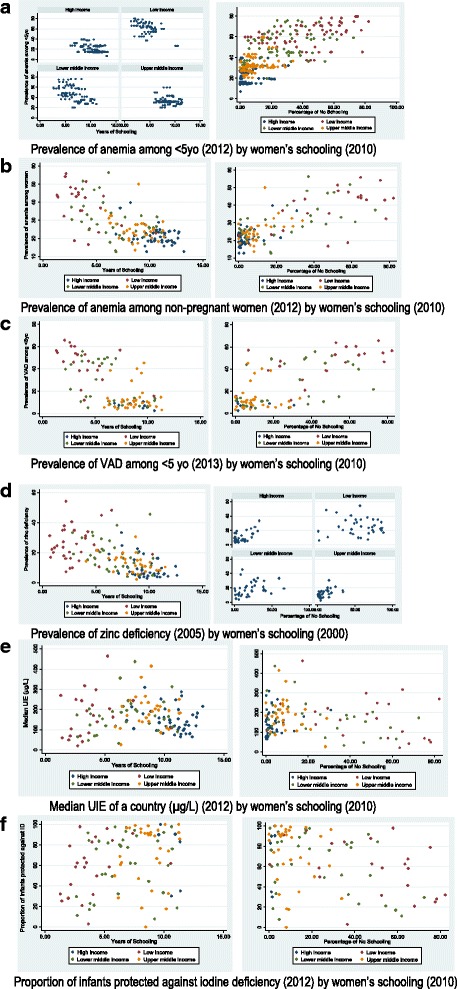
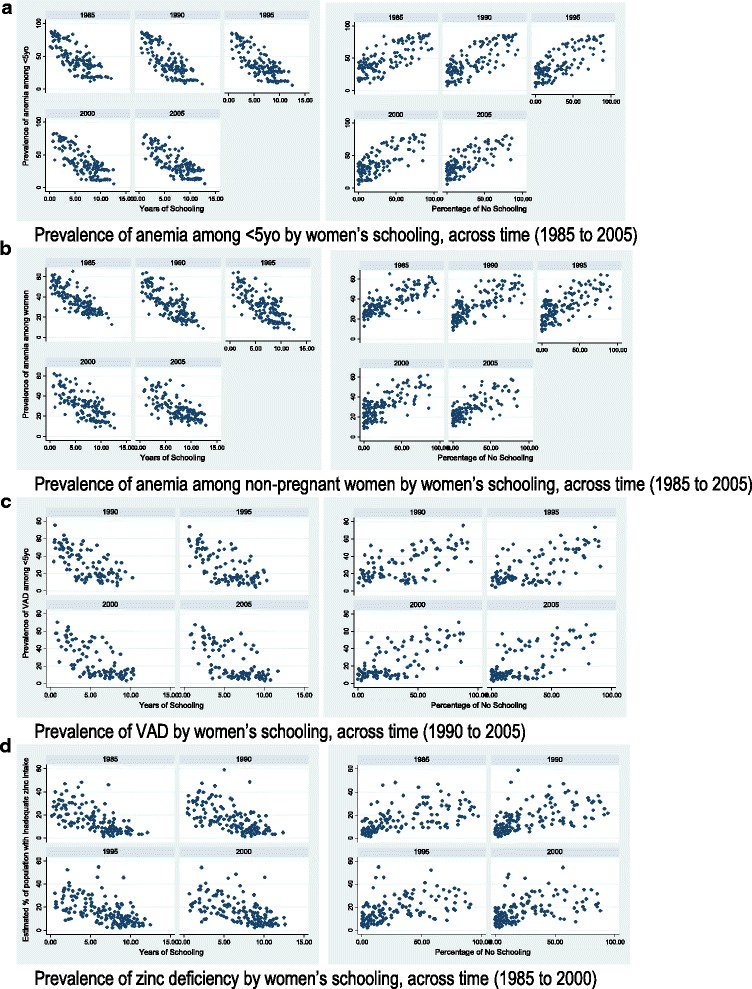
Using country-level data and an ecological study design, we explored the global associations between women's educational attainment and: a) anemia and vitamin A deficiency (VAD) in children aged 6-59 months; b) anemia in non-pregnant women; and c) zinc deficiency, urinary iodine excretion (UIE), and the proportion of infants protected against iodine deficiency in the general population Cross-sectional relationships (2005-2013) were assessed using linear regression models.
Percentage of women without schooling was negatively associated with all outcomes. Number of years of schooling among women was positively associated with all outcomes except for UIE and the proportion of infants protected against iodine deficiency. Income level was a significant effect modifier of the effect of years of women's schooling on child anemia as well as of the proportion of women without formal education on zinc deficiency in the population. The relationship was strongest in low-income countries for child anemia, and was not significant in upper middle-income countries. For zinc deficiency, the relationship was not significant in low or lower middle income countries, which may suggest that a minimum threshold of resources needs to be reached before education can influence zinc status.
While relationships between maternal schooling and micronutrient outcomes vary around the globe, more schooling is generally linked to lower rates of deficiency. These findings draw policy-relevant connections between formal education and anemia and micronutrient status globally. It is necessary to examine the mechanisms through which this relationship may be working at both household and country level.
正规教育可能是一种营养敏感型干预措施,有助于扩大营养具体行动的规模并产生影响。长期以来,母亲的教育程度一直与儿童的生存、成长和发展有关,而成年人的收入和营养水平则与儿童时期在校的年限有关。然而,人们对母亲教育程度与儿童、妇女和一般人口的微量营养素状况之间的关系知之甚少。
本研究使用国家层面的数据和生态研究设计,探讨了妇女教育程度与以下方面的全球关联:a)6-59 月龄儿童的贫血和维生素 A 缺乏症(VAD);b)非孕妇的贫血;以及 c)一般人群中的锌缺乏、尿碘排泄(UIE)和婴幼儿碘缺乏症保护率。使用线性回归模型评估了 2005-2013 年的横断面关系。
未接受学校教育的妇女人数百分比与所有结局均呈负相关。妇女人数的受教育年限与所有结局均呈正相关,除了 UIE 和婴幼儿碘缺乏症保护率。收入水平是妇女受教育年限对儿童贫血以及未接受正规教育的妇女人数对人群中锌缺乏影响的显著调节因素。在低收入国家,这种关系在儿童贫血方面最为强烈,而在中上收入国家则不显著。对于锌缺乏症,在低收入或中低收入国家,这种关系不显著,这可能表明,在教育能够影响锌的状态之前,需要达到一个最低的资源门槛。
虽然母亲受教育程度与微量营养素结局之间的关系在全球范围内有所不同,但受教育程度越高,缺乏的程度通常越低。这些发现为全球范围内正规教育与贫血和微量营养素状况之间的政策相关性提供了依据。有必要在家庭和国家层面上检查这种关系可能起作用的机制。