Laboratory of Laboratory Animal Science and Medicine, School of Veterinary Medicine, Kitasato University, 35-1, Higashi-23, Towada, Aomori, 034-8628, Japan.
BMC Genet. 2018 Apr 10;19(1):24. doi: 10.1186/s12863-018-0611-1.
Tensin2 is a focal adhesion-localized multidomain protein expressed in various tissues, and its dysfunction leads to alterations in podocytes. However, these podocyte-related manifestations are dependent on murine strain. Tensin2 dysfunction results in susceptible strains developing podocyte foot process effacement and massive albuminuria, whereas podocytes in resistant strains remain almost intact. In our previous studies, quantitative trait loci analysis and congenic analysis using resistant C57BL/6J and susceptible ICGN mice identified a modifier locus associated with podocyte injury caused by tensin2 dysfunction on chromosome 2. However, the effect of this modifier locus on chromosome 2 is insufficient to explain the resistance of C57BL/6J mice to tensin2 dysfunction, indicating the existence of other modifier genes.
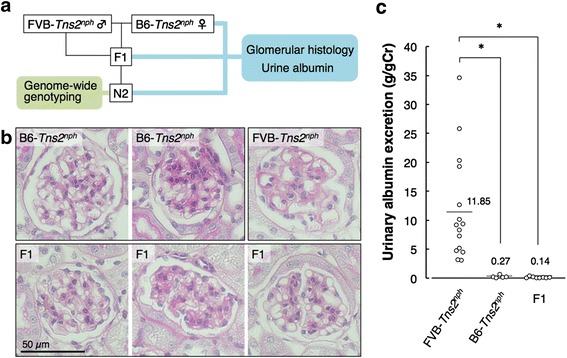
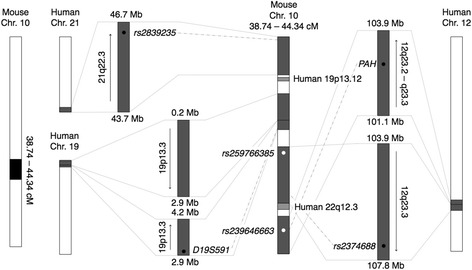
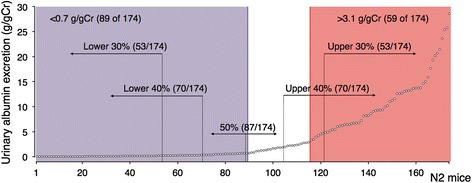
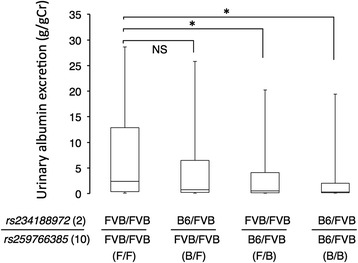
Whereas previous studies focused on the severity of chronic kidney disease, the present study focused on podocyte injury. We performed a genome-wide linkage analysis of backcrosses between two tensin2-deficient mouse strains, B6.ICGN-Tns2 and FVB.ICGN-Tns2 , and detected a novel major modifier locus on chromosome 10. The combined effect of the C57BL/6J alleles of the two loci on chromosomes 2 and 10 reduced the urinary albumin excretion caused by tensin2 dysfunction to a level comparable to that of C57BL/6J mice.
These data indicate that the resistance to podocyte injury caused by tensin2 dysfunction is mainly produced by the effects of the modifier genes on the two loci. The identification of these modifier genes is expected to help elucidate the mechanism underlying podocyte injury.
Tensin2 是一种在各种组织中表达的黏着斑定位的多功能蛋白,其功能障碍导致足细胞发生改变。然而,这些与足细胞相关的表现依赖于鼠种。Tensin2 功能障碍导致易感鼠种的足细胞足突消失和大量白蛋白尿,而抗性鼠种的足细胞几乎保持完整。在我们之前的研究中,使用抗性 C57BL/6J 和易感 ICGN 小鼠进行数量性状位点分析和同源导入分析,确定了与 Tensin2 功能障碍引起的足细胞损伤相关的修饰基因座位于 2 号染色体上。然而,2 号染色体上该修饰基因座的效应不足以解释 C57BL/6J 对 Tensin2 功能障碍的抗性,表明存在其他修饰基因。
与之前的研究集中于慢性肾脏病的严重程度不同,本研究侧重于足细胞损伤。我们对两种 Tensin2 缺陷型小鼠品系 B6.ICGN-Tns2 和 FVB.ICGN-Tns2 的回交进行了全基因组连锁分析,并在 10 号染色体上检测到一个新的主要修饰基因座。这两个基因座上的 C57BL/6J 等位基因的共同作用将 Tensin2 功能障碍引起的尿白蛋白排泄减少到与 C57BL/6J 小鼠相当的水平。
这些数据表明,Tensin2 功能障碍引起的足细胞损伤的抗性主要是由两个基因座上的修饰基因的作用产生的。这些修饰基因的鉴定有望有助于阐明足细胞损伤的机制。